

 English











Did Liverpool Fans Create a Blueprint for Affordable Premier League Tickets?
Written by Alex Bird
- Liverpool's $12 ticket for local residents has survived for a decade and is now almost 30% cheaper in real terms than when it launched in 2016.
- Manchester City's new $13 Local Resident Ticket arrives alongside a 7,000-seat expansion, echoing the combination of new capacity and supporter pressure seen at Liverpool ten years ago.
- Leeds, Aston Villa and Nottingham Forest look particularly well suited to similar hypothetical schemes as they expand their grounds.
In summer 2026, something has happened at a Big Six club that might escape the attention of most football fans.
Manchester City have announced that they are trialling something called a Local Resident Ticket, exclusive for fans in five wards on the east side of Manchester, costing just $13 for adults.[1]
Beyond a free Cityzens account, no paid membership is required, and eligible fans can enter a ballot for an allocation of between 100 and 500 tickets for every home game at the Etihad.[1]
This scheme may sound pretty familiar to Liverpool supporters. Since the start of the 2016/17 season, the Reds have run their own enduring Local General Sale (now Local General Ballot) selling a limited number of $12 Anfield tickets only to supporters with an L postcode.[2]
The similarities are uncanny. Both of these initiatives have been introduced amid major stadium expansions—the Main Stand at Anfield in 2016 and the North Stand (now Pep Guardiola Stand) at the Etihad in 2026.[6][11]
This follows the 1878 affordability initiative, introduced in 2025 at Everton’s new Hill Dickinson Stadium, bearing a few similarities to Liverpool’s scheme.[19]
Is this a coincidence, or did Liverpool create a model that other Premier League clubs making their own stadium expansions can now follow?
We’ll contrast the genesis of the Liverpool and Man City schemes, and speculate about the next clubs in line.
What Is Liverpool's $12 Local General Ballot?
For newcomers, it’s a ticketing initiative that has just celebrated its tenth anniversary. The Local General Ballot sells an allocation of discounted $12 tickets, eventually established at 10,000 around tickets across the home season at Anfield.[2][8]
It breaks down to about 500 seats per match, sold via a ballot only to fans with a Liverpool postcode.[2]
As well as a Local General Ballot, which requires no membership, there’s a Local Members Ballot and both draws are held in the days before each fixture.[2]
The scheme arrived with an expanded Main Stand, and its endurance across a decade in which the price of Premier League tickets has risen substantially across the board, tells us that this wasn’t some PR stunt.[2][6]
Facts and Figures around Liverpool $12 Local Ticket
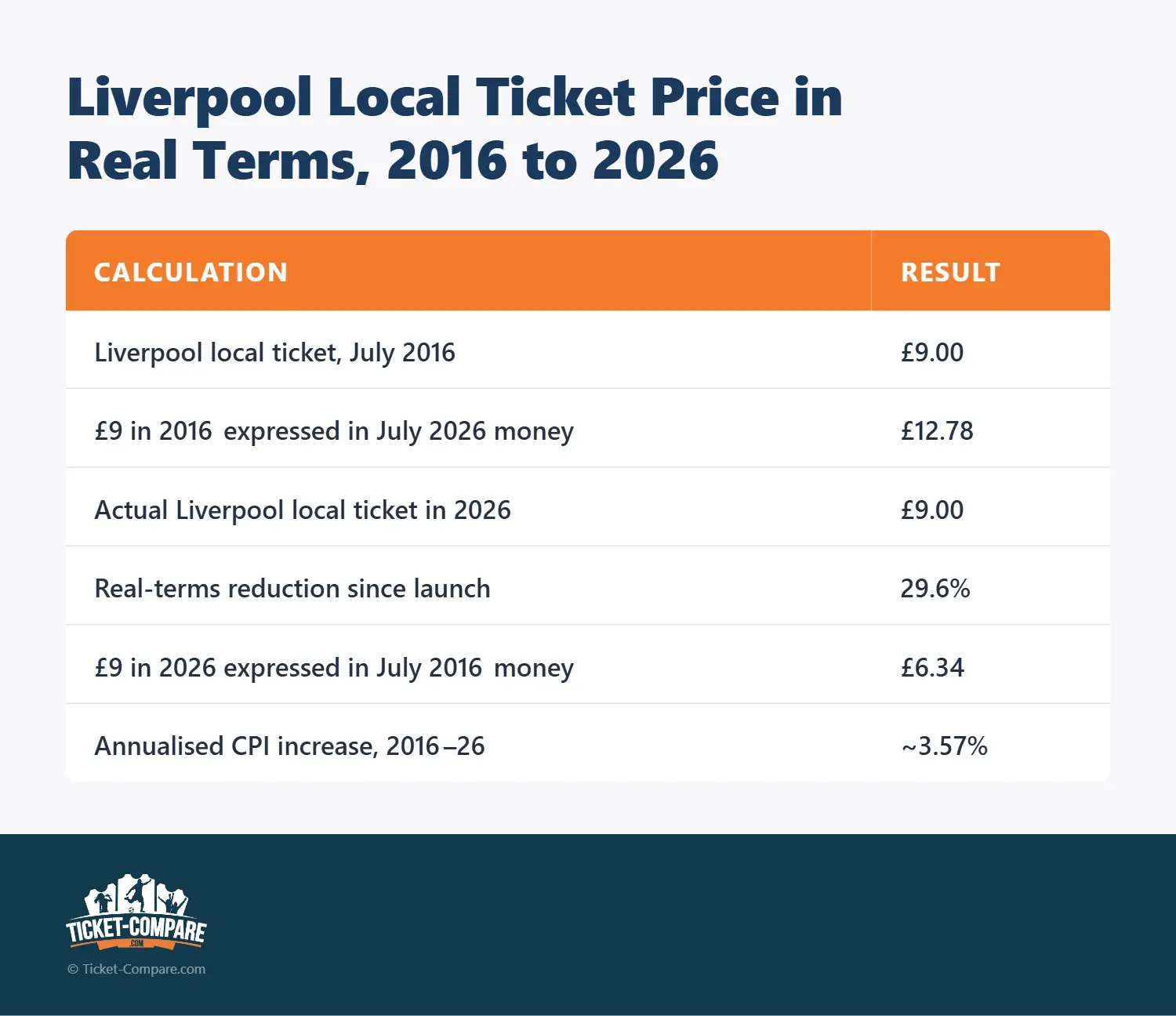
With no rises in ten years, in real terms Liverpool's $12 local ticket is now almost 30% cheaper than when it was introduced a decade ago.[3]
What if Liverpool had increased it every year?
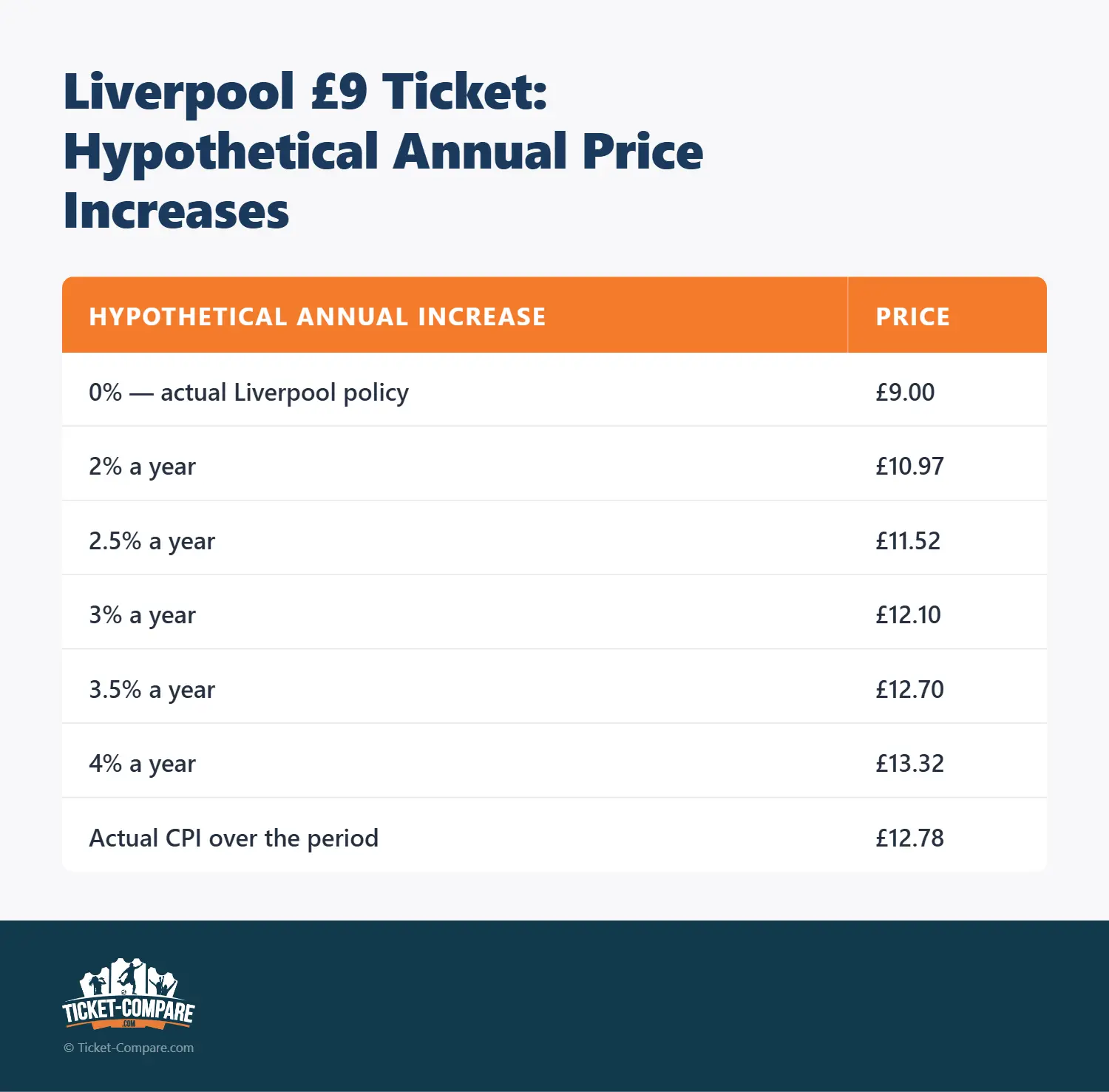
Even if Liverpool had increased the ticket by as little as 2% a year, this ticket would now cost almost $15. Had the price kept pace with actual inflation it would be nearly $17 in 2026/27.[3]
How Liverpool Supporters Pushed Affordability Onto the Agenda
The years leading up to the introduction of the Local General Sale were riven with supporter discontent over ticket pricing, leading to another ongoing policy shift that is still part of Premier League ticketing: The $40 away ticket cap.[4]
Twenty’s Plenty as Part of a Wider Ticket Pricing Revolt
The implementation of the Local General Sale coincided with a league-wide price cap on away tickets, the momentum for which began more than three years before.[4]
In January 2013 Manchester City’s trip to the Emirates became a national flashpoint when the club returned 900 tickets, almost a third of the away allocation.[4]
At that time the home club set the price of tickets for visiting fans, and Arsenal were charging City’s fans $83. It’s perhaps a sign of progress that a decade later (with 10 years of $27 or $40 away tickets) that price still feels excessive.[4]
After Liverpool fans encountered the same pricing shortly after, the Spirit of Shankly also helped raise awareness about ticket affordability.[4]
In this environment, the Football Supporters’ Federation’s (FSF) Twenty’s Plenty gained momentum.[4]
LFC’s Consultation with Spirit of Shankly, Spion Kop 1906 and the Ticket Working Group
At home, ticket pricing had long been a topic for Liverpool fans, with a protest staged by the Spirit of Shankly and the Spion Kop 1906 in November 2014 to protest pricing.
At home, ticket pricing had long been a topic for Liverpool fans, with a protest staged by the Spirit of Shankly and the Spion Kop 1906 in November 2014 to protest pricing.[5]
In the match against Stoke none of the usual flags or banners were to be seen in the Kop, as a reminder of the colour and atmosphere these groups bring to Anfield. [5]
Following this pressure FSG then reached out to its supporters, and these fan groups teamed up to form the Ticket Working Group, which over the next year or so consulted on three main needs, later identified by then Chief Executive, Ian Ayre on the back of this supporter pressure. These were:[5][6]
- Greater access for local people
- Greater access for younger people
- More affordable pricing generally
It would be another year before things truly came to a head with a mass protest over $103 tickets.
2 February 2016: Liverpool Announce the New Structure
This was the first mention of the local $12 ticket, but the original scheme was not initially available for every home Premier League match. In fact it was limited to a total of 1,581 seats at three Premier League ‘Category C’ matches.[6][7]
On top of that the club proposed General Admission ticket prices that rose as high as $103 at the upper end of the tariff.[6]
This was greeted with dismay, leading to a mass walkout during the Liverpool vs Sunderland match on 6 February 2016 during the match against Sunderland.[8]
Taking place in the 77th minute, it was one of the Premier League era’s most overt examples of an in-stadium protest.[8]
Anfield Expansion and What it allowed
One of the reasons ticket pricing was at the top of the agenda at the time was because the club was in the middle of expanding the Main Stand, adding approximately 8,500 new seats and lifting Anfield’s capacity to 54,000.[6]
At the time Ian Ayre connected this project to the issues raised by the Ticket Working Group. And until this point it’s fair to argue that, given that Anfield is always oversubscribed, Liverpool had little leeway to address the group's concerns.[6]
Liverpool then portrayed the $12 Local General Sale as the outcome of a lengthy consultation.[6]
Supporter representatives disputed that claim, saying the $12 proposal was a late club initiative rather than something they had devised together.[7]
What they did take credit for—and it’s backed up by the history of protest in the early to mid-2010s— was forcing affordability, youth access and ticket pricing onto the agenda in the first place.[5][7]
So fan organisation and direct action clearly affected the environment in which the notion of a $12 Liverpool ticket grew from a limited initiative of about 1,581 seats into a 10,000-seat concession that has endured.[7][8]
As we’ll see, it may have become a template for other clubs in the middle of an expansion.
Ten Years Later, Man City Land on a Similar Scheme
Here’s what Man City’s Local Resident Ticket initiative entails:[1]
- 100 to 500 tickets per Premier League home match.
- $13 adults
- $10 concessions
- $7 U18
- Tickets are awarded via a random ballot.
- There is no paid Matchday Membership requirement.
Manchester wards eligible for the scheme:[1]
- Ancoats & Beswick
- Ardwick
- Clayton & Openshaw
- Gorton & Abbey Hey
- Miles Platting & Newton Heath
Where Did Manchester City's Scheme Come From?
Man City Has Its Own History of Affordable Expansion
Manchester City's local ticket scheme bears a lot of similarities with Liverpool's—that much is clear. Still, the club also has its own history of linking stadium expansion with cheaper access.
When City expanded the Etihad's South Stand in the mid-2010s, some of the additional capacity was used to increase the allocation of budget season tickets available to supporters.[9]
Among them was the $400 Seasoncard, a reference point for affordable season ticket pricing in the Premier League.[9]
Ticketing Pressure Intensifies in 2025
Just like at Liverpool, City's most recent stadium expansion has taken place in a period when ticket pricing has become a bone of contention among the club’s support.
In February 2025, a coalition of supporter organisations including 1894, MCFC Fans Foodbank and Trade Union Blues called on the club to freeze or reduce ticket prices and improve access for ordinary fans.
Alongside those independent groups, City also consults supporters through City Matters, its formal fan-engagement network.[10]
Among the concerns were the cost of match tickets, as well as the availability of traditional season tickets.[10]
The pressure became especially hard to miss in April 2025, when supporters staged a nine-minute protest during the home game against Leicester.[10]
Formal negotiations had been taking place throughout that time, and later that month the club confirmed a price freeze, and fan groups took the decision as evidence that their organised pressure had made a difference.[10]
Again, an Expanded Stadium Creates the Room for Discounts
The latest Etihad redevelopment has added more than 7,000 general admission seats.[11]
For 2026/27, City also made more than 4,000 additional Flexi Season Tickets (pay-as-you-go STs) available across the stadium, half of which have been ringfenced for Junior Members.[11]
It’s hard to ignore the parallel with Liverpool's Main Stand redevelopment a decade earlier. In both cases, several thousand new seats gave the club an opportunity to decide how much of the extra capacity would simply be sold through existing routes and how much could be used to address concerns about access.
Local Support Had Long Been an Issue
City's dialogue with local residents stretches back more than two decades, since the club relocated to the City of Manchester Stadium in the early 2000s.[1]
Before the Local Resident Ticket had even been announced, the club had already decided that part of the benefit created by its expanded stadium should be protected for a group it wanted to keep represented in the stands and had consulted multiple times each year.[1][11]
At a City Matters meeting on 19 November 2025, representatives raised feedback that Manchester City’s approach to selling Etihad tickets could be perceived as placing greater emphasis on one-off international fans than those living locally.[12]
The club acknowledged the need to balance the influx of international supporters created by its recent success with the local identity that remains central to Man City and the Etihad’s immediate surroundings.[12]
As we mentioned, that discussion was taking place alongside another, older form of engagement.
Since moving to the Etihad in 2003, Man City has held regular meetings with residents from the neighbourhoods surrounding the stadium. When the Local Resident Ticket was finally announced in 2026, the club revealed that people attending those forums had specifically asked for greater access to Man City match tickets.[1]
City Matters ensured fan input as the scheme was developed. That makes City's route to the finished policy slightly different from Liverpool's. [1]
At Anfield, an independent supporter movement spent years campaigning around affordability and local access, before the Main Stand expansion created additional capacity and the 2016 ticket price protests helped turn the $12 ticket into a much larger concession.[5][6][7][8]
The histories are a little different, even if the eventual answer looks identical.
Everton Have Also Used New Capacity for Limited Cheaper Tickets
Everton give us another recent variation on this theme, although not aimed at local residents. Their move from the 39,572-capacity Goodison Park to the 52,888-seat Hill Dickinson Stadium for 2025/26 was accompanied by a new pricing structure for match tickets.
This included a limited number of $25 adult tickets in the North Stand, available across all three match categories ($12 to $15 for u11s) and sold via the Forever Blue+ member ballot.
The adult price refers to the club’s foundation in 1878 and again, unlike the Liverpool and Man City schemes, is not restricted to local residents and also requires a paid membership.[19]
Could Other Clubs Follow the Same Blueprint?
As well as supporter pressure, one condition shared by Liverpool and Manchester City’s schemes is a stadium expansion.[6][11]
Redevelopment at Anfield and now the Etihad has unlocked thousands of seats and given clubs room to implement a scheme involving hundreds of tickets without cutting into existing match ticket or season ticket allocations.
Good news then, as there are several Premier League clubs in the middle of stadium expansions and a few more with plans to add capacity.
As we have seen with Fulham’s Riverside Stand at Craven Cottage, where hospitality seats and pricier general admission seating make up the majority of the capacity, “premiumisation” is often at the forefront of these plans.
Still, not every Premier League team is in a location as wealthy as Fulham. Elsewhere the contrast between a high-revenue, high-profile business and a local community can sometimes look a little incongruous.
So now seems like a good opportunity to assess the clubs that could introduce something similar to Liverpool and Man City, and what the scheme might look like.
Expanding Premier League Clubs with Scope for a Local Resident Scheme
We’ll look at five aspects:
- Expansion leeway: How many additional seats are being added?
- Ordinary supporter access: Has the club announced an expansion of general admission capacity, or is it predominantly hospitality?
- Supporter pressure: Does the club have a strong culture of independent fan groups campaigning specifically around prices/access?
- Club responsiveness: Can we find enough evidence that consultation or protest has affected ticketing policy?
- Local access case: Does the stadium sit within a community for which a postcode/ward scheme would make sense?
Expansion and Local Discount Scheme Potential
| Club | Expansion leeway | GA/access commitment | Supporter pressure | Club responsiveness | Local-access case | Suitability |
| Leeds United | High | High | High | Medium/High | High | HIGH |
| Aston Villa | Medium/High | High | Medium/High | Medium | High | HIGH |
| Nottingham Forest | High* | Unclear/Medium | High | High recently | Medium/High | HIGH* |
| Crystal Palace | High | High | Medium | Medium | High | MEDIUM |
| Bournemouth | High | High | Low/Medium | Medium | Medium | MEDIUM |
*The City Ground’s large-scale redevelopment is still in the planning phase at the time of writing, so their rating is more speculative.[16]
We should say here that ‘suitability’ is our own assessment against these five criteria, all for the purpose of discussion. We are not suggesting that any of the clubs has announced or is considering a scheme resembling the Local General Ballot or Local Resident Ticket Initiative.
Leeds United: High Suitability
Elland Road is set to grow from 37,645 to around 53,000 and Leeds look especially suited to a local resident ticketing scheme.[14]
This expansion is designed to meet a considerable demand for tickets, and the club is promising an increase in general admission match tickets and season tickets.[14]
The Leeds fanbase is mobilised by Premier League standards, and the Leeds United Supporters' Trust regularly raises concerns about pricing and younger fans being squeezed out.[14]
Looking at demographics a little, Elland Road sits beside Beeston and Holbeck, with pockets of lower incomes, while Leeds' one-club-city identity supports the notion of a local discount. [14]
Up to now, the club has promised future prices at a fair market price, rather than ringfencing any cheap seats for a special scheme.[14]
Aston Villa: High Suitability
We know that the redevelopment of Villa Park's North Stand, taking place throughout the 2026/27 season, will add more than 5,500 seats, lifting the capacity beyond 50,000. [15]
Hospitality provision is a key part of the plans, but the club has also promised more match tickets and season tickets within general admission price ranges.[15]
As with Leeds, supporter pressure around affordability has made headlines. The Aston Villa Supporters' Trust strongly opposed Champions League prices reaching $130 in 2024/25, a recent high watermark. Meanwhile the Fan Advisory Board continues to hold the club to account on prices and concessions.[15]
As for Villa Park’s location, Aston is within one of the more deprived areas in a local authority where deprivation is also relatively high.[15]
So it’s not hard to make the argument that a relatively small allocation for nearby supporters would therefore have a benefit for the community.
Nottingham Forest: High Suitability
At Forest, we should say up top that organised supporter pressure and club dialogue has already produced tangible results when it comes to ticket pricing.[16]
The club's latest plans for the City Ground envisage an initial capacity of around 45,000, with long-term phases bringing the stadium to around 52,500 seats. Those plans remain subject to approval.[16]
In the meantime the Nottingham Forest Supporters' Trust has surveyed almost 2,000 supporters ahead of 2026/27.[16]
More than 80% opposed increases for match tickets. As part of this dialogue, the club has frozen season card prices and reinstated an 18 to 21 concession. Forest’s chairman Nicholas Randall KC said the club had ‘listened’.[16]
The geography is a little more complex as the City Ground is in affluent West Bridgford on the edge of Nottingham proper. Nottingham itself has far higher rates of deprivation.[16]
So a Forest equivalent might work as a city-wide scheme in Nottingham, complicated of course by Notts County being just across the river.
Crystal Palace: Medium Suitability
Palace have a few of the ingredients needed for a local scheme. The new Main Stand, gradually taking shape over the next few seasons, should eventually increase the capacity at Selhurst Park from around 26,000 to more than 34,000. That is more than a 30% increase, and should come with substantial additional general admission capacity.[17]
In every sense, Selhurst Park is deeply embedded in South London, and an SE25 or wider Croydon allocation could work.
The club has a respectable record when it comes to preserving affordability with season ticket freezes and ongoing concessions for young fans.[17]
Palace also have noticeably active supporter organisations and a Fan Advisory Board, but compared to Liverpool, Man City and Leeds, we have seen less ticket campaigning and major concessions directly springing from fan pressure.[17]
Which is not to say it won’t happen; just that it’s trickier to make a speculative guess.
AFC Bournemouth: Medium Suitability
When it comes to pure capacity, Bournemouth arguably have the greatest opportunity with their expansion.
The Vitality Stadium is planned to grow from 11,286 to around 20,200, and a large proportion of those new seats are expected to be for general admission.[18]
The club also wants to more than double its supply of season tickets—essentially, no new Bournemouth season tickets have been issued for more than a decade.
But while the club has made a major commitment to access, affordability has come up less. The club has consulted with Bournemouth's supporter organisations over the redevelopment, but we haven’t seen the same kind of campaigning visible at Liverpool, City or Forest.
Bournemouth draw support from across Dorset, but a local scheme might feature a catchment including Boscombe and Pokesdown, or people living within the BCP local authority.
Have Liverpool Created a Blueprint for Affordable Ticketing?
We’re going to be bold and say yes, but with a few qualifications. The big one is that every club is different, with unique demographics, pressures and fan cultures.
Liverpool’s fan groups were not the first and only ones to campaign for cheaper football.[4][5]
However, the road that led to the $12 Local General Ballot, amid the backdrop of a club carrying out a considerable expansion while balancing global support with the needs of local residents, was taken earlier at Liverpool.[6][7][8]
A decade later, other Premier League clubs are on a similar journey. In the case of Manchester City, consciously or unconsciously, similar needs have led to the Local Resident Ticket Initiative, which looks almost identical to Liverpool’s own scheme and comes a year after Everton’s 1878 initiative.[1]
With Premier League teams currently expanding, it’s an interesting time for those fanbases and anyone who wants Premier League football to be more affordable, however limited in scope the schemes may be.
If Liverpool can protect roughly 500 seats per match for local people at $12, and City can protect up to 500 at $13, what could Leeds, Villa, Forest, Palace and Bournemouth choose to do with their new capacity?[1][2]
Well, on the strength of Liverpool and Man City’s schemes, less than 1% of stadium capacity is enough to create thousands of cheap tickets for the community each season.
Sources and Methodology:
This article was researched using official club ticketing information, stadium redevelopment announcements and planning material, alongside contemporary reporting and statements from independent supporter organisations.
Where the history of a policy is disputed, both club and supporter accounts have been considered. Current ticketing and redevelopment information was checked against material available in August 2026.
The inflation calculations use the UK Consumer Prices Index (CPI), with July 2016 used as the starting point for Liverpool's $12 ticket. Inflation-adjusted values compare the CPI index at the beginning and end of the period, while the annualised figure represents the compound annual rate of change rather than an average of individual yearly inflation rates.[3]
The suitability ratings for Leeds United, Aston Villa, Nottingham Forest, Crystal Palace and AFC Bournemouth are editorial assessments rather than predictions that the clubs will introduce local ticket schemes.
They consider the five criteria set out in the article: additional stadium capacity, commitments to general admission access, organised supporter pressure, evidence of club responsiveness and the practical case for defining a local catchment.
Local demographic context was drawn from council and government deprivation data where relevant.
[1] Manchester City, Local Resident Ticket scheme and eligibility details, and the club's announcement explaining the resident consultation behind the initiative.
[2] Liverpool FC, current Local General Ballot rules and 500-ticket allocation; 2016 announcement establishing around 10,000 $12 tickets for local supporters; and 2026/27 ticket-pricing announcement confirming the $12 local price remains frozen.
[3] Office for National Statistics, CPI All Items index time series, 2015=100, and Consumer price inflation: July 2016. Calculations are Ticket-Compare.com's own from the published CPI indices.
[4] The Guardian, Manchester City's $83 Arsenal ticket controversy in January 2013; Football Supporters' Association archive, the aims of the Twenty's Plenty campaign; and the Premier League, original introduction of the $40 away-ticket cap for 2016/17 and its 2026 extension.
[5] This Is Anfield, Spirit of Shankly and Spion Kop 1906's November 2014 no-flags protest; Liverpool FC Supporters' Committee, 2015 annual report documenting formation of the Ticket Working Group; and Spirit of Shankly, Ticket Working Group conclusion statement.
[6] Liverpool FC, Ian Ayre's explanation of the February 2016 ticketing structure and the 8,500-seat Main Stand expansion, and Ayre's comments linking the extra capacity to affordability, local supporters and younger fans.
[7] Spirit of Shankly, supporter representatives' response to Liverpool's February 2016 ticket proposals. This is the source for the 527 $12 tickets at each of three Category C games, the 1,581 total, and the supporters' account of how late in the process the local-ticket proposal was introduced.
[8] The Guardian, contemporary report on the 77th-minute Sunderland walkout and report on FSG's subsequent ticket-price U-turn; Liverpool FC, July 2016 details of the expanded local ticket initiative.
[9] Manchester City, 2014 Etihad expansion announcement linking additional capacity with more $400 Seasoncards and the earlier stadium consultation outlining $400 Seasoncards.
[10] Football Supporters' Association, February 2025 coalition call for Manchester City to freeze or reduce season-ticket prices; BBC Sport, report on the nine-minute Leicester protest and subsequent ticket-price freeze; Manchester City, official 2025 ticket-price freeze announcement and description of City Matters as the club's elected formal fan-engagement programme.
[11] Manchester City, North Stand ticketing and expansion update, confirming more than 7,000 new general admission seats, more than 4,000 Flexi Season Tickets and the 50% Junior Cityzens allocation.
[12] Manchester City, City Matters meeting minutes from 19 November 2025, including discussion of perceptions around international and local supporters, and the club's Local Resident Ticket launch announcement.
[13] Fulham FC, Riverside Stand redevelopment planning summary. This was used as background when considering the balance between standard seating, premium products and hospitality in stadium redevelopment.
[14] Leeds United, Elland Road redevelopment plans and ticketing FAQ and planning approval for expansion to up to 53,000; Leeds United Supporters' Trust, response to 2025/26 ticket-price increases; Leeds Observatory, 2025 deprivation data.
[15] Aston Villa, 2026 North Stand redevelopment announcement and FAQs; The Guardian, report on supporter opposition to $94-$130 Champions League ticket pricing; Birmingham City Council, Aston Ward socioeconomic action plan and Birmingham deprivation data resources.
[16] Construction News, Nottingham Forest's phased 45,000-to-52,500 City Ground redevelopment plans; the planning register, current City Ground redevelopment application; Football Supporters' Association, 2026 Forest supporter survey and ticket-price freeze; Rushcliffe Borough Council, local economic and deprivation context for Rushcliffe and West Bridgford.
[17] Crystal Palace, Main Stand redevelopment timeline and capacity increase from 26,000 to more than 34,000; 2026/27 concession eligibility; and Fan Advisory Board discussions around ticket pricing and stadium development.
[18] BBC Sport, AFC Bournemouth's approved stadium expansion from 11,286 to more than 20,000 seats and detail on the planned additional general admission and hospitality capacity; AFC Bournemouth, current season-ticket eligibility information and 2026/27 season-ticket pricing.
[19] Everton, Hill Dickinson Stadium Ticket Pricing To Offer Greater Choice. Contemporary reproductions of Everton's announcement confirm the $25 wording and the surrounding $78/$83/$90 standard North Stand tariff.


