


Six Tests in Three Days: How Will Twickenham Cope With the Nations Championship Finals?
Written by Alex Bird
- Allianz Stadium Twickenham will host six international Tests over three consecutive days, with just 48 hours separating the opening match and Grand Final kick-offs.[1]
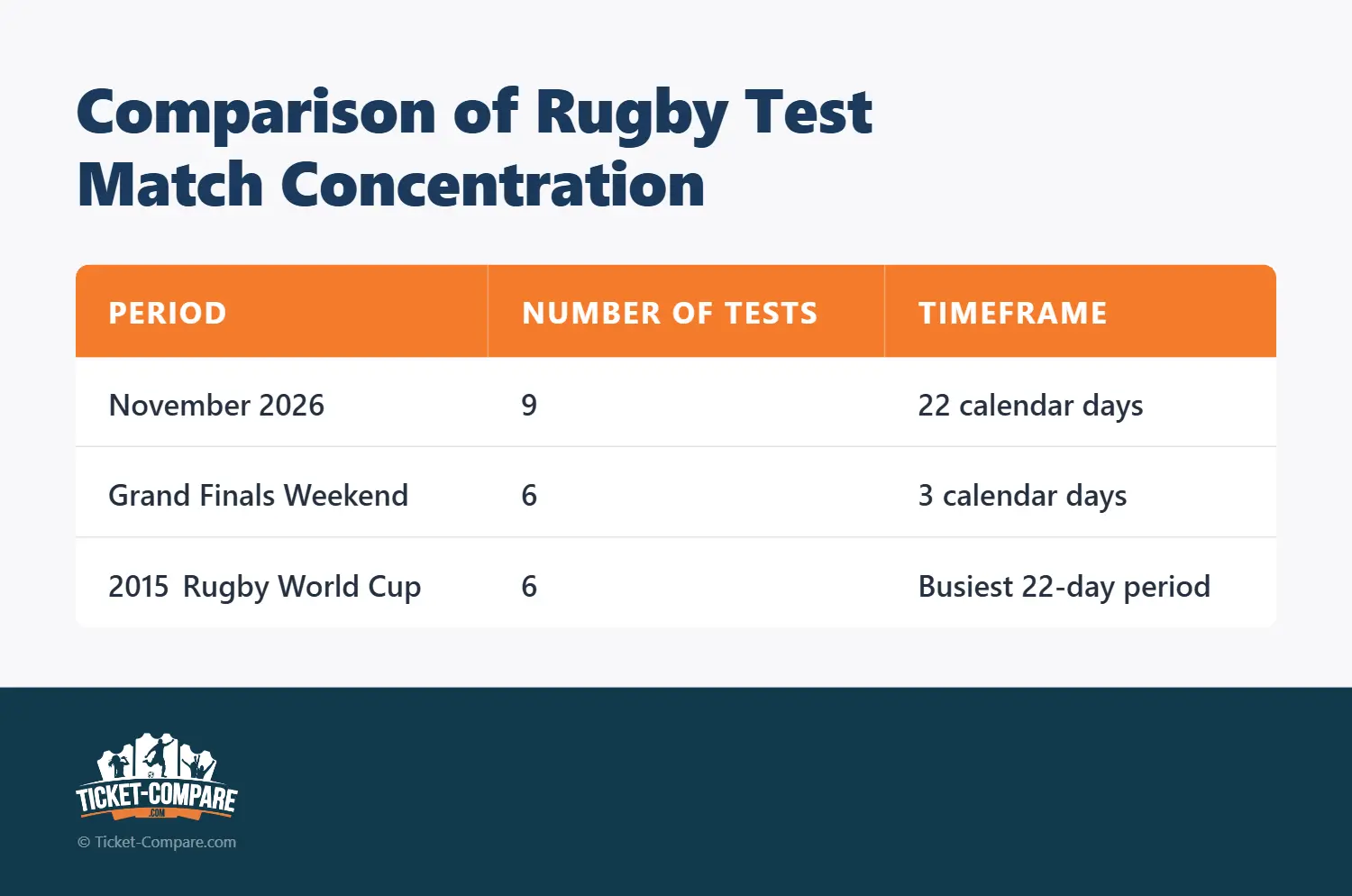
- During November 2026, nine Tests are scheduled at the stadium in 22 days, which is 50% more matches than during its busiest equivalent period at the 2015 Rugby World Cup.[1][2]
- Up to 246,000 spectator admissions are possible across the finals weekend, placing extraordinary demands on transport, stadium infrastructure and the surrounding residential area.[1][3]
In late November 2026 the inaugural Nations Championship will culminate in six finals in three double-headers across three consecutive days. There is no precedent for this concentration of elite men's international rugby at one venue.
Keeping in mind that Twickenham will already have staged England against Australia (8 November), Japan (14 November) and New Zealand (21 November). When it's all over, the stadium will have hosted nine senior internationals in just 22 calendar days.[1]
In August it was announced that more than 100,000 tickets for the finals weekend had already been sold, before fans knew which teams would meet in the placement matches.[4]
We have not identified a comparable three-day schedule of elite men's Tests on a grass surface. So, in the weeks before the event, now may be a good time to highlight the challenges and potential pressure points, involving the pitch, transport, the stadium's residential surroundings, crowd management and local services.
What strains does this cross-hemisphere festival of rugby put on Twickenham, infrastructure and the area? We'll look at a few now.
Can Twickenham's Pitch Survive Six Tests in Three Days?
The 2026 Nations Championship finals weekend packs as many Tests into three days as Twickenham hosted during its busiest 22-day period at the 2015 World Cup.[1][2]
To put the schedule into perspective, Harlequins' Twickenham Stoop has nine senior men's and women's home matches scheduled across September to November 2026, including one friendly and eight competitive fixtures (and accounting for the international break in November).[5][6][7]
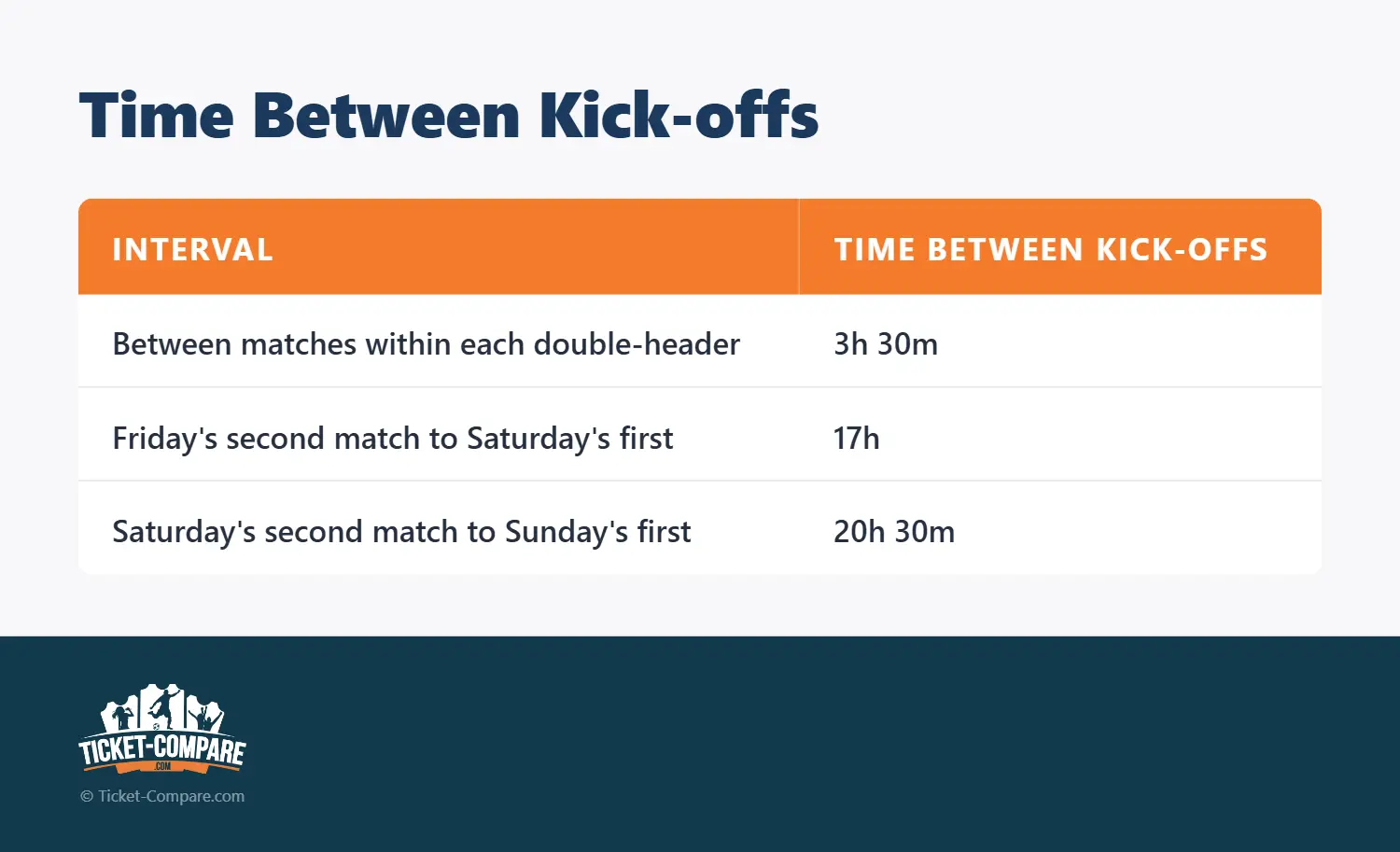
The pitch will have just 17 hours between Friday's final kick-off and Saturday's first
Why rugby union takes such a toll on natural grass
Here's an insight that caught our eye from Jim Buttar, Twickenham's head of grounds and technical operations: Damage from three scrum resets in one area was still visible three weeks after a fixture.[8]
When you multiply that by six and factor in the timing, towards the end of what is, by Heathrow's 1991 to 2020 averages, the wettest month of the year, you glimpse the size of the challenge that could be facing Twickenham's grounds staff.[9]
You also need to separate running repairs, replacing divots and the like, from natural regrowth and recovery, which can take weeks.[10]
Factor in the three England fixtures earlier in the month, along with the possibility of persistent rain, and the pitch becomes a potential pressure point.
World Rugby's analysis of the 2023 Six Nations recorded an average of 11 scrums per match. Extrapolating that historical average, the first five Tests could produce around 55 scrums before Sunday's Grand Final even kicks off. Of course, this is an illustration rather than a forecast.[11]
Twickenham has a completely rebuilt playing surface
In summer 2026, Twickenham was given an entirely new Hatko "hybrid" playing surface.[12] As is commonplace for most grass-surface sports now, the turf is reinforced with artificial fibres.
The surface is, well, just the surface, with extensive infrastructure intended to help maintain the pitch, including almost 6,200 metres of drainage pipework, 29,500 metres of undersoil heating pipes, 36 moisture sensors and an approximately 1,400m³ underground water storage reservoir.[12]
And to encourage the biological processes that allow the pitch to repair itself, grounds staff will use artificial growing lights to mitigate the stadium's limited sunlight in the darkest period of the year.[13]
Finding a comparable event is not that easy. The closest we have come is in Australia, where Brisbane's Suncorp Stadium hosted nine elite rugby league matches over four consecutive days in May 2026.[14]
What happened when Suncorp Stadium hosted nine rugby league matches?
In terms of precipitation, May in Brisbane has a similar historical average monthly rainfall to November at Heathrow (69.8mm versus 66.6mm), although the much warmer Brisbane climate makes conditions for grass recovery very different.[9][15]
The event at Suncorp Stadium received 31mm of rain on the first day. The central playing corridor did lose grass cover, but the grounds team reported satisfactory traction and firmness measurements throughout.[14]
That said, rugby league involves fewer players (13 vs 15) and because league scrums involve little of the sustained pushing seen in union, one of the most damaging elements of the Nations Championship did not occur at Suncorp Stadium in May 2026.
Can Twickenham Manage a Quarter of a Million Spectator Visits?
Remarkably, the Nations Championship finals will feature as many Tests in three days as Twickenham hosted across its busiest 22-day period during the 2015 Rugby World Cup.[1][2]
Three full houses across the finals weekend would give us just shy of 250,000 spectator admissions to Twickenham over three days.[3]
Include the three preceding England home matches and that is a theoretical maximum of 492,000 spectator admissions across six event days in November, rather than 492,000 distinct visitors.[1][3]
Note again that each day's ticket during the finals covers a double-header, with no exit and re-entry permitted. This could mean longer periods of spectator activity in and around the stadium than on a typical England international matchday.[16]
The RFU's consultation published in January 2026 identified faster road reopening as a priority for smoother matchdays, but a double-header could extend the period during which roads need to be managed or closed.[17]
The bulk of the challenge is managing existing controls, including road restrictions, managed pedestrian crossings and efforts to distribute fans across several railway stations over three days.[3][17]
Twickenham residents face up to 72 hours of special parking restrictions in 22 days
Richmond Council specifies an 11:00 to 23:00 operating window for the Twickenham Event Zone on major event days.[3]
With six such days scheduled in November, this means:
- 72 hours of scheduled special parking restrictions across November's 22-day period.
- 36 hours across three consecutive days during finals weekend alone.[3]
These figures concern controlled parking restrictions, not continuous road closures.
Two in Five Nearby Residents Already Rate Their Twickenham Matchday Experience Poorly
The RFU's November to December 2025 consultation revealed mixed feelings among respondents living closest to Twickenham Stadium.[17]
Of 168 respondents in the immediate vicinity, 40% rated their matchday experience as poor, while 38% described it as good or excellent.[17]
Road closures and traffic congestion emerged as the most significant concerns.[17]
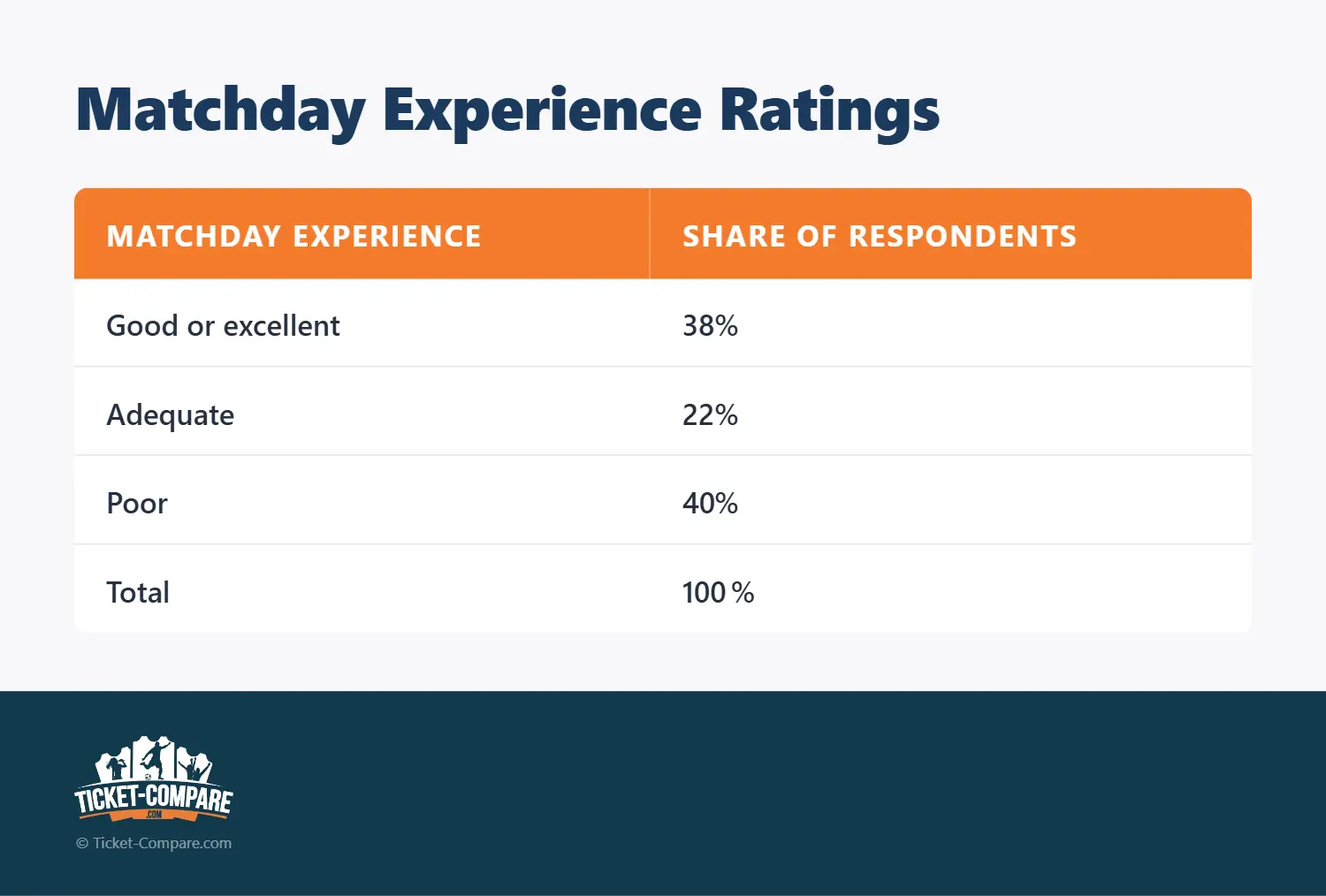
Source: RFU residents' consultation, hyperlocal sample of 168 respondents; not a representative poll of all local households.[17]
Extra Trains, Friday Rush Hour and Major Railway Works
Drawing from the RFU's own figures, up to 114,000 spectator journeys to the stadium could involve Twickenham railway station across the finals weekend, assuming three capacity crowds and the same travel patterns as a typical major matchday.[18]
In evidence to Parliament, the RFU said that up to 38,000 fans use Twickenham station on a typical capacity matchday, representing approximately 45% of attendees.[18]
Applying the same pattern across three capacity crowds gives us 114,000 spectator return journeys involving Twickenham station. This could produce 228,000 station entries and exits if each spectator uses the station in both directions.
What has already been arranged for the finals?
South Western Railway has published additional train services and timetable alterations for all three days of the finals weekend:
- On Friday 27 November there will be nine additional pre-match trains from Waterloo, seven additional post-match services from Twickenham and changes to late-night and commuter services.[19]
- Saturday 28 November 20 additional pre-match services from Waterloo via Twickenham will be provided, along with 13 additional post-match services towards Waterloo and diverted Shepperton services.[19]
- And on Sunday 29 November, there will be an extensive additional timetable, including services towards Waterloo and Reading.[19]
However, as the weekend draws closer, the potential for disruption comes into relief.
A particularly difficult weekend for rail travellers?
The opening match on Friday kicks off at 16:40, partly coinciding with the Friday afternoon peak in South West London.[1]
The special timetable adapted for the event by South Western Railway includes cancellations or alterations to ordinary commuter timetables, which could lead to disruption.[19]
The danger of further complications arises on the weekend, with engineering work halting services into London Paddington, potentially increasing demand on alternative routes, including services between Reading and Waterloo, which National Rail has warned may be exceptionally busy.[20]
Now, the RFU already operates shuttle bus connections from Richmond and Hounslow East and encourages use of alternative stations to relieve pressure on Twickenham.[21]
So the question is whether the additional transport provision can overcome the complication of a Friday rush-hour match and major weekend engineering works.
Will Three Consecutive Matchdays Exacerbate Twickenham's Public Urination Problem?
There's no easy way to broach this topic, but there's a documented history of nuisance public urination around the stadium on Twickenham matchdays. This is a partial upshot of the residential nature of the stadium's surroundings.
With alleyways, front walls and gardens all targeted for years, measures have been taken to tackle this issue.
During the 2026 Six Nations 24 fixed-penalty notices for public urination were issued in connection with England v Wales on 7 February.[22]
And yet, despite this enforcement, there was evidence for an ongoing problem in 2026, suggesting that the crackdown has not eliminated the problem altogether.[22]
What has the RFU already done?
As part of the residents' consultation in 2026 the RFU identified public urination and other antisocial behaviour as an area of concern.[17]
The RFU has outlined several targeted measures, including barriers around vulnerable alleyways and additional stewarding in areas such as Erncroft Way and Chudleigh Road. Some interventions were planned or being trialled when the RFU published its consultation, rather than all being fully implemented.[17]
To go with enforcement, Richmond Council has also expanded its borough-wide network of public toilets, even if the exact number and placement of any additional temporary toilets for finals weekend have not been established publicly.[23]
Double-headers, and fewer arrival waves could make this problem less pervasive. If there's a specific time that could be prone to this kind of offence, it could be the late departure on Friday night.
Six Matches, Three Days, and a Major Stadium to Reset Overnight
The scale of the undertaking to host six international rugby matches in three days will be extraordinary, covering a breadth of operations, both in and outside the stadium. This will involve:
- Pitch inspection, divot repairs, mowing and line marking.
- Cleaning seating areas, toilets and concourses.
- Waste collection and replenishment of catering facilities.
- Turnover of hospitality areas, stewarding and security operations.
- Cleaning nearby streets and restoring normal access for residents.
One particular pressure point could be the turnaround between Friday night, with the second match kicking off at 20:10, and Saturday afternoon, getting underway at 13:10.[1]
We can draw a comparison again with the Magic Round at Brisbane's Suncorp Stadium.
The scale of the undertaking at Brisbane's Magic Round
During Suncorp Stadium's four-day programme in May 2026, the venue expected more than 5,000 staff to work across stadium operations, catering, security, medical services, transport, cleaning and emergency response.[24]
In the build-up to the event it was estimated that over 80,000m² of grass would be mowed and approximately 7km of pitch lines would be drawn.[24]
A Historic Weekend, and a Test of Twickenham's Preparations
The evidence suggests that Twickenham is not entering the event unprepared. There's a newly rebuilt and technologically advanced hybrid playing surface, while, following consultation, extensive existing crowd management systems will be in place.[12][17]
Additional railway services have already been scheduled for all three finals days and there are targeted measures against documented antisocial behaviour around the stadium.[19][17]
All the same, six major Tests across three consecutive days, almost on the back of three England internationals earlier in the month, is an unusually intensive undertaking.
You can find examples of comparable schedules in other forms of rugby, but we have not identified a directly comparable three-day programme at the highest level of the men's international game.
In an inaugural event, the rugby itself promises to be fascinating. How the stadium, playing surface and surroundings cope with the occasion could prove almost as interesting.
Sources and Methodology
Sources
^ a b c d e f g h i [1] Nations Championship — official 2026 fixtures and finals kick-off times — England's November matches; six finals fixtures; three double-header dates and kick-off intervals.
^ a b c [2] ITV News — 2015 Rugby World Cup fixtures and Twickenham match dates — Historical Twickenham venue schedule; comparison of six matches during the busiest 22-calendar-day window.
^ a b c d e f [3] Richmond Council — Twickenham rugby event dates, parking and road closures — Six November stadium days; 82,000 crowd assumptions; 11:00–23:00 event-zone window; road-management practice.
^ [4] Ticketmaster Sport — 100 days to go, over 100,000 finals tickets sold — Ticket-sales announcement dated 20 August 2026.
^ [5] Harlequins — men's 2026/27 ticketing and home-fixture schedule — Five competitive men's Stoop fixtures in September–October, plus one Edinburgh friendly.
^ [6] Premiership Women's Rugby — 2026/27 Next Gen Cup fixtures — Women's Stoop home fixtures on 19 September and 17 October.
^ [7] Harlequins — women's home match against Bristol Bears, 22 November 2026 — Women's Premiership fixture, completing the Stoop comparison.
^ [8] Pitchcare — Jim Buttar interview on Twickenham's turf and scrum wear — Example of signs of three scrum resets remaining visible three weeks later.
^ a b [9] Met Office — Heathrow 1991–2020 monthly climate averages — November rainfall of 66.63mm, seasonal temperature and sunshine context.
^ [10] World Rugby — natural-turf maintenance and repair guidance — Immediate divot repair, scrum-area wear, surface stability and recovery.
^ [11] World Rugby — 2023 Six Nations game-analysis report — Historical mean of 11 scrums per match; basis for illustrative 55-scrum figure.
^ a b c [12] TurfPro — Allianz Stadium pitch renovation, September 2026 — Hatko hybrid grass, drainage and heating lengths, 36 sensors and water-storage volume.
^ [13] Allianz Stadium — Jim Buttar on winter turf maintenance and grow lights — Artificial grow-light use, stadium shade, and pre/post-match groundskeeping.
^ a b [14] Australian Sports Turf Managers Association — Suncorp Magic Round review — Nine elite league fixtures in four days, 31mm of rain and turf traction observations.
^ [15] Australian Bureau of Meteorology — Brisbane May 2025 climate summary — Long-term May rainfall mean of 69.8mm at Brisbane.
^ [16] England Rugby — Nations Championship finals-day ticket rules — One ticket admits one person to both matches on a finals day; no exit and re-entry.
^ a b c d e f g h i j [17] RFU — Residents' Event Information Boards, January 2026 (PDF) — 2025 local consultation, 168 hyperlocal respondents, 38% positive/22% adequate/40% poor, complaints and proposed or existing mitigation.
^ a b [18] RFU — written evidence to Parliament on Twickenham transport — Up to 38,000 Twickenham station users and 45% of a typical capacity match crowd.
^ a b c d e [19] South Western Railway — November 2026 works and rugby service plans — Specific Friday, Saturday and Sunday special services, diversions and amended commuter trains.
^ [20] National Rail — London Paddington closure, 28–29 November 2026 — Engineering closure and warning regarding busy Reading–Waterloo services.
^ [21] England Rugby — event-day shuttle buses — Existing shuttle provision from Richmond and Hounslow East.
^ a b [22] The Guardian — 24 public-urination penalties after England v Wales — February 2026 fines and enforcement context.
^ [23] Richmond Council — expansion of community and public toilets — Borough-wide public toilet network expanded in July 2026.
^ a b [24] Suncorp Stadium — staffing and turf workload ahead of Magic Round — Pre-event staffing estimate and expected mowing/line-marking workload.
Methodology and limitations
Scope and date: Research reflects fixture and operational announcements available on 22 October 2026. November fixtures, crowds, rail plans and management measures are forward-looking and may change. All dates and times are local to London unless stated otherwise.
What counts as a Test: The principal Twickenham count includes the three scheduled England men's internationals (8, 14 and 21 November) and six scheduled Nations Championship placement and title matches (27–29 November). The 22-day interval is counted inclusively, from 8 to 29 November.
Historical comparison: The 2015 World Cup comparison counts matches played at Twickenham Stadium only, rather than matches throughout the whole tournament. Its busiest 22-calendar-day period was 10–31 October 2015, containing six matches. Nine compared with six is 50% more; this comparison does not establish an all-time stadium world record.
Kick-off intervals: The 48-hour overall span, the 3h 30m spacing between matches on each day, and the 17-hour and 20h 30m overnight gaps are calculated directly from published kick-off times. These are intervals between kick-offs, not hours available for pitch maintenance after full time.
The Stoop comparison: Counts scheduled senior home games for Harlequins' first men's and women's teams between 1 September and 30 November 2026: eight competitive fixtures and one friendly, across 91 calendar days. It is an illustrative local comparison, not an average for Premiership grounds; postponed or newly scheduled fixtures would change the total.
Scrum illustration: Five matches multiplied by World Rugby's 2023 Six Nations average of 11 scrums per match gives approximately 55. This is a historical extrapolation, not an event-specific forecast; the estimate excludes the final itself and does not count England's earlier November Tests.
Weather comparison: London-area averages use Met Office Heathrow observations for 1991–2020; Brisbane's 69.8mm May long-term average comes from the Australian Bureau of Meteorology. The underlying reference periods and climates are not identical. Monthly rainfall alone says little about turf response without temperature, drainage and recent rainfall.
Attendance and parking: Maximum finals-weekend admissions are 3 event days × 82,000 = 246,000; adding three preceding November event days gives a theoretical 492,000 admissions, not unique people or a forecast of actual turnout. Special parking restrictions are 6 event days × 12 hours = 72 cumulative hours, of which the finals comprise 36; these are not continuous road closures.
Rail demand: The RFU's figure of up to 38,000 station-using supporters per capacity match is applied to three hypothetical full finals days to obtain 114,000 spectator round trips and, if all those people both arrive and depart at Twickenham station, 228,000 station entries/exits. Neither figure is measured demand for November 2026.
Residents' survey: RFU percentages are for 168 respondents classified as hyperlocal, not a random or representative sample of all Twickenham residents. Percentages are reproduced as reported by the RFU and may be rounded.
Operational plans: Distinguish published standard matchday arrangements from specific November finals provisions. In the RFU's January consultation, some neighbourhood interventions were being introduced, tested or considered rather than confirmed as fully in place. Similarly, the absence of published finals-specific overnight cleaning or temporary-toilet figures does not establish that no such arrangements exist.
Comparability: Brisbane's Magic Round is a relevant illustration of consecutive matchdays and groundskeeping logistics, but rugby league involves different scrum mechanics, match formats and climate conditions. Its turf results should not be read as a prediction for Twickenham.
Historical uniqueness: No definitive, globally exhaustive database of international matches at individual grounds was established for this review. Claims of an unprecedented elite men's three-day programme are therefore qualified as the absence of an identified equivalent, not a formally certified world first.


