

 English











Premier League Season Ticket Usage Rules: How Many Games Can You Miss?
Written by Aviran Zazon
- 12 of 20 Premier League clubs now operate some form of season ticket usage rule.[1–12]
- Of these 12, Chelsea allows the most genuine no-shows under a fixed numerical rule, with six, while Arsenal can allow as few as two.[1][5]
- Manchester City are the only club to require a separate minimum of personal attendances, with 10.[8]
In 2026/27, more than ever, having a season ticket for a Premier League club does not mean you can leave your seat empty whenever you want.
Increasingly, clubs have introduced usage rules, and now more than half of the league has instituted a minimum usage threshold. Not showing up for a few matches can put a season ticket in jeopardy.[1–12]
Where things get a little complicated is that a holder doesn’t have to attend for the seat to be used, with facilities like a ticket exchange or ticket transfer counting as "usage".
Now, what a club considers to be usage varies wildly across the league, as do the consequences for falling foul of usage rules.
So we’ll start with something simple. How many complete no-shows can a fan get away with before their season ticket holdership is in danger?
By that we mean, the holder does not attend, does not relist the ticket on the club’s ticket exchange and does not use the club’s transfer or forwarding system to pass it to a friend.
How Many Premier League Games Can a Season Ticket Holder Miss?
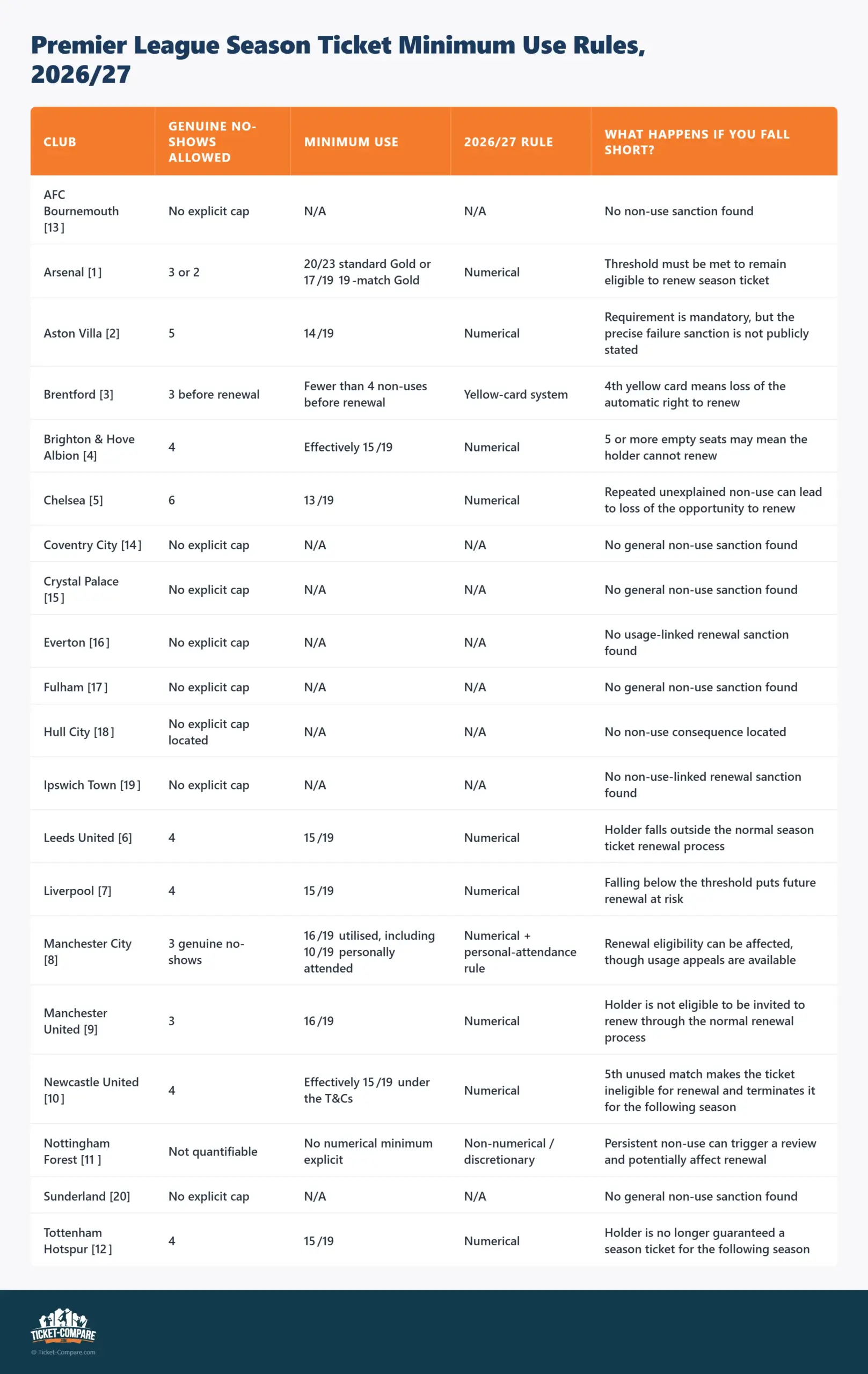
It may come as no surprise to see all of the Big Six featured in the table above, as well a handful of traditionally well-supported clubs, including Aston Villa, Leeds United and Newcastle United.
Per our findings, Arsenal are the strictest with a maximum of two or three no-shows permitted depending on the ticket tier.[1]
The Gunners are followed by the Manchester clubs with three, while Brentford’s warning system permits three “yellow cards” before a fan loses the automatic right to renew. Then Brighton, Leeds, Liverpool, Newcastle and Spurs come in with four.[3][4][6–10][12]
Of these Clubs, Chelsea Gives the Largest Fixed Allowance
According to Chelsea’s 2026/27 ticketing policy, 13 of 19 Premier League matches must be utilised, so six genuine no-shows are theoretically possible. This makes them the most lenient of the clubs that use a fixed numerical threshold for holders to follow.[5]
On top of that, Chelsea's language around the consequence establishes some leeway. It doesn’t appear to be a case of missing seven matches and automatically losing a seat. Instead, the club says that a supporter who continually leaves their seat unused without explanation may lose the opportunity to renew.[5]
At Eight Clubs there Is No Published Minimum Usage Requirement
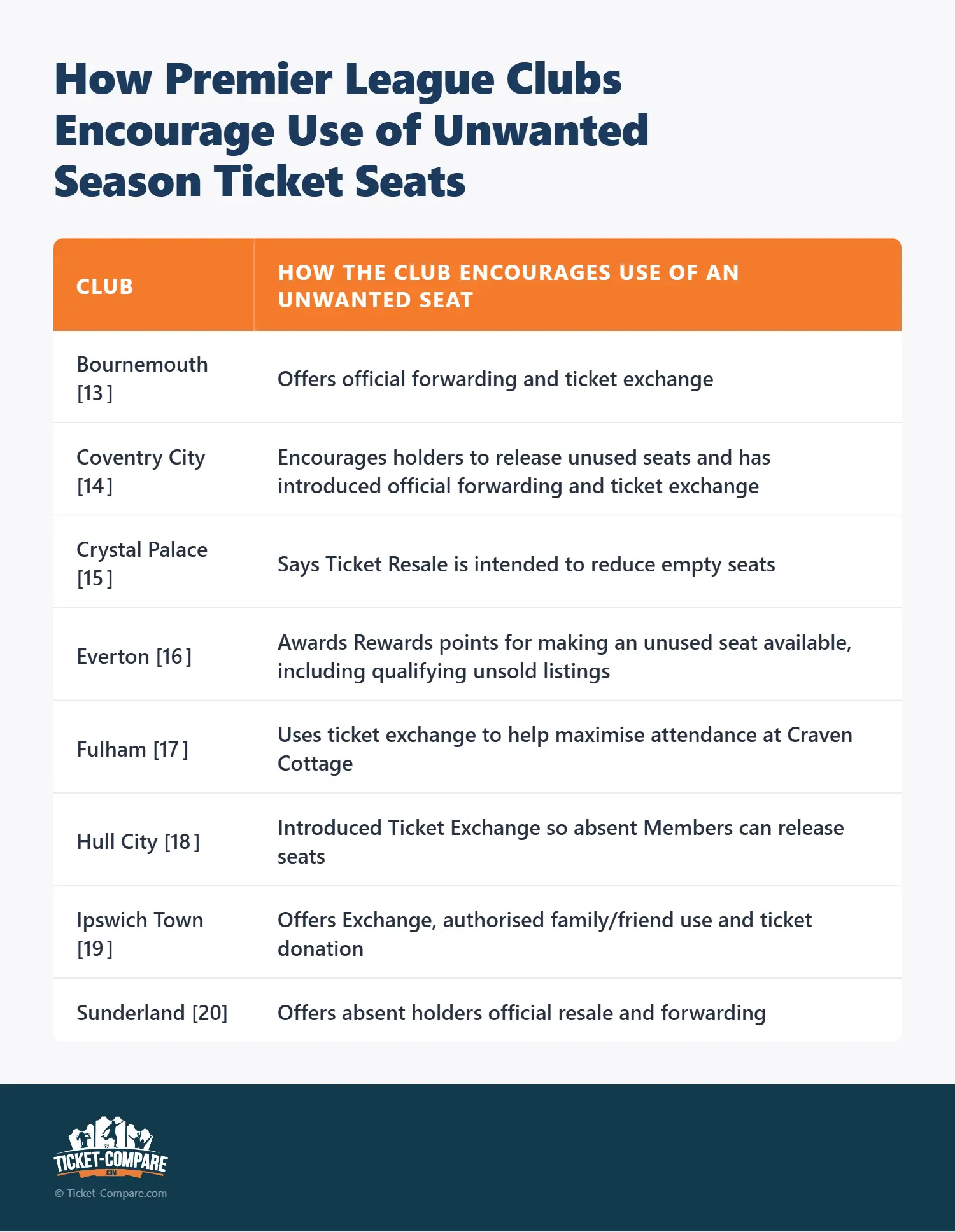
As for the remaining teams with no explicit rule, they tend to encourage or incentivise use of the seat rather than attach a published renewal penalty to no-shows.[13–20]
Some promote resale or forwarding as a way of maximising attendance, while Everton even rewards season ticket holders for making an unused seat available.[16]
We found no indication that ordinary repeated no-shows at these eight clubs currently put a season ticket holder’s renewal at risk. This isn’t to say that there wouldn’t be consequences for repeatedly leaving a seat empty, more that no rules are officially codified.
You Usually Don't Have to Attend Yourself
Now, a season ticket usage rule does not usually mean that the holder has to attend every match included in the ticket in person.
At most Premier League clubs with usage policies, the important thing is that the seat is either used or made available via the club’s own sharing facilities.[1–12]
Depending on the club, forwarding the season ticket to somebody else or relisting it on the club’s ticket exchange can count towards the holder's requirement.
Manchester City are the major exception, and they require standard Gold, Platinum and 93:20 holders to utilise their ticket for at least 16 Premier League home matches. But—and this is the crux—at least 10 of those must involve the season ticket holder attending personally.[8]
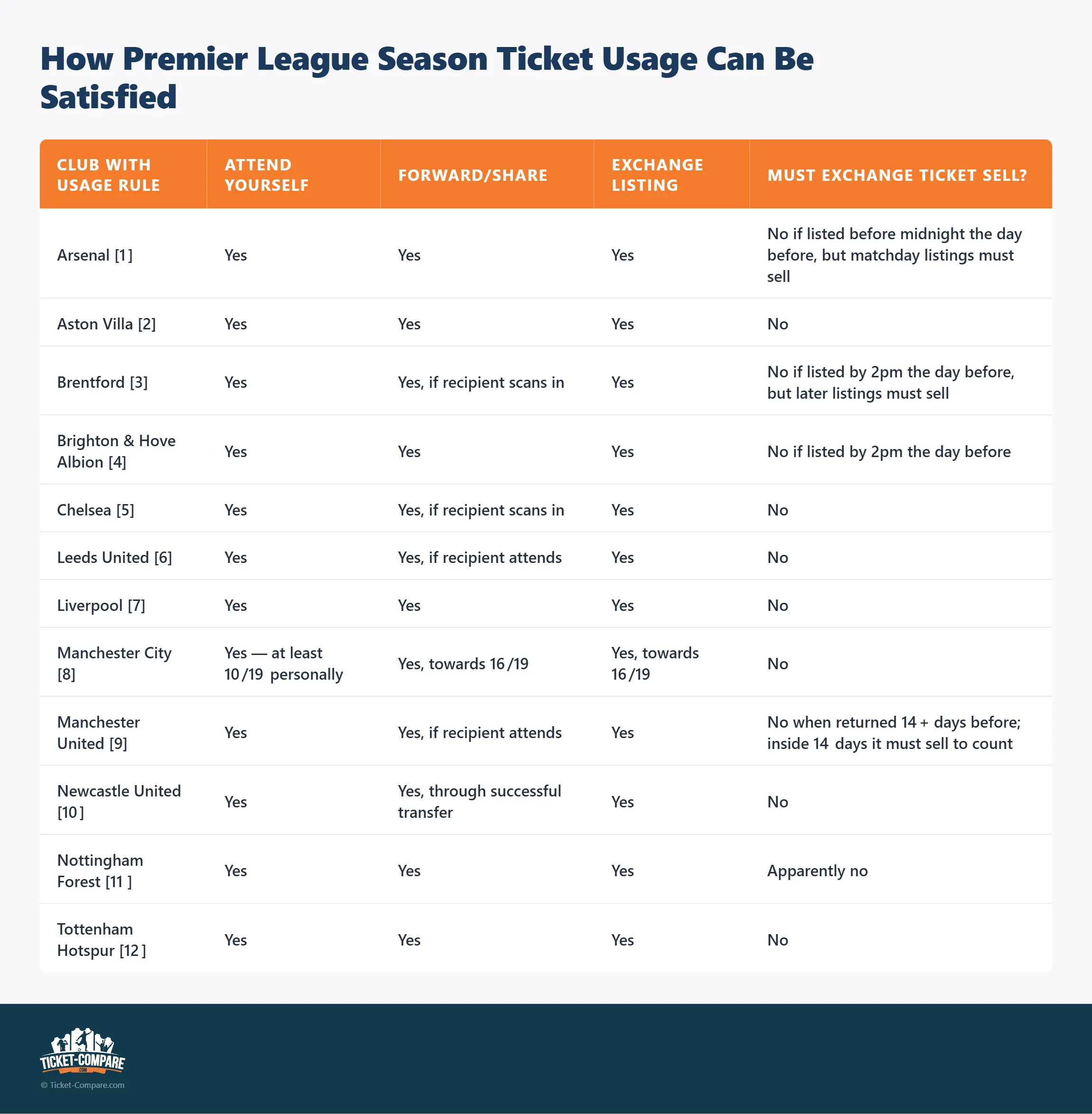
The difference between relisting a ticket and actually selling it is also crucial here.
At Aston Villa, Chelsea, Leeds, Liverpool, Manchester City, Newcastle and Tottenham, the holder can maintain their usage record by making the seat available on the ticket exchange, even if another supporter never actually buys it.[2][5–8][10][12]
Nottingham Forest's non-numerical policy also recognises making the seat available through the club's official facilities as a way of avoiding unexplained non-use.[11]
Listing early can make a big difference, even if the exchange stays open
Arsenal, Brentford and Brighton apply an additional timing condition.[1][3][4]
At Arsenal, an Exchange listing made before midnight on the day before the match counts as usage, whether or not it sells, while a listing on the day of the match only counts if it is sold.[1]
In a similar vein, Brentford’s policy protects a holder who lists by 2pm on the day before, while a later listing has to sell to count. Brighton requires the seat to be listed by 2pm on the day before for it to count unequivocally towards its usage rule.[3][4]
Manchester United requires a season ticket to be used through attendance, forwarding, resale or donation for at least 16 of 19 Premier League matches.[9] An unsold resale listing made sufficiently early can count towards usage, but within the final 14 days before a fixture an unsuccessful resale does not automatically protect the holder's usage record.[9]
Again, Manchester City's rules are different. Forwarding, ticket exchange and donation can all help a holder reach the 16-match usage requirement, but they cannot replace personal attendance altogether. The holder must still attend at least 10 Premier League home matches themselves.[8]
Newcastle United also try to steer a holder towards in-person attendance, as more than 10 resale requests or more than 10 ticket transfers in a given season can trigger an account review.[10]
High Season Ticket Demand and Usage Rules Often Go Together
Perhaps it’s no coincidence that the clubs with the most stringent usage rules also tend to have high demand for season tickets, combined with either a long season ticket waiting list or a high qualification threshold based on previous match attendance.[21]
The figures below are drawn from Ticket-Compare.com's separate 2026/27 league-wide season ticket waiting-list research.[21]
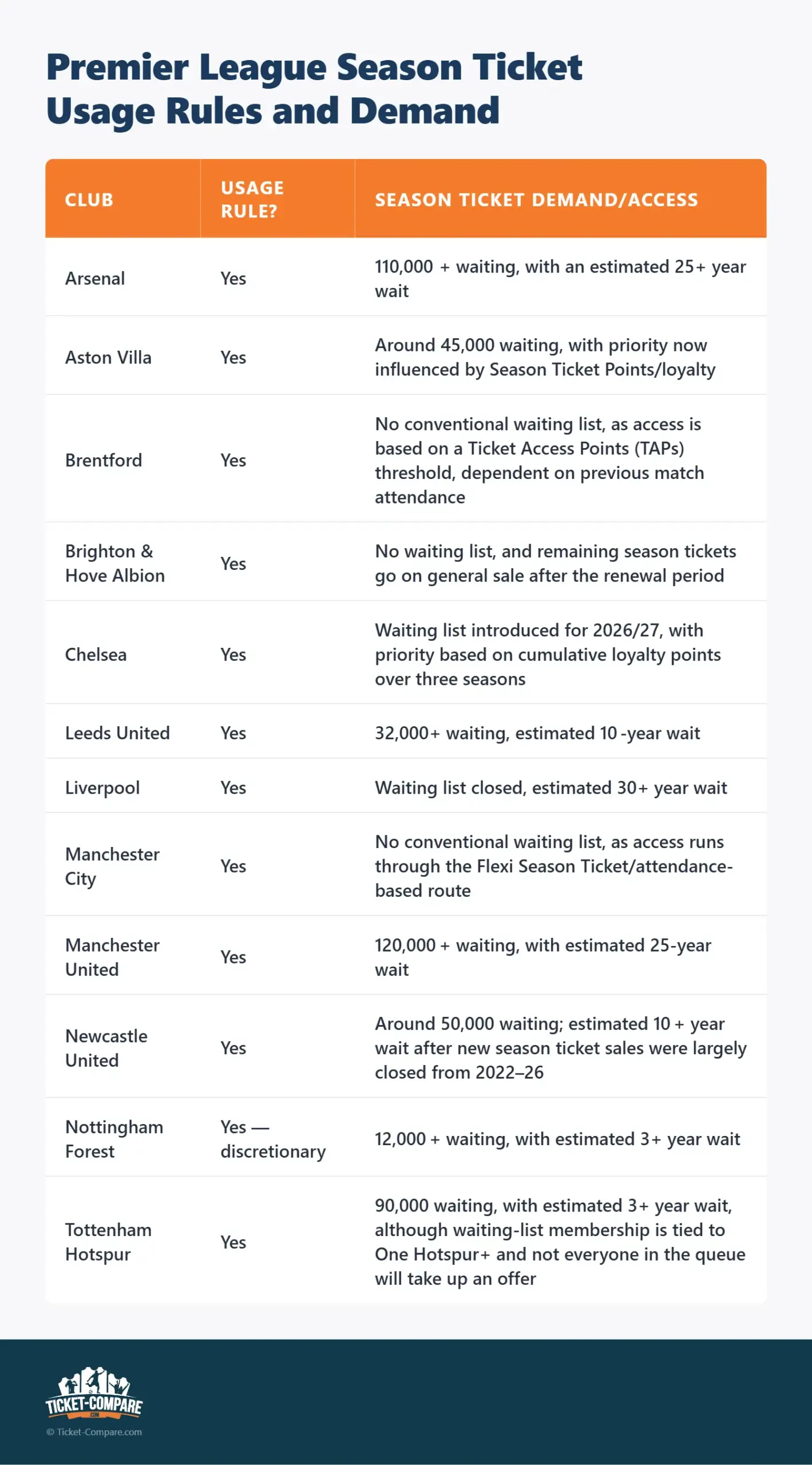
Brighton & Hove Albion stands out as a notable exception, as season tickets have remained comparatively accessible in recent seasons.[21]
Season Ticket Holders Are Being Asked to Use It or Share It
Failing to adhere to clubs’ increasingly stringent season ticket usage rules can have real consequences. It may begin with the club reaching out to a fan to tell them that their seat has gone unused too often.
At Brentford, this has already gone beyond warnings. The club confirmed that a small number of holders who accumulated four or more yellow cards were not invited to renew automatically, with 99.8% of season ticket and premium-seat holders receiving renewal invitations and the remaining affected supporters instead being given memberships.[22]
Leeds have also confirmed real enforcement. In 2025, the club identified a small number of season ticket holders who could no longer mathematically reach its then 80% usage requirement and said that they would not be invited to renew.[23]
This comes at a time when a preference for more lucrative match-to-match tickets appears to be putting pressure on season ticket holders.[24]
In 2026, Chelsea’s language has also become stricter. The club says it will monitor usage, contact holders whose seats repeatedly go unused and offer advice. Supporters who continually leave their seat unused without explanation may lose the opportunity to renew.[5]
Sources and Methodology
Sources
Where possible, we used clubs' own 2026/27 season ticket terms and conditions, ticketing policies and supporter guidance. Where a policy predates 2026/27, it was only carried forward when the club had explicitly confirmed that the policy remains in force.
[1] Arsenal: Arsenal — Seat Utilisation guidance. This confirms the 20/23 and 17/19 requirements, renewal consequence and the different treatment of early and matchday Ticket Exchange listings.
[2] Aston Villa: Aston Villa — 2026/27 Season Tickets. Villa states that holders must use their ticket for 14 of 19 league games and can satisfy the rule by Attend, Share or Exchange; an Exchange listing counts whether it sells or not.
[3] Brentford: Brentford — 2026/27 Season Ticket Benefits and Brentford — Every Seat Counts mid-season policy update. These confirm that Every Seat Counts remains relevant to current holders, the yellow-card system, the recipient-scan requirement and the 2pm day-before Exchange deadline.
[4] Brighton & Hove Albion: Brighton — Season Ticket utilisation changes. Brighton introduced the 75% usage rule from 2025/26 onwards, explicitly stating that a holder cannot leave the seat empty for five or more times and setting the 2pm day-before Exchange deadline.
[5] Chelsea: Chelsea — 2026/27 ticketing policy updates. This sets the 13/19 requirement, defines attendance, forwarding and Exchange listing as utilisation, confirms that an Exchange ticket does not need to sell and explains the potential renewal consequence.
[6] Leeds United: Leeds — 2026/27 Season Ticket renewal process. Leeds states that 15 or more home league games satisfy its usage requirement and confirms that personal attendance, forwarding and putting the seat on Ticket Exchange all count.
[7] Liverpool: Liverpool — Every Seat, Every Game policy. Liverpool requires usage at 15 Premier League home matches and explicitly says that an unsold Ticket Exchange listing still counts as a used seat.
[8] Manchester City: Manchester City — 2026/27 Men's Season Ticket Terms and Conditions. City's terms require Gold, Platinum and 93:20 holders to use the ticket for at least 16 league matches and personally attend at least 10.
[9] Manchester United: Manchester United — 2026/27 Old Trafford ticketing update and Manchester United Fans' Forum — October 2025 minutes. United confirms a 16/19 usage requirement. The Fans' Forum material explains the treatment of resale listings made inside the final 14 days before a match.
[10] Newcastle United: Newcastle United — 2026/27 Season Ticket Terms and Conditions. These terms state that five unused matches make the ticket ineligible for renewal and define attendance, transfer and a resale request as usage. They also impose account-review triggers above 10 resale requests or 10 transfers.
[11] Nottingham Forest: Nottingham Forest — Ticketing terms and policies. The classification also draws on Forest's 31 July 2026 Every Supporter Counts club announcement, reviewed during this research. The body of that announcement is not currently exposed reliably through search indexing, so Forest is deliberately treated more cautiously than the clubs with a numerical policy: no numerical threshold is inferred.
[12] Tottenham Hotspur: Tottenham — 2026/27 Membership and Ticketing Terms. Spurs requires the seat to be utilised for at least 15 of 19 league matches to guarantee the following season's ticket and expressly counts personal use, Ticket Share and Ticket Exchange listing.
For the eight clubs where we found no published minimum-use requirement, we checked current club terms and/or official ticket-management information rather than treating the mere existence of resale or forwarding as evidence of a usage rule:
[13] AFC Bournemouth: AFC Bournemouth — 2026/27 Matchday Hub. Current guidance gives season ticket holders forwarding and Ticket Exchange options but does not publish a minimum-use threshold or renewal sanction for ordinary non-use.
[14] Coventry City: Coventry City — Ticketing Update: More Flexibility for 2026/27. Coventry provides official ways to forward or release an unwanted seat, but no general home season ticket usage quota was identified.
[15] Crystal Palace: Crystal Palace — Ticket Resale. Palace explicitly says resale is intended to reduce empty seats at Selhurst Park, but does not attach a published minimum-use requirement to renewal.
[16] Everton: Everton — Forever Blue Rewards FAQs. Everton gives Rewards points when a holder makes an unused seat available on the resale platform, even if it does not sell, but this is a rewards mechanism rather than a renewal requirement.
[17] Fulham: Fulham — Ticket Exchange. Fulham says the Exchange is intended to increase ticket availability and help keep Craven Cottage at maximum possible capacity, without publishing a season ticket utilisation quota.
[18] Hull City: Hull City — Your Guide to Ticket Exchange. Hull introduced its Ticket Exchange for 2026/27 so Members unable to attend can release their place. No general numerical or discretionary renewal rule for ordinary non-use was located.
[19] Ipswich Town: Ipswich Town — 2026/27 Season Ticket Terms and Conditions. Ipswich's terms recognise authorised ticket-management routes but do not publish a minimum home-season ticket usage threshold.
[20] Sunderland: Sunderland — 2026/27 Season Ticket Terms and Conditions and Sunderland — Ticket Resale guidance. Sunderland provides resale and forwarding routes when holders cannot attend but does not publish a minimum-use renewal rule.
The demand comparison and enforcement examples use the following additional sources:
[21] Ticket-Compare.com: Premier League Season Ticket Waiting Lists in 2026/27. This separate league-wide study supplies the waiting-list sizes, estimated waits and alternative access systems used in the demand section.
[22] Brentford: Every Seat Still Counts — renewal enforcement. Brentford confirmed that a small number of supporters with four or more yellow cards were not invited to renew automatically.
[23] Leeds United: Leeds — Season Ticket usage reminder. The club stated that a small number of holders who could no longer reach its usage threshold would not be invited to renew.
[24] Ticket-Compare.com: Why Your Season Ticket May Be in Danger. This previous Ticket-Compare study provides wider context on changes in the proportion and commercial role of Premier League season tickets.
Methodology
This is a 2026/27 audit of general admission men's first-team season tickets, last checked on 25 September 2026.
For research we used clubs' current terms and conditions, ticketing policies, renewal information and official supporter guidance. Where a current policy carried over from an earlier season, we only used it where there was evidence that it remained in force.
We classified a club as having a season ticket usage rule only where repeated non-use could itself lead to a consequence such as review, loss of renewal rights or exclusion from the normal renewal process.
The existence of Ticket Exchange or ticket forwarding alone was not enough. This is why clubs that encourage supporters to release unused seats, but do not attach a published renewal penalty to no-shows, are listed as having no explicit usage requirement. Nottingham Forest is treated separately because its policy allows persistent non-use to trigger review without setting a numerical threshold.
For the purposes of our main comparison, a genuine no-show means that the holder does not attend and does not take another action recognised by the club as usage, such as forwarding the ticket, listing it on Ticket Exchange or using another approved scheme.
Where clubs publish a numerical requirement, the no-show allowance was calculated from that threshold. Club-specific rules were preserved rather than forced into a single formula, including Arsenal's different season ticket products, Brentford's yellow-card system and Manchester City's separate personal-attendance requirement.
We prioritised primary club sources wherever possible. Ticket-Compare.com's separate season ticket waiting-list research was used for the demand comparison, while reported examples of enforcement were only included where clubs themselves had confirmed that usage records affected renewal. Ticketing policies can change during a season, so later club announcements may supersede individual details.


