

 English










Worst Place to Sit at Craven Cottage
Written by Aviran Zazon
If seeing the football clearly is your priority, the worst places to sit at Craven Cottage are seats directly aligned behind the roof-support pillars in the Johnny Haynes Stand and Putney End.
The Johnny Haynes Stand is the biggest overall risk because its Lower Tier contains eight separate pillar positions. Yet the most extreme individual views we found are arguably in the Putney End, where three much wider columns can dominate a sightline from the wrong seat.
When buying Craven Cottage tickets there is no entire Craven Cottage stand, block or even rear row that should simply be written off.
In some cases, moving only a few seats sideways turns a seriously obstructed view into a perfectly good one. The safest rule here is row plus seat number, rather than block plus row.
Filter by Location
Fulham vs Crystal Palace
EFL Cup - Carabao Cup・Craven CottageLondon, United Kingdomfrom $431,645 available ticketsFulham vs Coventry
Premier League・Craven CottageLondon, United Kingdomfrom $643,768 available ticketsFulham vs Ipswich
Premier League・Craven CottageLondon, United Kingdomfrom $505,042 available ticketsFulham vs Everton FC
Premier League・Craven CottageLondon, United Kingdomfrom $635,532 available tickets
What Is the Worst Place to Sit at Craven Cottage?
If we rank seats according to how much of the actual football can disappear from view, this is the hierarchy for Craven Cottage.
| Seat or area | Main problem | How serious is it? |
|---|---|---|
| Johnny Haynes Lower seats directly behind the eight CC/DD pillar lines | Repeated roof supports can obscure substantial parts of the pitch | Worst overall area for frequency |
| Putney P3 low 40s and P4 high 80s/low 90s behind row II | Two further wide roof supports | Potentially severe but highly localised |
| Hammersmith high 90s/low 100s around H4/H5 | Two supports at different depths | Real issue in a narrow corridor |
| Very low Johnny Haynes or Putney seats | Shallow perspective rather than structural obstruction | Mostly preference |
| Johnny Haynes Upper seats aligned with pillars | Columns can still interfere from the higher angle | Seat-specific |
| Johnny Haynes Upper seats in uppermost rows | The roof is remarkably low and can interfere with sightlines. | Uppermost rows O to R are the worst affected |
The important theme here is localisation. No doubt, Craven Cottage has plenty of pillars, with 13 affecting sightlines across the stadium, but it does not have whole blocks of uniformly terrible seats.
Johnny Haynes Stand: The Most Widespread Pillar Problem
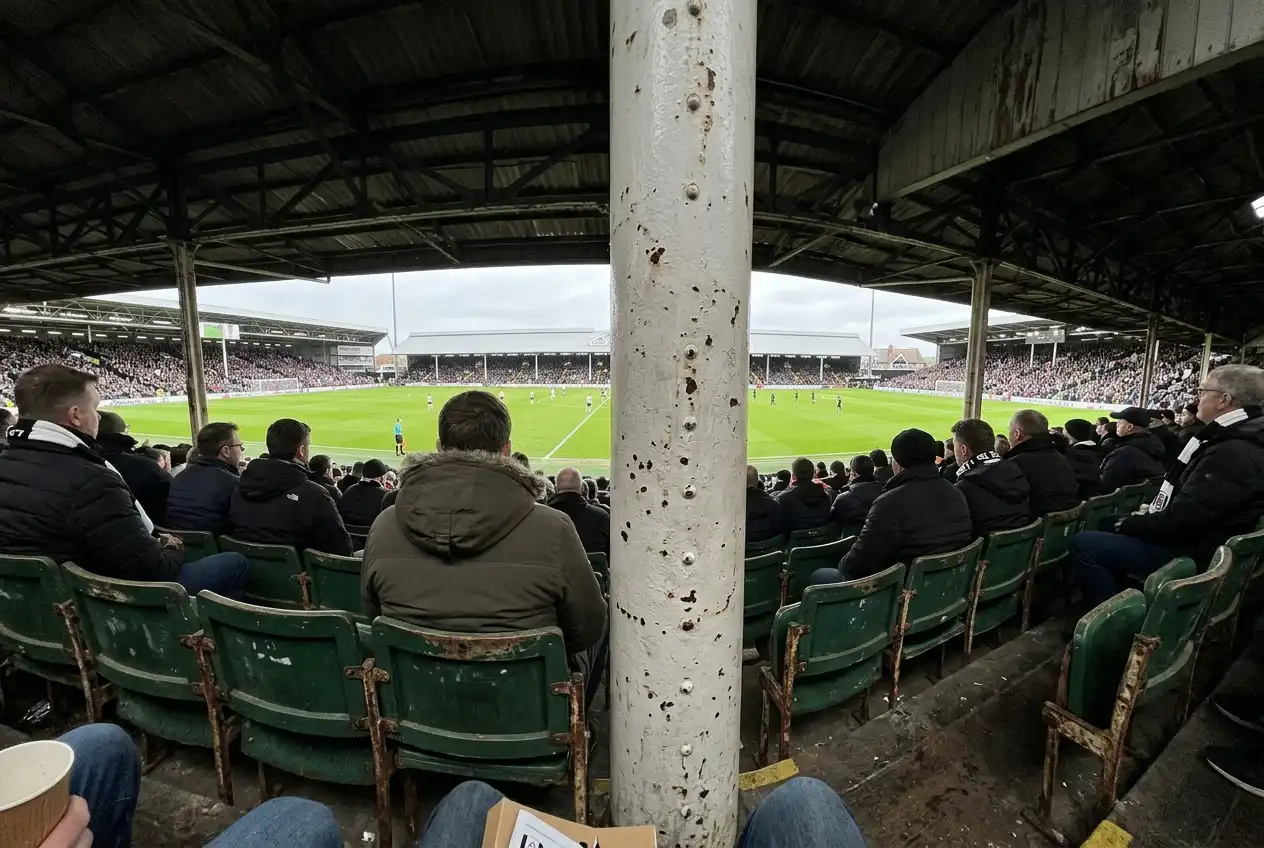
The Johnny Haynes Stand, the oldest stand at Craven Cottage, comes up most if somebody asks which part of Craven Cottage has the greatest overall risk of an obstructed view.
Dating back to 1905, it’s an architectural treasure and serves as the ground’s main facade along Stevenage Road.
But the joy of sitting in such a well-preserved stand comes with some sightline issues, qualifying it as a problem stand in our summary of the worst places to sit at a football stadium.
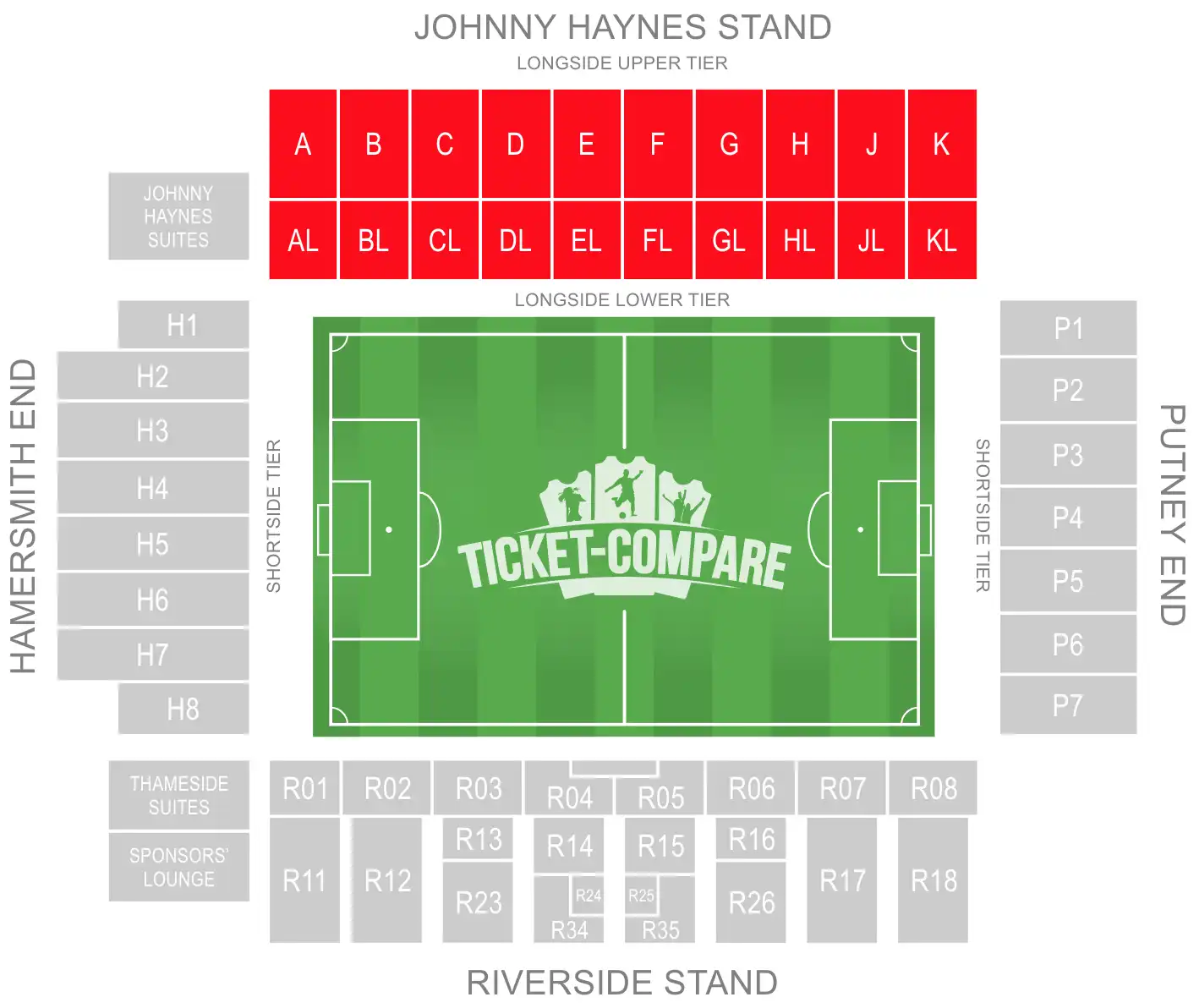
Our inspection of Fulham's seating map identifies eight materially relevant roof supports, with their bases running across rows CC/DD in the Lower Tier:
| Block | Pillar position |
|---|---|
| AL | Seats 16–17 |
| BL | 33–34 |
| DL | 57–58 |
| EL | 82 |
| FL | 105–106 |
| GL | 130–131 |
| JL | 154–155 |
| KL | 172–173 |
That produces eight narrow obstruction corridors running backwards through the stand rather than one bad horizontal band.
Seats through row BB sit in front of the main pillar line, so these are the simplest Lower Tier choice for somebody determined to remove the eight supports from the equation.
Behind CC/DD, exact seat position starts to matter much more.
Supporter evidence illustrates why. FL Row CC Seat 104 sits immediately beside the mapped support at 105–106 without the pillar interfering with the pitch view, while GL Row DD Seat 129, alongside the 130–131 support, has similarly been reported as next to a pillar yet unrestricted.
So, sitting beside a pillar is not the same thing as having it directly between your eyes and the football.
The risk becomes greatest when your seat lines up behind one of the eight supports. Move several places sideways and the column may shrink to an irritation at the edge of your view; move farther again and it can cease to matter.
Blocks CL and HL are interesting because neither contains one of the eight pillar bases. Seats close to their boundaries can still look diagonally across a neighbouring support, so we would not promise that every rear CL or HL seat is pillar-free.
The middle of those blocks should nevertheless be among the safer choices farther back in the Lower Tier.
Putney End: Where the Worst Individual Views Can Be Found
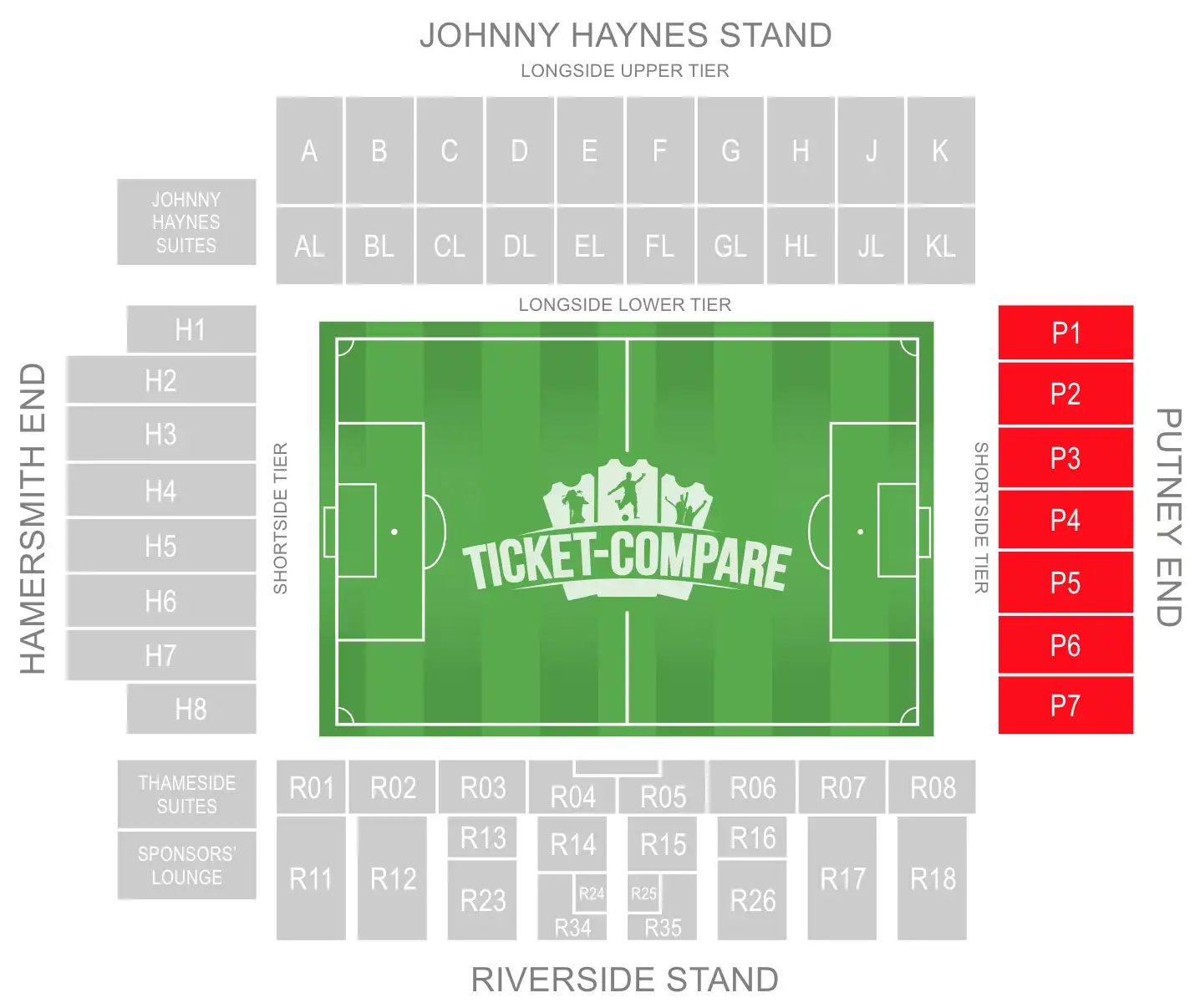
The Putney End has only three main roof supports, all positioned on row II, yet their width makes the worst seats here particularly unpleasant.
The three principal danger areas are:
- P2: seats in the 20s.
- P3: seats in the low 40s.
- P4: seats in the high 80s and low 90s.
- P6/P7: the 130s around P6, spreading towards the 140s farther across.
Any seat ahead of row II has the pillar behind the spectator rather than between the spectator and the pitch. Once you move behind the support line, the combination of row and seat number becomes crucial.
The P6 pillar provides a particularly useful demonstration.
A supporter in P6, Row HH, Seat 134 specifically notes that the roof post is in row II behind the seat. The view is unobstructed by that pillar.
Move backwards to P6, Row MM, Seat 134, however, and the same seat number receives a one-star review with the wide support dominating the view. MM Seat 139 is also rated one star and described as having a restricted view of the goal.
That is about as good a before-and-after demonstration as we could ask for: Seat 134 in front of the pillar can be excellent; Seat 134 behind it can be among the worst places to sit at Craven Cottage.
The first few rows immediately behind these wide Putney supports deserve the greatest caution because the pillar fills more of the spectator's field of vision at close range.
Moving farther backwards does not automatically make the view good, although the precise angle increasingly depends on how far sideways the seat lies from the pillar.
Hammersmith End: A Much More Localised Problem
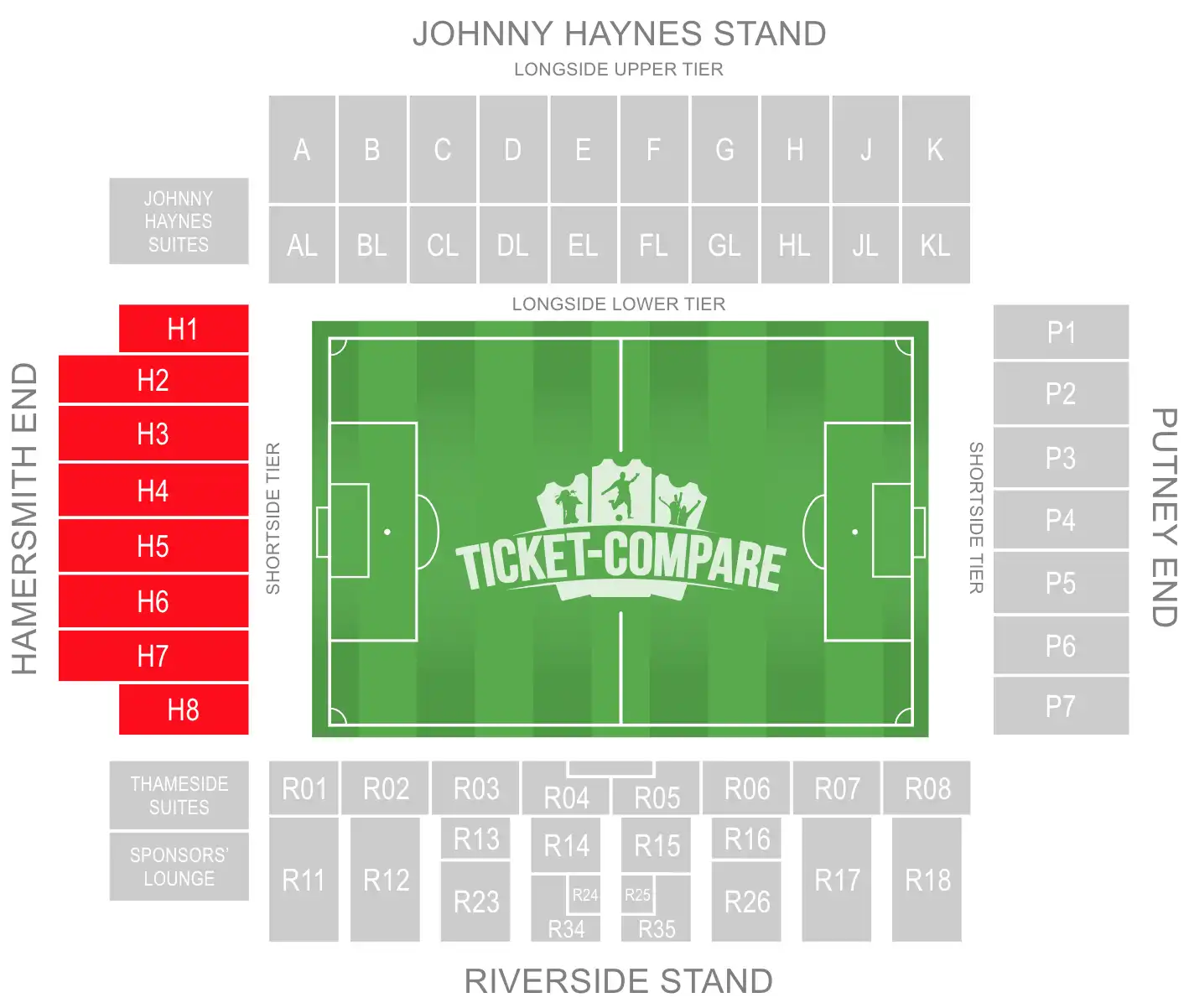
The Hammersmith End also has pillars, although there is much less reason to be wary of the stand as a whole.
Both supports are central, concentrated around the H4/H5 boundary, roughly in the high-90s and low-100s seat-number corridor. Unlike Putney, they do not share a common row: one stands at around row J, with another substantially farther back around row CC.
The row-J support has the potential to affect more people because every aligned spectator behind it can encounter the column in their sightline. The CC support creates a shorter second corridor affecting seats still farther back.
That can make some central rear seats surprisingly awkward, while large areas only a short distance away remain completely unaffected.
So there is no case for describing H4 or H5 as bad blocks. The warning applies to particular seat numbers directly behind two structures, not to the Hammersmith End generally.
Why a Pillar Does Not Always Mean Restricted View
Fulham's own definition of Restricted View is unusually important when assessing Craven Cottage.
A ticket is formally classified as Restricted View when a permanent fixture or fitting obscures the view of either goalmouth.
Fulham separately acknowledges that other seats can have part of the pitch obscured by a roof-supporting pole or railing without receiving a discount if both goalmouths remain visible.
In practical terms, that means an ordinary full-price seat can still have a pillar intruding into your view.
It also explains why two nearby seats can receive different classifications even when both spectators can clearly see the same column. The important question under Fulham's policy is where the column falls across the pitch from that precise viewing angle.
Restricted views remain part of current ticketing rather than a historical curiosity. Wolves were allocated 2,641 tickets for their November 2025 visit, including 294 restricted-view seats, with those tickets discounted by $3. West Ham's March 2026 allocation likewise included separately priced restricted-view tickets at $3 below the corresponding standard tariff.
That does not mean every one of those tickets was affected by one of the Putney pillars mapped above. It does confirm that Fulham continues to classify and sell a substantial number of obstructed seats.
What About Low Rows and the Johnny Haynes Upper?
Once the genuinely obstructed seats are removed, most of Craven Cottage's other supposed bad positions become matters of preference.
Very low seats bring you remarkably close to the players, although the flatter angle can make it harder to judge spacing and follow play at the opposite end.
Recent seat reviews illustrate both sides of that trade-off: some spectators praise being almost at playing level, while others find the perspective too low to follow passages of play properly.
The Johnny Haynes Upper presents another compromise. The elevation improves the overall picture of the match, while the historic wooden seating is narrower than many modern stadium seats and the roof supports can still enter the viewing angle.
The supplied supporter discussion captures that trade-off rather neatly:
That thread represents individual supporter preferences rather than a definitive ranking. Several contributors favour the Upper Tier for its better overview of the pitch, while describing the Lower Tier as particularly enjoyable for its proximity to the action. Pillars, weather exposure and the narrow wooden seats all enter the calculation.
There is also evidence of pillar interference upstairs. A January 2026 report from Upper Block K, Row M, Seat 27 describes the far end as compromised by a support. Lower Tier seat-number rules should not simply be transferred upstairs, however, because the viewing angle and seating layout are different.
Johnny Haynes Upper: The Roof Can Cut Out High Balls
There is another sightline issue right at the top of the Johnny Haynes Stand, particularly across rows O to R.
From these uppermost rows, the pitch itself remains visible, subject to the usual pillar positions. The problem is higher up: the front edge of the roof enters the top of your field of vision, cutting off part of the sky above the pitch.
For most of the match that makes little difference. When the ball is played high, though, it can briefly disappear behind the roof before dropping back into view. Goal kicks, long clearances and lofted passes are the most obvious examples.
That makes rows O to R a different proposition from a genuinely restricted-view seat. You can still see the playing surface and follow the match, but you may temporarily lose sight of high balls while they are in the air.
Supporters who want an uninterrupted view of the full flight of the ball may therefore prefer to sit a little farther forward.
How We Judged the Worst Seats at Craven Cottage
Our ranking gives greatest weight to how much actual football becomes impossible to see.
There are three useful levels:
- Structural obstruction: A pillar or permanent fitting hides a meaningful part of the playing area or a goal.
- Partial interference: A pillar enters the pitch view, although the seat may not qualify as Restricted View under Fulham's definition.
- Viewing preference: The whole pitch is essentially visible, but the position is very low, behind a goal, exposed to weather or less comfortable.
Only the first two provide a strong basis for calling a seat objectively problematic.
That is why an aligned Johnny Haynes or Putney pillar seat ranks well above a perfectly clear front-row position that somebody happens not to enjoy.
How to Avoid a Poor Seat at Craven Cottage
The most useful thing you can do at Craven Cottage is check out the exact row and seat, rather than rejecting an entire block or stand.
For the Johnny Haynes Lower, BB and forward removes the eight main Lower Tier roof supports from the sightline. Farther back, compare your seat number with the mapped pillar positions.
In Putney, staying ahead of row II achieves the same thing. Behind it, exercise particular care around the low 40s in P3, high 80s/low 90s in P4 and 130–140 corridor around P6/P7. Hammersmith requires much less general caution, except around the high-90s and low-100s near H4/H5.
You can also use the Craven Cottage seating plan alongside our guide to the best place to sit at Craven Cottage when weighing up different areas.
When official availability becomes limited, Craven Cottage tickets can also be compared through Ticket-Compare.com. Ticket-Compare.com is a comparison platform rather than a ticket seller: it brings listings from pre-vetted resale sites and official ticketing partners into one place, allowing supporters to compare available locations and prices before clicking through to the respective provider.
At Craven Cottage, checking the precise location is particularly worthwhile because two seats separated by only a small distance can produce dramatically different views of exactly the same match.
Worst Place to Sit at Craven Cottage | Frequently Asked Questions
Are there restricted-view seats at Craven Cottage?
Yes. Fulham officially classifies a seat as Restricted View when a permanent fixture or fitting obscures either goalmouth. Other seats may still have part of the pitch blocked by a pillar or railing without receiving that classification or a discount.
Which stand at Craven Cottage has the most pillars?
The Johnny Haynes Stand has the most widespread problem. There are eight materially relevant Lower Tier supports across rows CC/DD, creating eight separate obstruction corridors.
Putney has only three principal supports, although their greater width can make the worst individual seats there more severely compromised.
What rows should I choose in the Johnny Haynes Stand to avoid pillars?
In the Lower Tier, row BB and everything in front of it sits ahead of the main CC/DD pillar line.
Behind that point, seat number becomes increasingly important because the eight roof supports create narrow corridors running backwards rather than making an entire rear row equally obstructed.
Where are the worst seats in the Putney End?
The strongest warning is around P6 and P7, particularly seats in the 130s and into the 140s behind the row-II support.
P6 Row MM Seats 134 and 139 have both received one-star reports, while Seat 134 farther forward in HH sits ahead of the pillar and has a clear view.
Do away fans get restricted-view seats at Craven Cottage?
Yes. Visiting allocations in the Putney End still contain restricted-view tickets. Wolves received 294 restricted-view tickets within a 2,641 allocation in November 2025, while West Ham's March 2026 allocation also included discounted restricted-view seats. The precise number can vary by fixture and allocation.
Can I check my Craven Cottage seat view before buying?
Yes. Fulham currently links to a Digital Seating Map intended to show the view from individual seats around Craven Cottage. That is especially useful here because the effect of a pillar can change substantially over only a few seat numbers or rows.
So, Where Is the Worst Place to Sit at Craven Cottage?
For the best general answer, look to seats directly behind the eight CC/DD pillar lines in the Johnny Haynes Lower. No other part of Craven Cottage presents structural supports at that frequency.
For the worst individual sightline, however, we would be even more wary of the wide Putney End support around P6/P7.
The evidence around P6 Seat 134 is particularly revealing: ahead of the row-II pillar it can offer a good view, while the same seat number several rows behind it becomes one of the poorest documented positions in the ground.
The Hammersmith End comes a clear third. The two supports in that stand around H4/H5 deserve your attention, but they occupy such a narrow area that there is no reason to treat the whole stand as much of a problem, view-wise.
The broader lesson is what makes Craven Cottage unusual. Do not ask whether a block is good or bad. Work out where your exact seat sits in relation to the pillar.
A few places sideways can be the difference between spending 90 minutes craning around a piece of steel and hardly noticing that the same support is there at all.
As you read this there are 81,987 Fulham tickets currently on sale, starting from $28. One fixture in high demand on Ticket-Compare.com is Fulham vs Hull City at $69.
Related Articles:
Best Place to Sit at Craven Cottage


