

 English












Blind-Sided: 5 Worst Football Stadium Seats Revealed
Written by Martin Black
The worst place to sit at a football stadium is not necessarily the back row, the front row or even a seat officially labelled as restricted view.
In practice, it’s the one you want the least, whether that means a pillar in the way, being hundreds of feet above the action or finding yourself in a section where everybody’s standing and you need to sit.
There is also a more surprising problem that we have come across. A ticketing department's definition of a restricted view does not always match what a supporter would naturally consider an obstructed view.
Some clubs heavily discount certain restricted seats, while elsewhere a severe sightline restriction will shave only a couple of pounds from the price.
So, rather than attempting to identify one universally terrible plastic seat, we have looked at the different ways the worst seats in a Premier League football stadium can go wrong.
We have also ranked five of the most prominent examples in Premier League grounds, updated for 2026/27.
Find Your Ideal Seat
Ipswich vs Nottingham Forest
Premier League・Portman Road StadiumIpswich, United KingdomAston Villa vs Manchester City
Premier League・Villa ParkBirmingham, United KingdomArsenal vs Everton FC
Premier League・Emirates StadiumLondon, United KingdomCoventry vs Fulham
Premier League・Coventry Building Society ArenaCoventry, United Kingdom
5 Worst Football Stadium Seats Revealed
Our ranking concentrates on current Premier League seating where fixed infrastructure can prevent you from seeing a meaningful part of the match.
The exact seat still matters enormously in every case. As a rule, it makes more sense to identify the problematic stand and block first, before narrowing the problem down to particular rows and individual seats.
1. Selhurst Park: The Rear of the Arthur Wait Stand
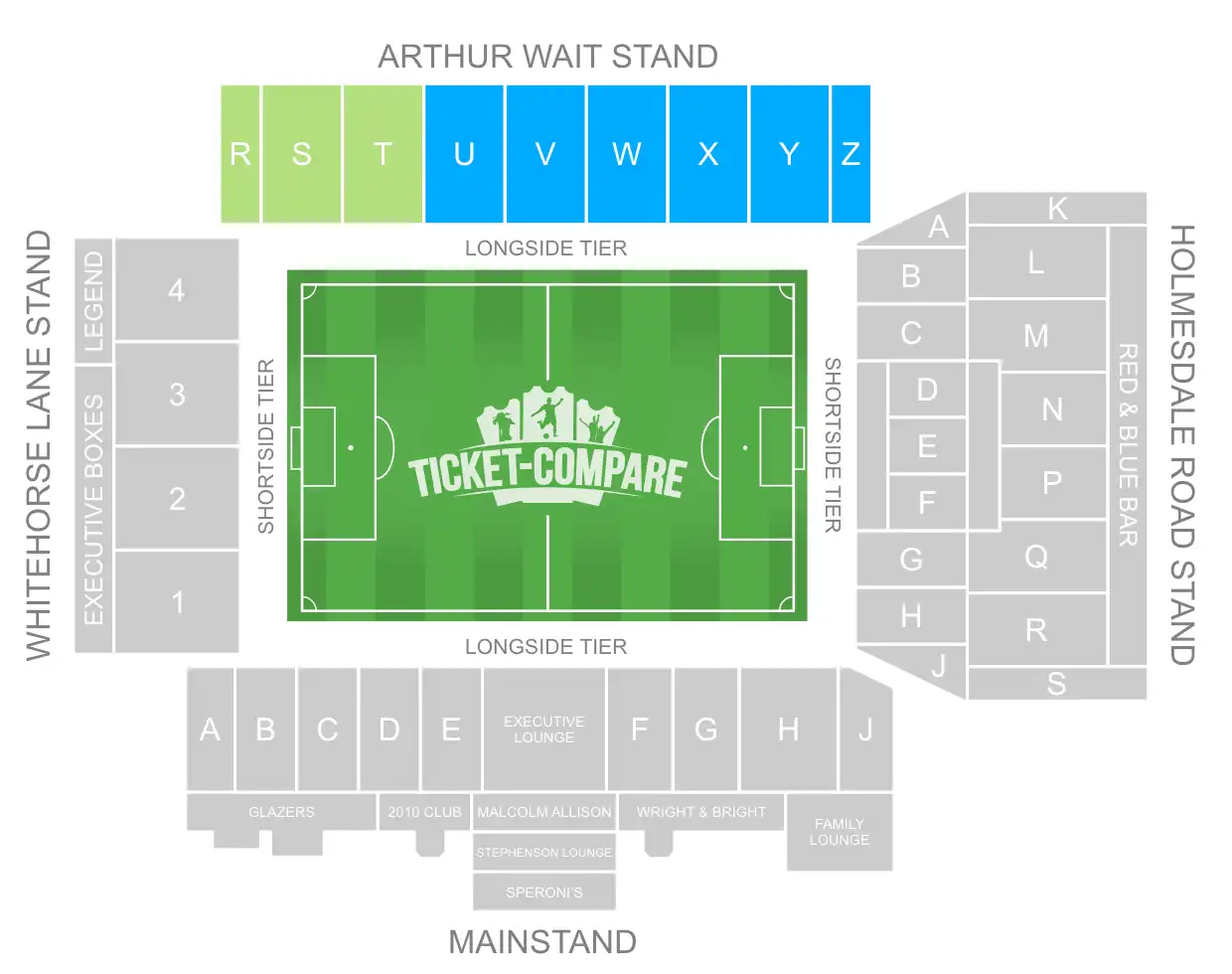
The biggest culprit is towards the rear of the Arthur Wait Stand, particularly T and S, with similar risks extending across the other rear Arthur Wait blocks.
From roughly the low 40s backwards, the low roof and television gantry can begin to close the view down, while an unfortunately aligned support pillar can remove another section of the pitch.
Block T shows how severe that combination can become. One documented position in Row 48 had roughly half the pitch obscured by the gantry; another only two seats away combined the overhead obstruction with a pillar towards one goal.
The significance is the area, rather than those two seat numbers. The rear of Block T is a high-risk zone in which several pieces of old stadium infrastructure can affect the same sightline.
Current ticketing evidence reinforces the point. Recent visiting allocations have contained hundreds of officially restricted-view seats, with both the gantry and supporting pillars identified as causes.
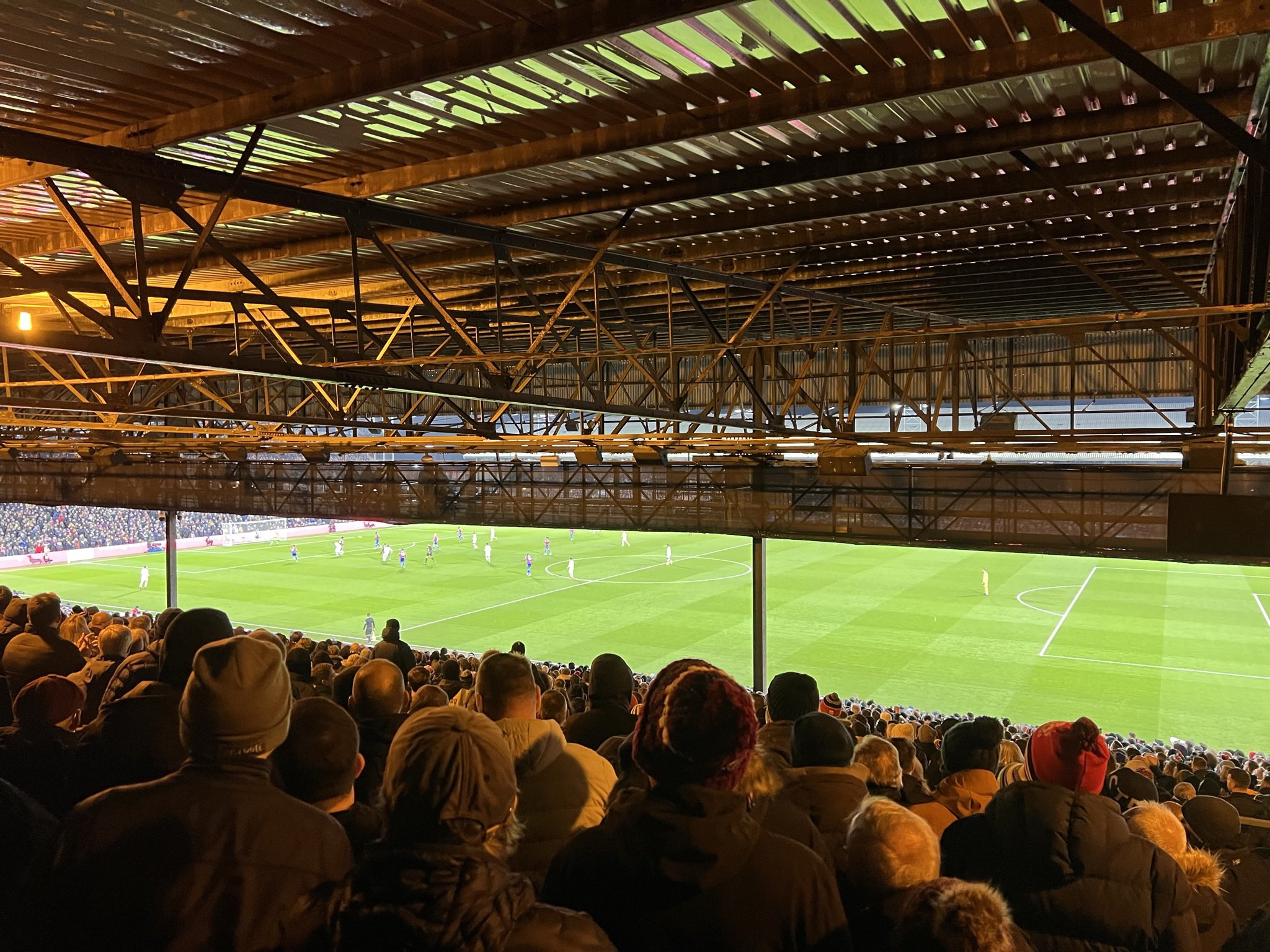
This is how the view appears in the existing X post from @CF3Loyal, who said that he had ticked off the worst seat inside Selhurst Park.
Source: X user @CF3Loyal
For considerably more detail, see our guide to the worst place to sit at Selhurst Park.
2. Portman Road: Rear Cobbold Upper
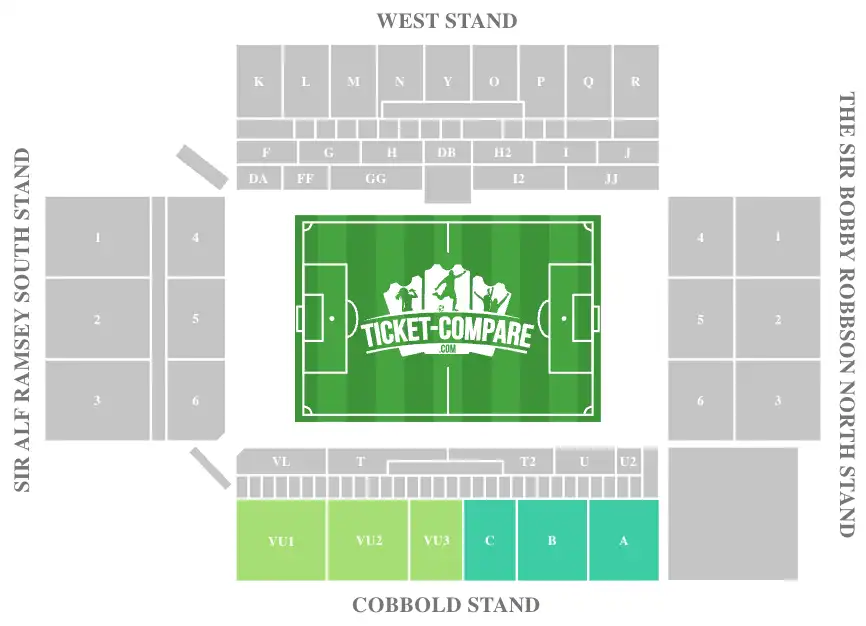
At Portman Road, the main danger zone is the rear of the Cobbold Upper, particularly Rows U to X across Blocks A, B and C and VU1 to VU3.
The low roof and older supporting structure increasingly enter the sightline as you move backwards, and some tickets are formally sold as severely restricted.
In one documented rear position, a supporter reported seeing only around half of the pitch. Again, the value of that example is that it illustrates what the architecture can do in the final rows rather than establishing one uniquely bad seat.
Portman Road also has another widespread old-ground problem in the West Stand, where roof-support columns affect groups of seats across the back six rows.
Our full guide to the worst place to sit at Portman Road explains both areas in more detail.
3. Elland Road: North Stand Upper and the Old West Stand
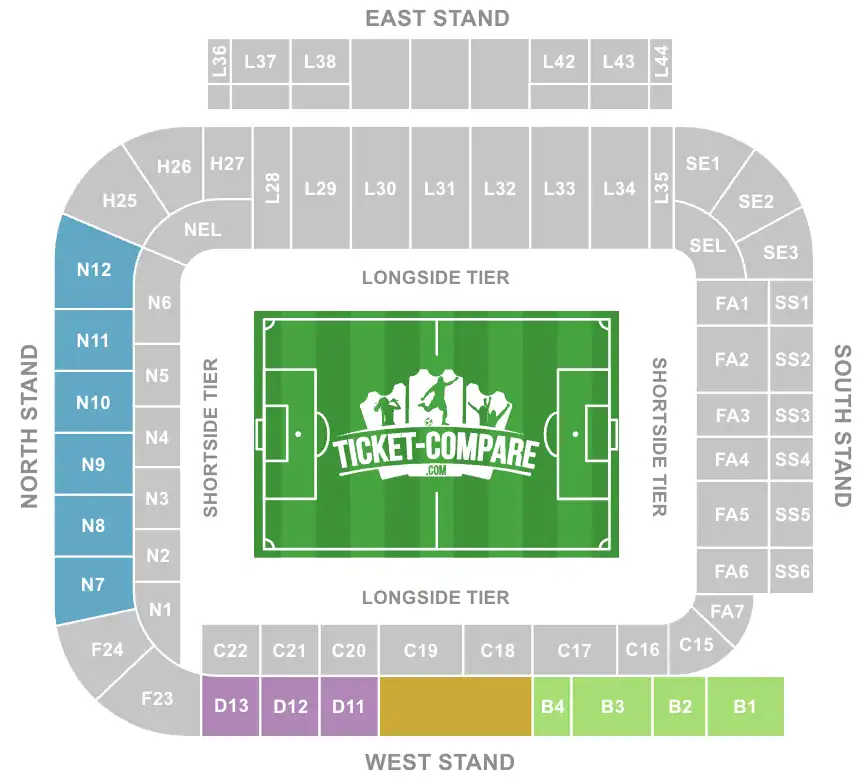
Elland Road earns its position because the problem is neither one pillar nor one iffy seat. In the North Stand Upper, particularly Blocks N7 to N12, bulky roof-support columns begin to create problems from around Row R backwards.
When a seat lines up badly with one of these supports, a goalmouth or a substantial section of the playing surface can disappear. Examples in N7 show seats requiring supporters to lean around the column to follow play, while the same basic problem appears farther along the tier in N10.
The old West Stand adds another concentration of pillar-affected seating, including within the away allocation. That remains relevant during 2026/27 because the existing seating continues to be used while redevelopment takes place around it.
See our complete guide to the worst place to sit at Elland Road for the affected blocks and rows.
4. Stamford Bridge: Rear Matthew Harding Lower
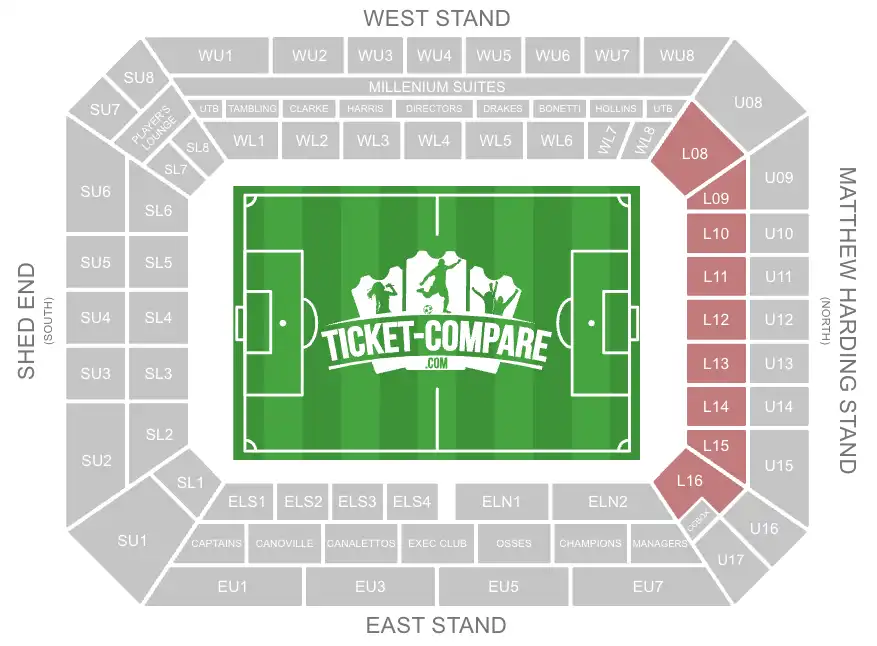
The back of the Matthew Harding Lower, underneath the upper tier, is Stamford Bridge's main danger zone for obstructed views.
From around Row DD backwards, supporters sit increasingly deep beneath the Matthew Harding Upper. The resulting overhang can cut into the view towards the opposite end, obscure corners and make high balls disappear from sight.
Standing can make matters worse because raising your eye level brings the underside of the tier farther into the field of vision.
Unlike many isolated bad-seat examples, Chelsea itself continues to recognise restricted-view inventory in this part of the ground.
A supporter discussion about the rear rows gives a useful first-hand sense of the issue:
Rows to avoid in Matthew Harding lower ?
by u/Ryan598 in chelseafc
That thread represents supporter experience rather than a seating classification, but its description of the rear of the tier fits the broader architectural evidence and Chelsea's continued sale of restricted-view Matthew Harding Lower tickets.
Our dedicated guide to the worst place to sit at Stamford Bridge also covers the much more localised East Upper, MHL 16 and barrier-related restrictions.
5. City Ground: The Peter Taylor Stand
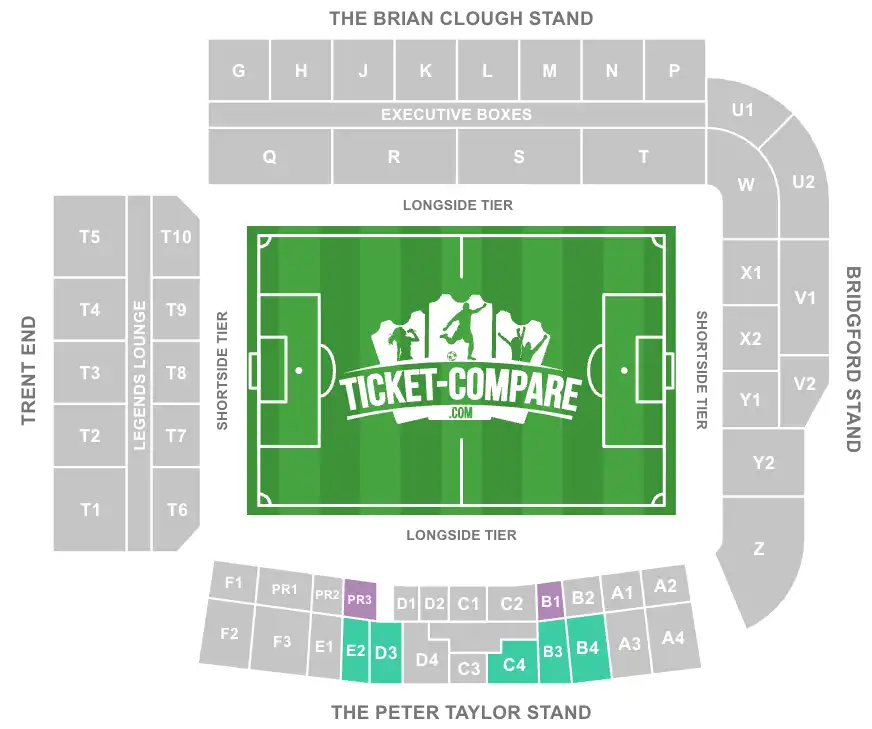
At the City Ground, the worst physical problems are concentrated in the Peter Taylor Stand.
Two large roof-support columns come down around Blocks RR3 and B1, with their sightlines spreading into seats farther back in areas including E2, D3, C4, B3 and B4.
A supporter directly behind one of these columns may need to move their head repeatedly to follow the football, while somebody only a few seats away can have a much cleaner view.
The front of the same stand produces a completely different problem. Its parapet wall, combined with cameras, stewards and other matchday personnel, can interfere with the lowest sightlines.
RR1, Row 1, Seat 176 is a particularly striking documented example, but the useful warning is broader: the very front and pillar-aligned positions in the Peter Taylor deserve checking carefully.
The current structure remains in use despite approved redevelopment plans, so the advice is still relevant for 2026/27.
See our full guide to the worst place to sit at the City Ground for the stand-by-stand analysis.
Notable Mentions
Three other Premier League grounds from our research contain seats that deserve serious caution, but their problems are either more localised or less objectively bad across a wider area.
Old Trafford: The North-West Corner
Old Trafford has some extremely poor individual sightlines, but they are less widespread than the five areas above.
The main danger zone is high in the north-west corner of the Sir Alex Ferguson Stand, especially NW3427 and NW3429.
Above roughly Row 35, the adjoining stand structure can increasingly cut across the view towards the Stretford End. In NW3429, Row 41, Seat 140 around one sixth of the pitch has been reported as hidden.
The separate Old Trafford worst seats guide also identifies pitchside camera interference around the very lowest Bobby Charlton Stand rows.
Vitality Stadium: Central Ted MacDougall Stand
For home supporters, the main structural obstructions at Vitality Stadium are in the central Ted MacDougall South Stand, particularly Blocks 27 and 28.
Two columns supporting the roof can cut directly across the pitch from unfortunately aligned seats.
Naturally, good seats can still be found in those same blocks, making this a localised column problem rather than a reason to avoid the centre of the stand altogether.
The away section adds officially restricted and severely restricted seats, with Bournemouth defining the latter strongly enough to cover a situation where most of the pitch is badly obscured.
See the full Vitality Stadium worst-seats guide for more depth.
St James' Park: The Back of Level 7
St James' Park illustrates why we have not simply ranked the highest seats as the worst, as much of Level 7 gives an uninterrupted bird's-eye view despite being extraordinarily distant.
The more serious warning is Rows X and Y at the back of Level 7 in the Milburn and Leazes stands. These rows have their own heavily reduced season-ticket category, and our research indicates interference from the roof and concrete structure.
Other isolated Level 7 positions can be affected by the front parapet wall or step railings.
It misses the top five because the broader Level 7 complaint is generally about height and distance rather than physically losing the football. These difficulties are explored in the full St James' Park worst-seats guide.
What Makes a Football Seat Bad?
If you’re looking at the official word, then FIFA stadium guidance about the best place to sit at a football stadium generally favours side stand seats around the halfway line, particularly between the two penalty areas.
Elevation helps you understand how a game is panning out, while excessive distance, awkward angles and physical obstructions will of course compromise the experience.
From there, bad football seats broadly fall into three categories.
| Type of bad seat | What goes wrong | Typical examples |
|---|---|---|
| Optically bad | Something physically blocks your sightline | Pillars, railings, roofs, gantries, cameras, parapet walls, adjoining stands |
| Geometrically bad | The pitch is visible, but from an awkward distance, height or angle | Very high upper tiers, low seats behind goals, extreme corners |
| Socially bad | The view is fine, but the section does not suit how you want to watch | Safe-standing areas for someone wanting to sit; family sections for groups seeking a louder atmosphere |
A perfectly unobstructed seat can still be somebody's worst seat in the stadium. For the ranking above, though, we give the greatest weight to actual loss of the football view.
A pillar hiding a goal or a gantry removing half of the pitch is inherently more problematic than sitting very high or at an angle that another supporter might actively prefer.
How Much Cheaper Are Restricted-View Tickets?
A restricted-view label should at least tell the buyer that something is wrong. What it does not tell you is how serious the obstruction will be or how heavily the ticket will be discounted.
The differences are striking.
| Ground/ticket | Standard adult | Restricted adult | Reduction |
|---|---|---|---|
| Vitality Stadium – Restricted away view | $40 | $39 | 3.3% |
| Vitality Stadium – Severely restricted away view | $40 | $37 | 6.7% |
| Selhurst Park – Restricted away view | $40 | $37 | 6.7% |
| Elland Road – Recent restricted away view | $40 | $37 | 6.7% |
| Portman Road – Severely restricted away view | $39 | $37 | 3.4% |
| Stamford Bridge – Category AA Matthew Harding Lower | $88 | $36 | 59.1% |
Bournemouth goes as far as distinguishing between a restricted view and a severely restricted view, where a majority of the pitch may be severely impaired. Yet in the current example, the difference between the ordinary $40 adult away ticket and the severe-view ticket is only $3.
Selhurst Park and Elland Road have similarly offered $37 restricted-view away tickets against the $40 Premier League away cap.
At Portman Road, one recent severely restricted away category was reduced by only $1.
Chelsea sits at almost the opposite extreme. For a Category AA match, an adult member price of $88 in the Matthew Harding Lower compares with $36 for the restricted-view category — a reduction of just over 59%.
These are not like-for-like products, so the table is not a ranking of how generously clubs compensate supporters.
Instead, it demonstrates something more useful: there is no standard relationship between the phrase restricted view, the severity of the problem and the discount attached to it.
Newcastle provides another revealing example that does not belong neatly in the table. Level 7 Rows X and Y have their own $509 adult season-ticket category, compared with $978 for Category 3 and $1,073 for Category 2.
The club does not formally describe those rows as restricted view, however, so it would be misleading to present the price difference as a conventional restricted-view discount.
When the Crowd Around You Changes the Seat
Sometimes there is nothing wrong with the architecture at all. Safe-standing and singing sections are excellent examples. If you want to stand, chant and spend the match among the most vocal supporters, they may be among the best areas in the ground.
If you expect to sit for 90 minutes, exactly the same ticket can be a terrible choice.
Family sections create the reverse mismatch. They make sense for adults attending with children, while a group specifically looking for sustained standing and singing may prefer somewhere else.
Height can work in much the same way.
Newcastle's Level 7 and the highest reaches of Old Trafford can feel extraordinarily distant from the football, yet the elevation can also provide an excellent tactical overview of the whole pitch.
Very low seats behind a goal reverse the equation again. They bring you exceptionally close to the action, but the net, advertising boards, photographers and shallow viewing angle can make the opposite end much harder to follow.
The worst social or geometric seat, then, is often one bought without understanding what type of matchday experience comes with it.
That is different from the five areas ranked above, where the stadium itself can physically prevent you from seeing part of the match.
How Ticket-Compare.com Can Help You Avoid a Bad Seat
Start with the stadium rather than an individual seat number.
Check the exact stand and block first, then narrow your search to the row and individual seat once you understand the architecture around it.
Pay particular attention to any restricted or severely restricted designation. As the pricing table demonstrates, the size of the discount is a poor guide to how much of the football may disappear.
For away games, read the visiting club's ticket information about where the Premier League away allocation is located too. These pages frequently contain precise warnings about licensed standing, restricted seats and individual rows.
Ticket-Compare.com also provides stadium seating plans and, for many major grounds, view-from-seat and 3D tools that can help establish where a ticket sits before you buy.
If official availability has become limited, Ticket-Compare.com can be used to compare listings from multiple pre-vetted resale sites and official ticketing partners in one place. Ticket-Compare.com is a comparison platform so supporters click through to the respective site to purchase.
As you read this there are thousands of Premier League tickets on sale, with the cheapest going from $35. One upcoming match in high demand right now is Arsenal vs Everton FC at $0.
Frequently Asked Questions | Worst Football Stadium Seats
What is the worst place to sit at a football stadium?
There is no universal answer, but the rear of an older stand beneath a low roof, gantry or supporting columns carries the greatest objective risk.
In our current Premier League research, the rear Arthur Wait Stand at Selhurst Park produces the worst combination of widespread restricted views and severe individual examples.
Are restricted-view football tickets always cheaper?
Usually, although the reduction varies enormously. Current and recent examples range from only $1 or $3 off some away tickets to reductions of more than half for certain restricted-view categories at Stamford Bridge.
The size of the discount therefore does not reliably indicate how serious the obstruction will be.
Are front-row seats good at a football stadium?
They are excellent for proximity but not always for seeing the whole game.
Advertising boards, photographers, cameras, stewards and substitutes become much more prominent from a low sightline, while the shallow angle can make action at the opposite end difficult to interpret.
Is sitting behind the goal bad?
Not inherently. Behind-goal sections frequently combine a powerful atmosphere with an excellent view of nearby goalmouth action.
The compromise is perspective: depth becomes harder to judge and play at the opposite end may feel much more distant.
Are high seats at football stadiums bad?
Not necessarily.
Greater elevation can improve your view of formations and movement across the whole pitch.
The trade-off comes when the distance becomes extreme or stadium infrastructure starts to interfere, as happens in some isolated Level 7 positions at St James' Park.
Can an unrestricted football ticket still have an obstruction?
Yes. Official definitions differ between clubs, and some railings, columns or stadium structures may partially interfere with a sightline without meeting a particular ticketing definition of restricted view.
Checking the actual block, row and seat remains worthwhile even when the ticket does not carry a warning.
So, What Are the Worst Football Stadium Seats?
There is still no single seat that deserves that description in every ground. If we give greatest weight to how much of the actual match can disappear from sight, the rear of the Arthur Wait Stand at Selhurst Park currently makes a very strong case.
The combination of a low roof, television gantry and supporting pillars affects enough seats that restricted views are not merely an isolated curiosity.
The rear Cobbold Upper at Portman Road, the pillar-affected North and West stands at Elland Road, the back of the Matthew Harding Lower at Stamford Bridge and parts of the Peter Taylor Stand at the City Ground complete our five.
The common theme is more useful than any individual seat number.
In each case, a piece of the stadium creates a zone of risk, with the precise obstruction changing as you move backwards or sideways.
That is why the best way to avoid a genuinely poor football seat is to identify the stand and block first, understand what infrastructure sits around it, and only then start worrying about the exact row and seat.
Related Articles:
How to Buy Premier League Tickets Without Membership


