

 English











Worst Place to Sit at Elland Road
Written by Aviran Zazon
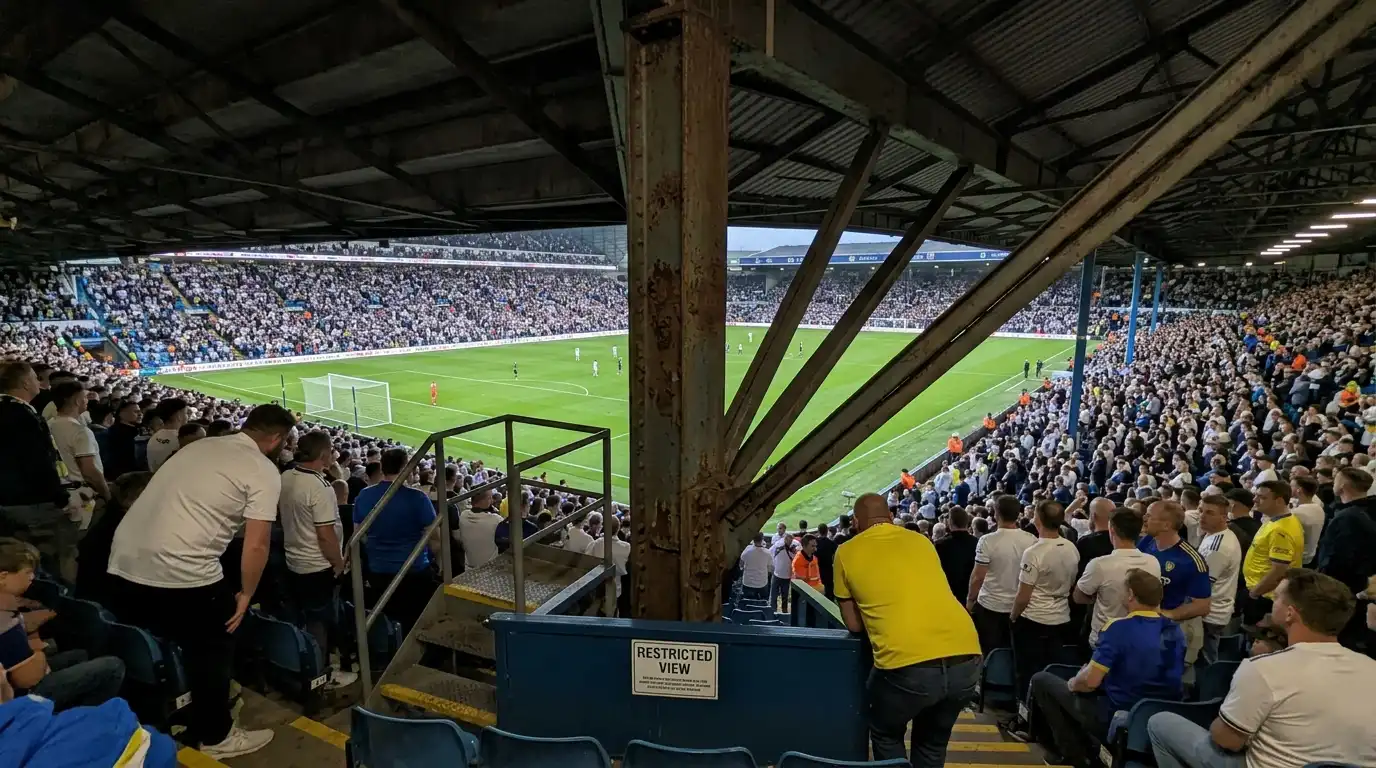
When it comes to views, the worst place to sit at Elland Road is likely to be one of the unlucky seats in the North Stand Upper or West Stand that lines up directly behind a column.
For home supporters, some of the strongest examples are found towards the back of the upper tier of the Don Revie North Stand, from Block N7 to Block N12.
Individual Elland Road tickets here have been sold as restricted or obstructed view, with columns capable of hiding a goalmouth or cutting through the middle of the pitch. Similar problems remain in parts of the old John Charles West Stand.
The East Stand Upper is extremely high and steep, while North Stand Upper has rail seating, and very low seats can make the far end difficult to follow. Those can all influence your choice, yet none is quite as fundamental as having part of the football physically hidden behind a pillar.
Find Your Ideal Seat
Leeds United vs Sunderland
Premier League・Elland RoadLeeds, United Kingdomfrom $230534 available ticketsLeeds United vs Arsenal
Premier League・Elland RoadLeeds, United Kingdomfrom $303678 available ticketsLeeds United vs Liverpool
Premier League・Elland RoadLeeds, United Kingdomfrom $303749 available ticketsLeeds United vs Nottingham Forest
Premier League・Elland RoadLeeds, United Kingdomfrom $172752 available tickets
What Is the Worst Place to Sit at Elland Road?
If we give most weight to how much of the match can actually disappear from view, the main areas to approach carefully are:
| Seat or area | Main problem | How serious is it? |
|---|---|---|
| North Stand Upper, especially pillar-aligned seats in N7 to N12 | Structural columns can hide a goal or substantial area of the pitch | Most obstructed home seats |
| West Stand Upper, including parts of D11, D12, D13, Bremner Suite, and B1, B2, B3 and B4 in the Away section | Old roof-support columns | Major area-specific restrictions |
| North-East and North-West Upper | Isolated structural supports | Potentially substantial, but very isolated and highly seat-specific |
| Low away seats around C15 | Shallow rake and spectators standing in front | Can make play difficult to follow |
| East Stand Upper | Extremely high and steep | Preference and accessibility issue |
| North Stand Upper N7 to N12 | Rail seating and persistent standing | Poor fit if you expect to sit |
| Very low rows around the ends | Weak perspective towards the far end | Mostly personal preference |
The important dividing line is between an objective obstruction and a seat that simply does not suit a particular supporter.
By that measure, the old support columns come first.
North Stand Upper: Elland Road's Biggest Home Sightline Risk
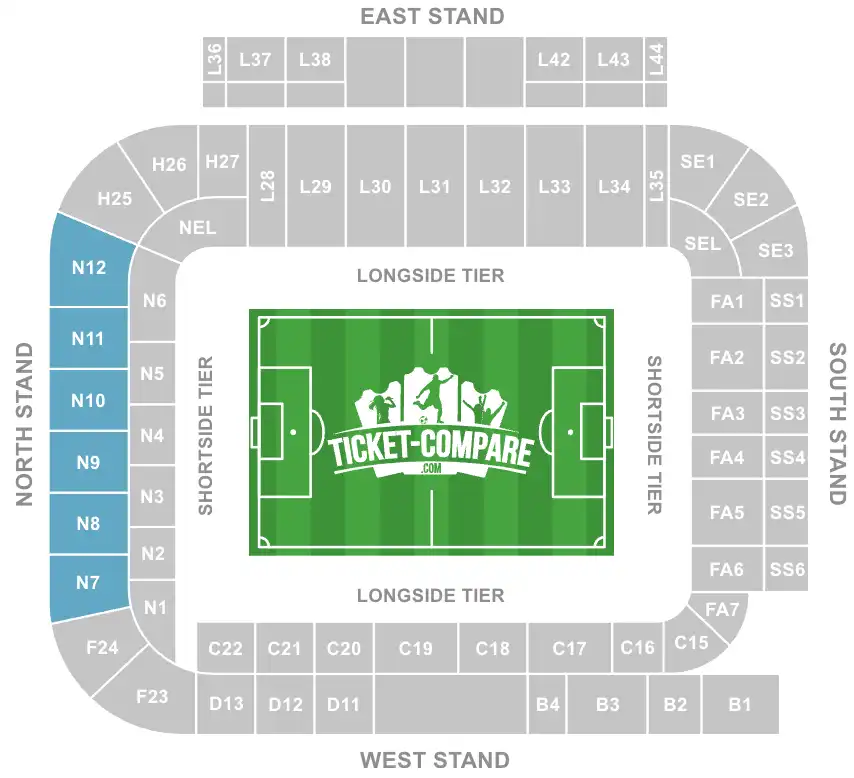
The upper tier of the Don Revie North Stand has some of the most obstructed home seats at Elland Road.
The problem is not the whole stand, and it really comes down to when an individual seat lines up with one of the old roof-support columns, which are especially bulky here.
North Stand Upper: Pillar Obstructions From Row R Backwards
The issue in the North Stand Upper extends across blocks N7 to N12, where the old roof-support columns begin to interfere with sightlines from around Row R.
From that point backwards, any seat that lines up with one of the supports runs the risk of at least a partially obstructed view, with the problem continuing in patches all the way to the rear of the tier.
Now, of course, not every seat from Row R upwards is restricted, but these rows are the main risk zone if an uninterrupted view is your priority.
Some individual examples show how intrusive the columns can become. In N7 Row U, Seat 12 loses part of the goal and wing, while Seat 14 was reportedly sold at a restricted-view discount and required the supporter to move from side to side to follow action around the goalmouth.
N7 Row V Seat 17 was sold as obstructed view, with one set of goalposts disappearing behind the support. The same pattern appears farther along the stand in N10 Row W Seat 121, where the spectator reported having to sway repeatedly to see around a column cutting through the central area of the pitch.
The issue of restricted views in the North Stand has also been also raised by supporters during consultation over the Elland Road redevelopment, so it’s an ongoing topic.
Rail seating adds a separate consideration
There is another reason to think carefully before buying in North Stand Upper. Leeds United currently confirms that rail seating is available in the upper tier, while also describing the North and South Stands as the ground's busiest and most vocal areas.
The club does not recommend these areas for young children or family groups and notes the tendency for supporters to stand throughout matches.
The combination can still make a big difference. Moving your head around a pillar becomes harder when the people immediately around you are also standing, while the area is unlikely to suit anybody expecting a quiet match or needing to remain seated for most of the game.
West Stand Upper: Pillar Obstructions From Row F Backwards
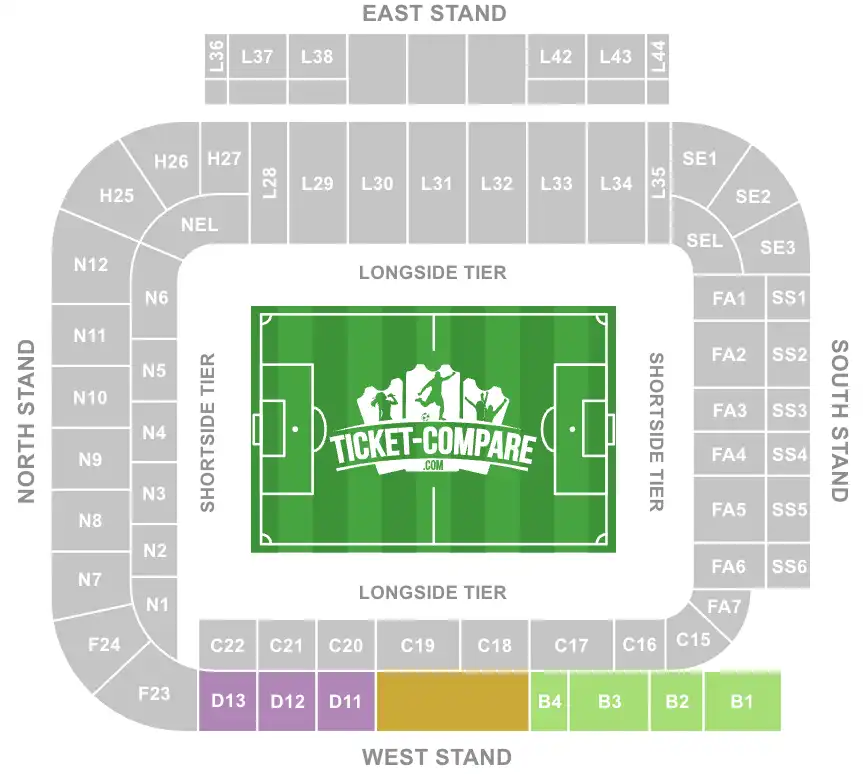
The John Charles West Stand has the same fundamental weakness as the North Stand, with eight roof-support columns positioned across the old seating area.
These affect rows L and up, in patches across blocks D13 to D11 and the Bremner Suite seats, as well as blocks B1 to B4 in the away section.
To illustrate, the first rows sit far enough forward to escape them, but from around Row F backwards, any seat that lines up with a column runs the risk of at least a partially obstructed view.
The problem continues in spots through to the rear of the upper section around Row T, although the severity depends heavily on the precise seat rather than the row alone.
D12 has some of the most affected seats. A supporter in Row M Seat 222 reported a substantial pillar cutting into the view, while observations from the same area suggest Seats 212–230 can be affected farther back through the block.
This remains relevant during 2026/27 because the existing West Stand seating is still being used while the replacement structure is constructed around and above it.
The redevelopment may eventually remove this particular Elland Road problem, but the old pillars are still part of the matchday view for now.
Away Section: Some Seats Are Officially Restricted
The southern end of the same West Stand houses visiting supporters, so away fans in the Premier League can encounter exactly the same structural problem.
The evidence here is particularly clear because visiting clubs have sold Elland Road tickets as clear view, restricted view and severely restricted view, with previous guidance identifying pillars and nearby big screens as the causes.
That does not make the whole away end poor. Plenty of seats have unobstructed views, including well-reviewed positions around C15 to C17.
The important point is that the allocation contains some of Elland Road's most compromised individual seats, so an away supporter whose ticket is marked restricted or severely restricted should expect a genuine physical obstruction rather than simply a distant or awkward angle.
Pillar Risks in the North-East and North-West Corners
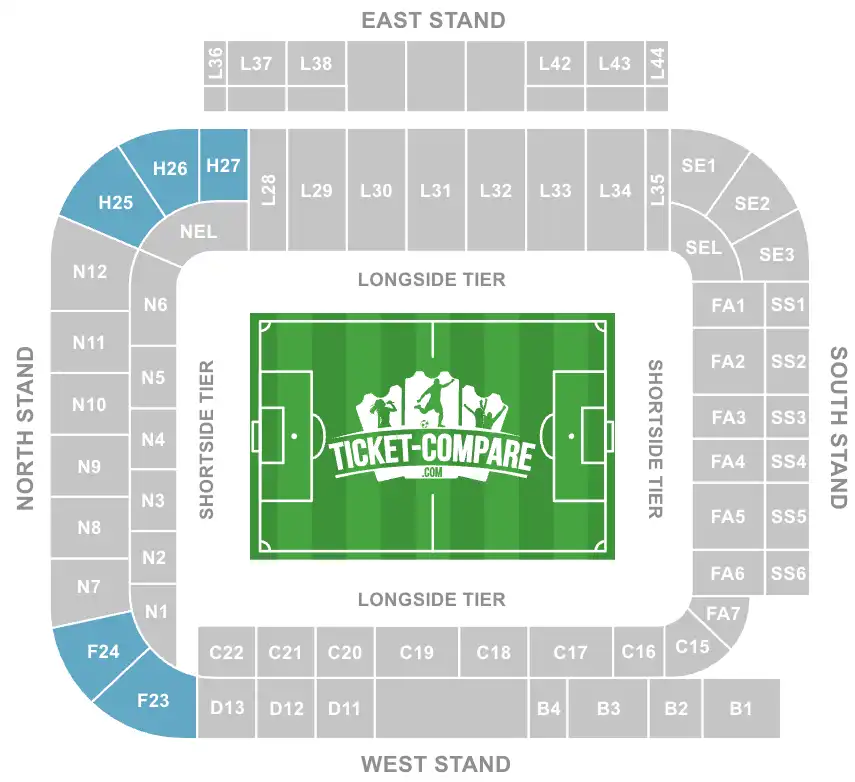
The North-East Upper and North-West Upper also contain isolated examples of genuine structural obstruction.
The pillars here are a little more isolated and slender than in the North Stand and West Stand. Very isolated, there are three in each corner, and they’ll only affect a handful of unlucky punters in H25, H26, H26 (North-East) and F23 and F24 in the North-West.
H25 Row U Seat 3 has been reported as an obstructed-view seat, with a structural support sitting directly in the sightline. A separate April 2026 report from H25 describes two supports interfering with the view.
Move away from the alignment of the supports and the view can change substantially. Similar, generally milder restricted-view reports exist around the opposite corners, including F24.
East Stand Upper: Height Rather Than Obstruction
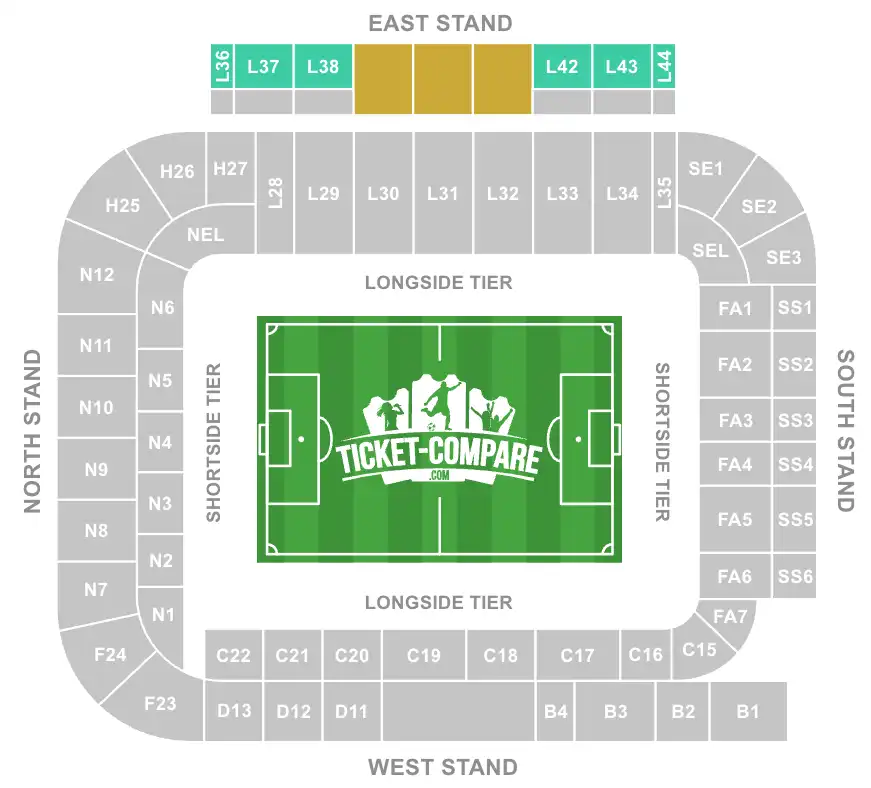
Once the genuine pillar seats are removed from consideration, the East Stand Upper is probably Elland Road's most obvious preference-based warning.
Leeds United itself describes this tier as extremely high, while its accessibility guidance adds that it is very steep. The club advises against it for supporters who suffer from vertigo or have difficulty walking, and children under five are not permitted there.
The actual football view can be very good. Elevation gives you a broad picture of the pitch and there is no equivalent of the old North or West Stand pillar problem across the tier.
The drawback is the experience of getting there and watching from such a height. If you dislike steep upper tiers, want to feel close to individual incidents or have mobility concerns, the East Upper is unlikely to be the right part of Elland Road.
Front Rows: Close to the Pitch, Harder to Read the Game
Elland Road can also demonstrate why being close to the players does not automatically mean getting the best view.
Very low positions around the ends and corners reduce your angle over the pitch. Supporter reports from the North-East Lower describe the far end becoming difficult to see, while older examples from the South Stand Lower show how advertising boards, the goal structure and the low perspective can enter the sightline.
A supporter discussion about restricted views in the South Stand illustrates how dependent the experience can be on the exact seat:
That discussion represents individual supporter experience rather than proof that front-row South Stand seats are universally poor. Other reports suggest some of these restrictions are fairly mild.
The main trade-off is proximity against perspective: nearby action can feel exceptionally close, while attacks towards the opposite end are harder to read.
Cramped Seating and Legroom
Comfort deserves a brief mention because parts of the older Elland Road bowl can feel tight even where the actual view is clear.
Supporters have recently described seats around C21, L30 and C18 as cramped or limited for legroom, while consultation over the redevelopment recorded calls for more space between seats.
For a taller supporter, an older seat in the West or lower areas may be worth checking more carefully than a sightline guide alone would suggest.
What Does the Elland Road Redevelopment Change?
For 2026/27, less than you might initially assume.The West Stand replacement is under construction, yet the old seating structure remains in use.
The North Stand is intended to follow as another major phase, meaning the two areas associated most strongly with column-related restrictions are precisely the sections that will eventually change.
The new design aims to improve seating comfort and sightlines. Planning material for the replacement bowl targets at least a C80 sightline in the upper tier, a measure designed to give spectators a clearer view over the person in front.
One old warning can already be dropped. Leeds installed new dugouts during summer 2026, and a subsequent C18 supporter report described a seat previously classed as obstructed as substantially improved.
So an Elland Road guide relying heavily on old complaints about the previous benches is already out of date.
How We Judged the Worst Seats at Elland Road
The strongest weighting goes to how much football you physically cannot see.
A support column hiding the penalty area or centre of the pitch therefore ranks above distance, atmosphere or comfort. Next come situations where the rake or people standing ahead repeatedly prevent you following play.
Height, steepness, persistent standing, legroom and a low viewing angle matter after that because their importance depends much more heavily on the individual supporter.
That is why a pillar-aligned N7 seat ranks above an unobstructed East Stand Upper seat, even though the latter may be completely unsuitable for somebody uncomfortable with heights.
How to Avoid a Poor Seat at Elland Road
The most useful rule is to check the exact block, row and seat whenever you are buying in an older part of the ground.
A block name alone cannot tell you whether a column aligns with your view. Moving several seats sideways or a few rows forward can make a substantial difference in the North and West Stands.
Away supporters should also check whether their ticket has specifically been designated restricted or severely restricted rather than assuming every seat in the visitor allocation has the same sightline.
When official availability is limited, Ticket-Compare.com can be used to compare available Elland Road tickets from pre-vetted resale sites and official ticketing partners. It is a comparison platform rather than the ticket seller, so supporters can compare locations and prices before clicking through to the respective platform.
Ticket-Compare.com also has a detailed seating plan for Elland Road, highlighting each stand.
Worst Place to Sit at Elland Road | Frequently Asked Questions
Which rows should I avoid in the North Stand Upper?
The main risk begins at around Row R in blocks N7 to N12. From there to the back of the tier, seats that line up with the roof-support columns can have at least part of the pitch obscured. The precise seat is still important, so not every position from Row R backwards has a restricted view.
Which rows are most affected by pillars in the West Stand?
The West Stand columns can begin to interfere with sightlines from roughly Row F backwards in the upper tier, depending on where the seat sits in relation to the support.
The problem continues in patches towards the rear of the upper section, so moving farther back generally increases the number of seats potentially affected.
Are all seats behind the Elland Road pillars restricted view?
No. The columns only affect seats that line up with them, which means two supporters in the same row can have very different views.
Some positions lose little more than a narrow section of the pitch, while the worst examples can hide a goalmouth or force spectators to move from side to side.
Does the Elland Road away end have restricted-view seats?
Yes. Visiting clubs have sold tickets at Elland Road as restricted view and severely restricted view, with pillars and nearby screens identified as causes. The problem is concentrated in individual seats rather than the entire away allocation, and plenty of positions around the visitor sections still have clear views of the pitch.
Is the North Stand Upper a bad place to sit if I want atmosphere?
Not necessarily. Its rail seating and tendency for supporters to stand make it one of the livelier parts of Elland Road. The concern is different if you need to remain seated or prioritise an uninterrupted sightline, particularly from Row R backwards where the old roof supports can also enter the view.
Is the East Stand Upper a restricted-view area?
Generally, no. Its main drawback is height rather than obstruction. Leeds describes the tier as extremely high and steep, so it may not suit supporters uncomfortable with heights or those who have difficulty with steep access. From a football-watching perspective, the elevated view itself can actually be very good.
Are front-row seats at Elland Road better than sitting farther back?
Not automatically. Sitting close to the pitch gives excellent proximity, but very low seats around the ends and corners can make the opposite end harder to judge. A shallow viewing angle also makes people standing in front more influential, so a little extra elevation can sometimes produce a clearer overall view.
Will the Elland Road redevelopment remove the restricted-view seats?
That is one of the aims of the redevelopment, but the existing problems still matter during 2026/27. The old West Stand remains in use while its replacement is constructed, and the North Stand is expected to follow in a later phase. For now, the existing columns and their associated sightline problems remain relevant.
So, Where Is the Worst Place to Sit at Elland Road?
The most obvious answer is a seat in the old North or West Stand that lines up directly with a roof-support column.
In the North Stand Upper, the main risk starts around Row R across N7 to N12. In the West Stand, pillar obstructions can begin from around Row F backwards in the upper tier, including the away allocation where some tickets are officially sold as restricted or severely restricted view.
Elsewhere, the drawbacks are more subjective. The East Stand Upper is extremely high and steep, North Stand rail seating means plenty of standing, and very low rows can make the far end harder to follow.
For 2026/27, the most useful rule is simple: check the exact row and seat in the North and West Stands, rather than judging the view from the block alone.
In real-time there are 10,023 Leeds United tickets for sale, starting from just $136. One fixture attracting a lot of buyers on Ticket-Compare.com right now is Leeds United vs Tottenham Hotspur at $138.
Related Articles:
Blind Sided: Worst Football Stadium Seats Revealed


