

 English









Top 25 Largest Football Stadiums in the World
Written by Lydia Reynolds
Live football can pack an amazing number of people into one place. To put the scale of the world’s 25 largest football grounds into perspective, the combined capacities of the venues in this list add up to 2,167,214 seats, which is more people than live in Paris, France.
From those refined hospitality seats to the raucous spots behind the goals, there’s a small world inside the biggest grounds.
That helps explain why the world’s largest football stadiums capture our imaginations so well. They become like temporary cities, with a whole spectrum of experiences and emotions within.
So before we get carried away, let’s round up the biggest stadiums in the world. From famous old cathedrals to futuristic mega-projects to the World Cup’s part-time football stadiums, these are the grounds with a scale off the charts—and in some cases, the venues where demand for World Cup tickets reaches its absolute peak
Compare and Save
Top 10 largest football stadiums at a glance
| Rank | Stadium | Country | Capacity used here |
|---|---|---|---|
| 1 | Rungrado 1st of May Stadium | North Korea | 113,281 |
| 2 | Spotify Camp Nou | Spain | 105,000 projected |
| 3 | FNB Stadium | South Africa | 94,736 |
| 4 | AT&T Stadium | United States | 94,000 |
| 5 | Misr Stadium | Egypt | 93,940 |
| 6 | Cotton Bowl | United States | 92,100 |
| 7 | Wembley Stadium | England | 90,000 |
| 8 | Lusail Stadium | Qatar | 88,966 |
| 9 | Bukit Jalil National Stadium | Malaysia | 87,411 |
| 10 | Borg El Arab Stadium | Egypt | 86,000 |
25. Azadi Stadium — 78,116 (Tehran, Iran)
From 1970, Azadi Stadium remains one of Asia’s most formidable football venues. Its current all-seater capacity is 78,116, yet it once hosted a reported 128,000 for Iran vs Australia in a 1998 World Cup qualifier.
24. Maracanã — 78,838 (Rio de Janeiro, Brazil)
Maracanã’s modern seated capacity is far below the colossal crowds historically associated with it, but that contrast is part of its legend. Once able to hold nearly 200,000 people, it shows better than almost any stadium how modern football has switched pure volume for safety and comfort.
23. Stade des Martyrs — 80,000 (Kinshasa, DR Congo)
Stade des Martyrs is one of Africa’s largest stadiums at 80,000 and ranks among the continent’s top five by capacity. Built in 1994 in the heart of Kinshasa, it serves as the national stadium of DR Congo and regularly hosts international qualifiers, major domestic clubs and large-scale national events, from football to state ceremonies.
22. Hangzhou Olympic Sports Expo Centre Stadium — 80,000 (Hangzhou, China)
Hangzhou Olympic Sports Expo Centre Stadium reflects the scale of modern Chinese sports infrastructure at its most ambitious. With 80,000 seats, it was the centrepiece for the 2022 Asian Games, and its sweeping, lotus-inspired design mirrors Hangzhou’s status as one of China’s fastest-growing tech and cultural hubs.
21. Guangdong Olympic Stadium — 80,012 (Guangzhou, China)
Guangdong Olympic Stadium is one of those rare venues where sheer scale and relative obscurity sit side by side. Opened in 2001 with 80,012 seats, it was built for China’s Ninth National Games on the site of a former airport, and its flower-inspired roof was designed to reflect Guangzhou’s nickname, the Flower City.
20. Estadio Monumental “U” — 80,093 (Lima, Peru)
Estadio Monumental “U” is the largest stadium in Peru at 80,093 and was, at the time of its opening, the second-largest in South America, built to FIFA World Cup technical standards. It gained global visibility by hosting the 2019 Copa Libertadores final.
19. Luzhniki Stadium — 81,000 (Moscow, Russia)
Russia’s premier national stadium, Luzhniki’s most telling statistic is the gap between eras. It holds 81,000 today, yet reached 103,000 during the 1980 Olympics and welcomed 100,000 at its 1956 opening match.
18. Stade de France — 81,338 (Saint-Denis, France)
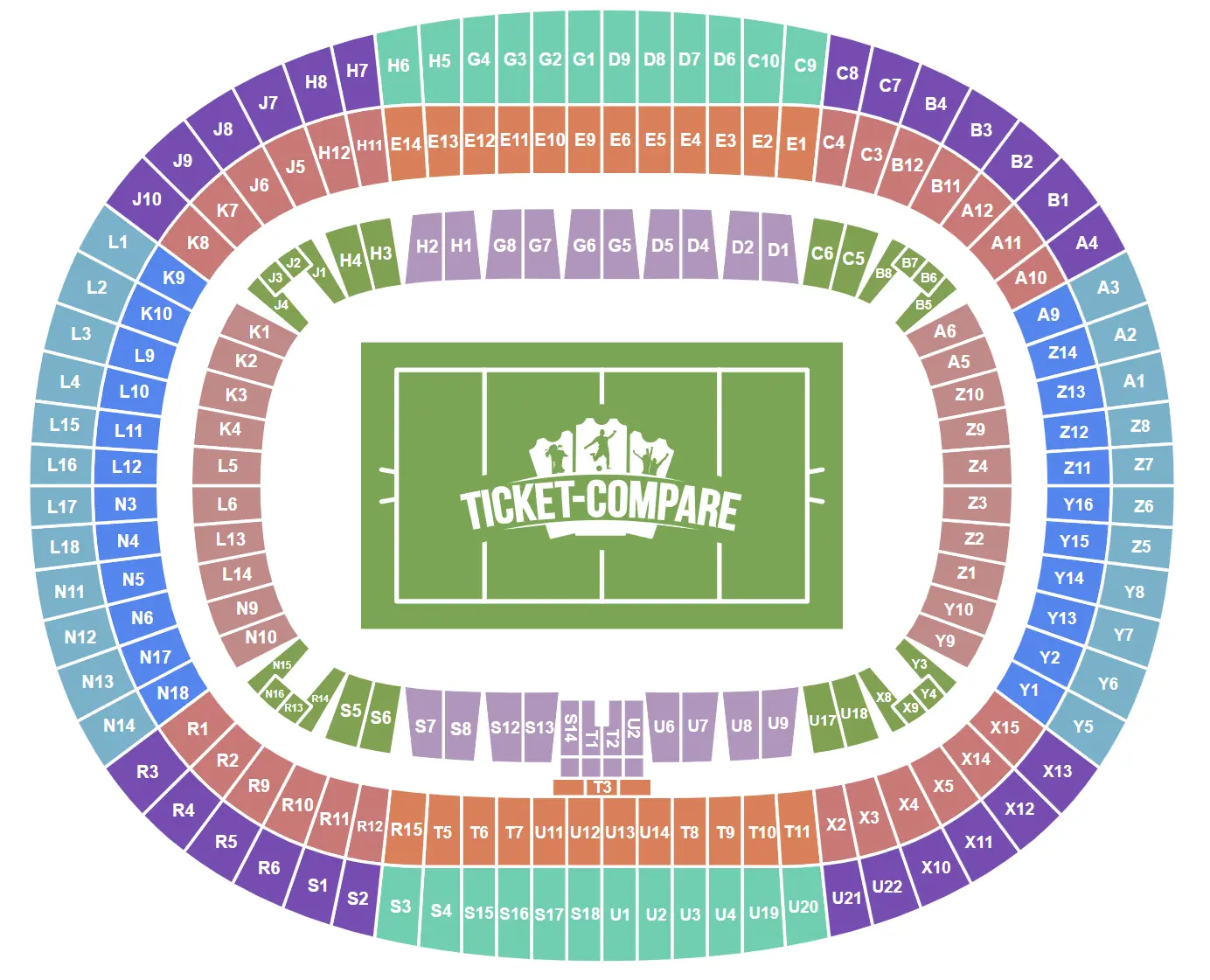
A technical marvel built for the 1998 World Cup, Stade de France remains the centrepiece of French national sport. Built in under three years for the 1998 World Cup, it is a striking example of speed at scale, a national arena large enough for football, rugby and state occasions alike.
For more information, check our Stade de France seating plan.
17. Signal Iduna Park — 81,365 (Dortmund, Germany)
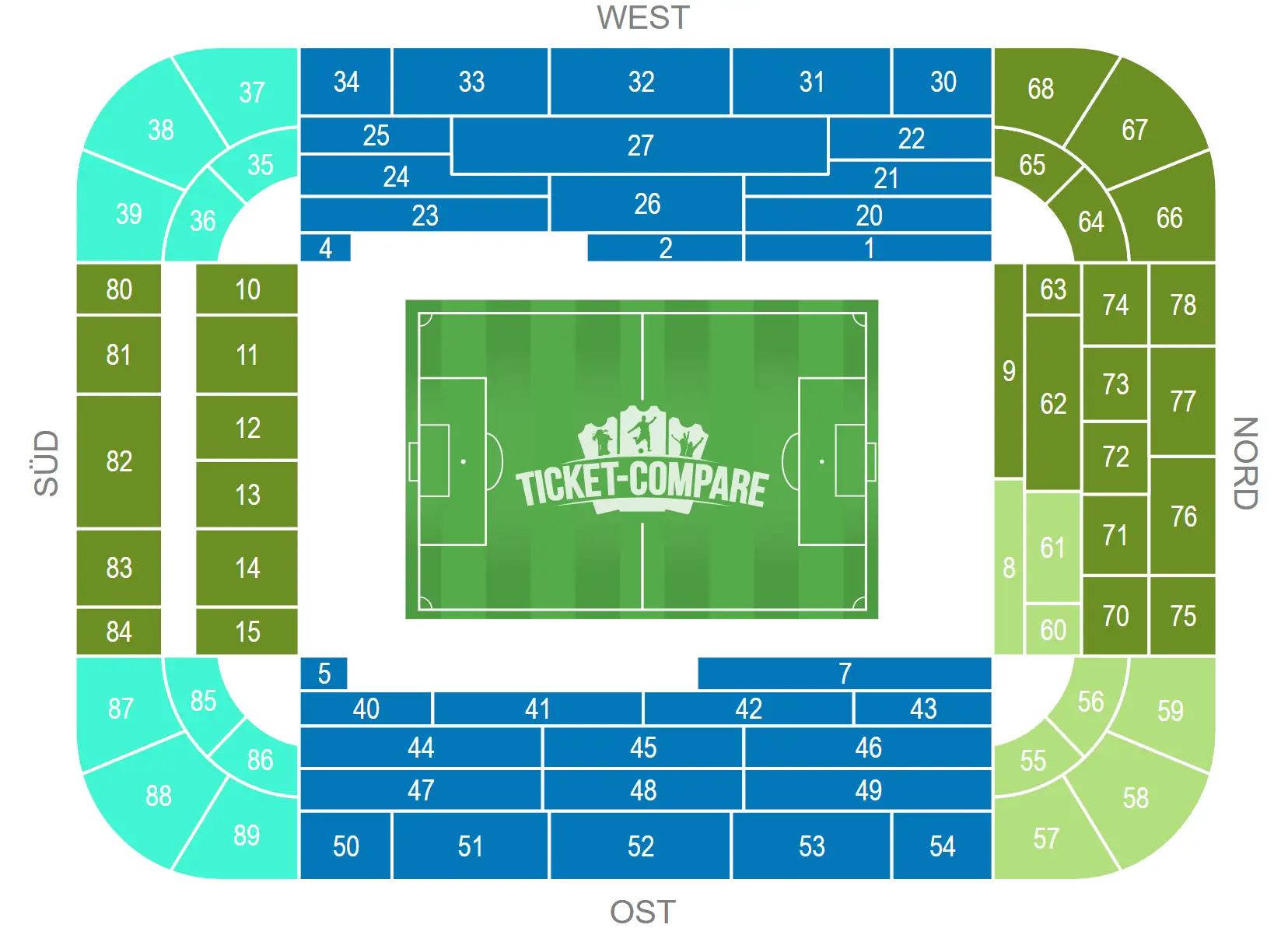
Signal Iduna Park is Germany’s largest stadium, but capacity alone is not what gives it so much charm. The Südtribüne, better known as the Yellow Wall, holds around 25,000 people on its own, effectively creating a stadium-within-a-stadium.
Take a closer look with Ticket-Compare.com’s Signal Iduna Park seating plan.
16. Jakarta International Stadium — 82,000 (Jakarta, Indonesia)
Jakarta International Stadium is one of the largest new-build football-specific stadiums in the world. It belongs to a newer generation of mega-venues, expressing architectural ambition and football-first design. Opened in 2022, stadiums like this have helped push some old classics like Milan’s San Siro off the list altogether.
15. MetLife Stadium — 82,500 (East Rutherford, USA)
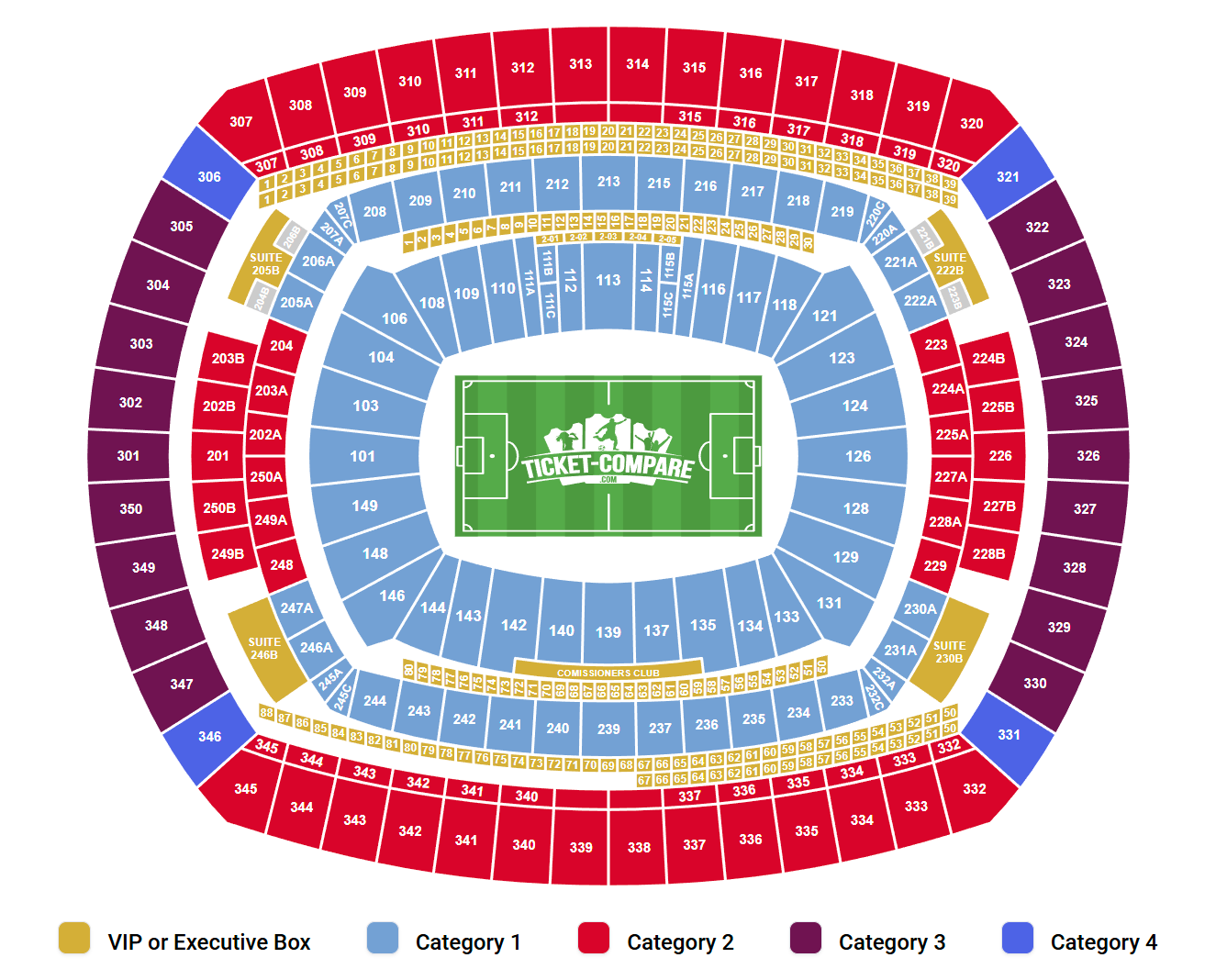
MetLife Stadium will host the 2026 World Cup final, placing it at the centre of the tournament’s biggest moment. As the largest open-air NFL stadium, its clean sightlines and adaptable design allow it to transform from a multi-sport venue into a global football stage capable of hosting crowds approaching 90,000.
See the layout on our MetLife Stadium seating plan.
14. Estadio Banorte (Estadio Azteca) — 83,000 (Mexico City, Mexico)
Operating at tournament capacity, this Mexico City venue sits over 2,200 metres above sea level, adding a physical edge to its already intense atmosphere. Estadio Banorte will become the first stadium to host matches at three separate World Cups, reinforcing its status as one of football’s most historic and demanding stages, particularly when Mexico national team tickets are in play.
13. Stadium Australia — 83,500 (Sydney, Australia)
Also known as Accor Stadium, this Sydney venue shows how modern mega-stadiums have evolved. It once exceeded 110,000 in Olympic mode, but its lower current figure reflects a wider trend across global sport. Now, comfort, sightlines and flexibility increasingly count more than packing in the biggest possible crowd.
12. Salt Lake Stadium — 85,000 (Kolkata, India)
Salt Lake Stadium remains one of Asia’s largest football venues. Its older six-figure reputation was not invented either: at one stage it could hold more than 120,000. Even after its all-seater rebuild, it remains bigger than most of Europe’s major club grounds.
11. Estadio Mâs Monumental — 85,018 (Buenos Aires, Argentina)
River Plate’s home is the largest football stadium in South America. That matters all the more because it has overtaken Rio’s Maracanã, home to regional rivals CR Flamengo and Fluminense FC, in pure modern capacity terms.
10. Borg El Arab Stadium — 86,000 (Alexandria, Egypt)
Borg El Arab Stadium ranks among Africa’s largest football venues and, at full scale, sits comfortably alongside the global giants. Built to serve as Egypt’s national stadium, it has the distinction of being fully air-conditions, and has hosted major international fixtures and continental finals.
9. Bukit Jalil National Stadium — 87,411 (Kuala Lumpur, Malaysia)
Bukit Jalil stands as the largest stadium in Southeast Asia, and its significance comes from how consistently it operates at that scale. Built for the 1998 Commonwealth Games, it has since hosted the AFC Asian Cup, SEA Games and World Cup qualifiers, making it the region’s go-to mega-venue for both football and major international events.
8. Lusail Stadium — 88,966 (Lusail, Qatar)
Lusail is one of the clearest examples of the modern event mega-stadium. Built as the showpiece for the 2022 World Cup, it is enormous by any standard, yet also designed with partial repurposing in mind. Argentine fans who went the extra mile for World Cup Final tickets will have fond memories of this stadium.
7. Wembley Stadium — 90,000 (London, England)
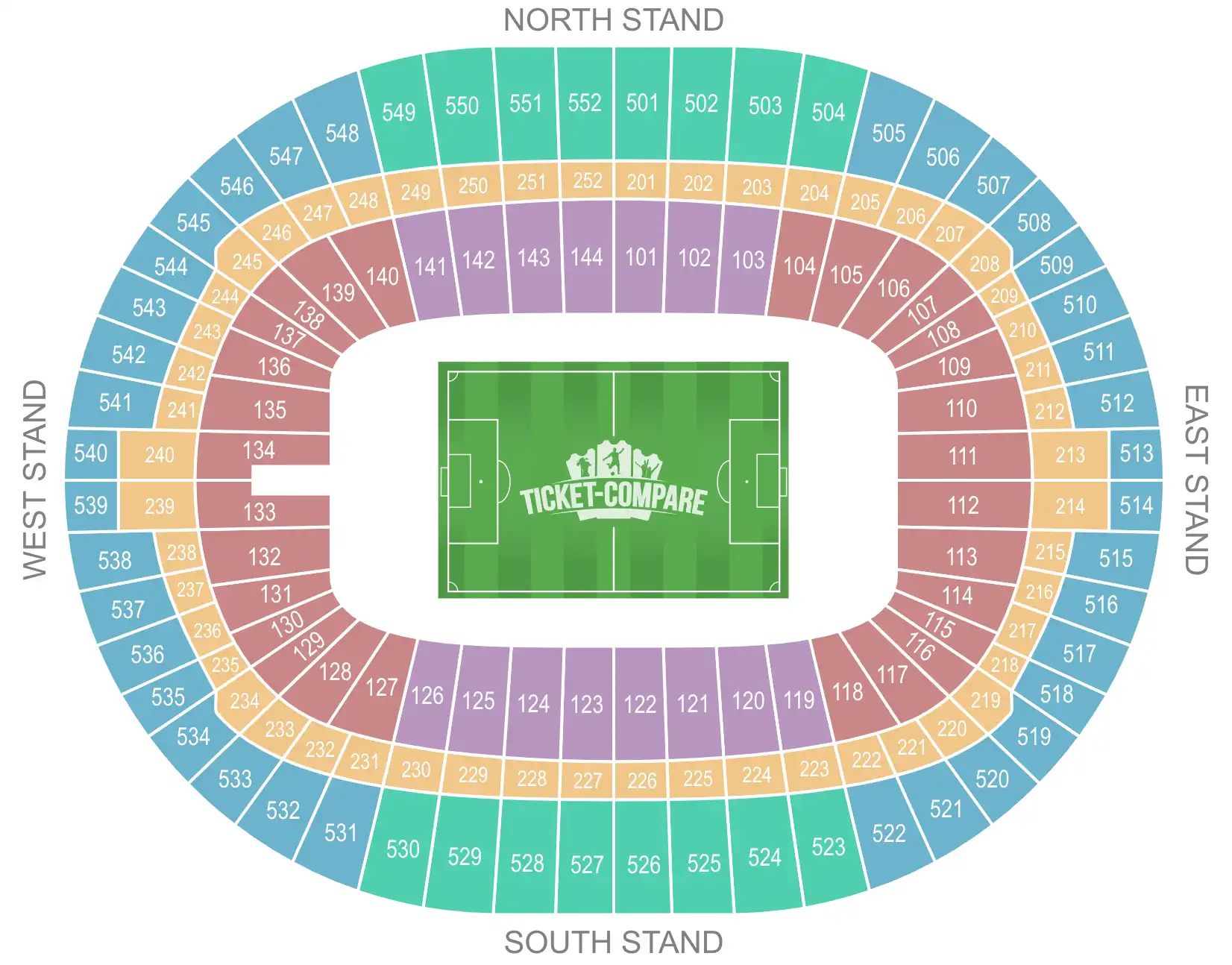
Wembley is the largest stadium in Europe in active full use. Its famous arch rises 133 metres, making it taller than the London Eye, and gives the stadium one of the most recognisable silhouettes in world sport. This is the venue for English football’s biggest occasions, including those Three Lions matches when England tickets are in huge demand.
Find your ideal seat through our Wembley Stadium seating plan.
6. Cotton Bowl — 92,100 (Dallas, USA)
The Cotton Bowl stands as one of the largest traditional stadiums in the United States, with a football capacity that pushes beyond 90,000. Unlike newer enclosed venues, its open-bowl design delivers a more old-school feel, and its inclusion in the 1994 World Cup underlines its footballing heritage.
5. Misr Stadium — 93,940 (New Administrative Capital, Egypt)
Unveiled in 2024, Misr Stadium is one of the most important additions to the global top tier of football venues. It is part of a wider city-building project designed to house millions, making it part of a much larger national vision for Egypt.
4. AT&T Stadium — 94,000 (Arlington, USA)
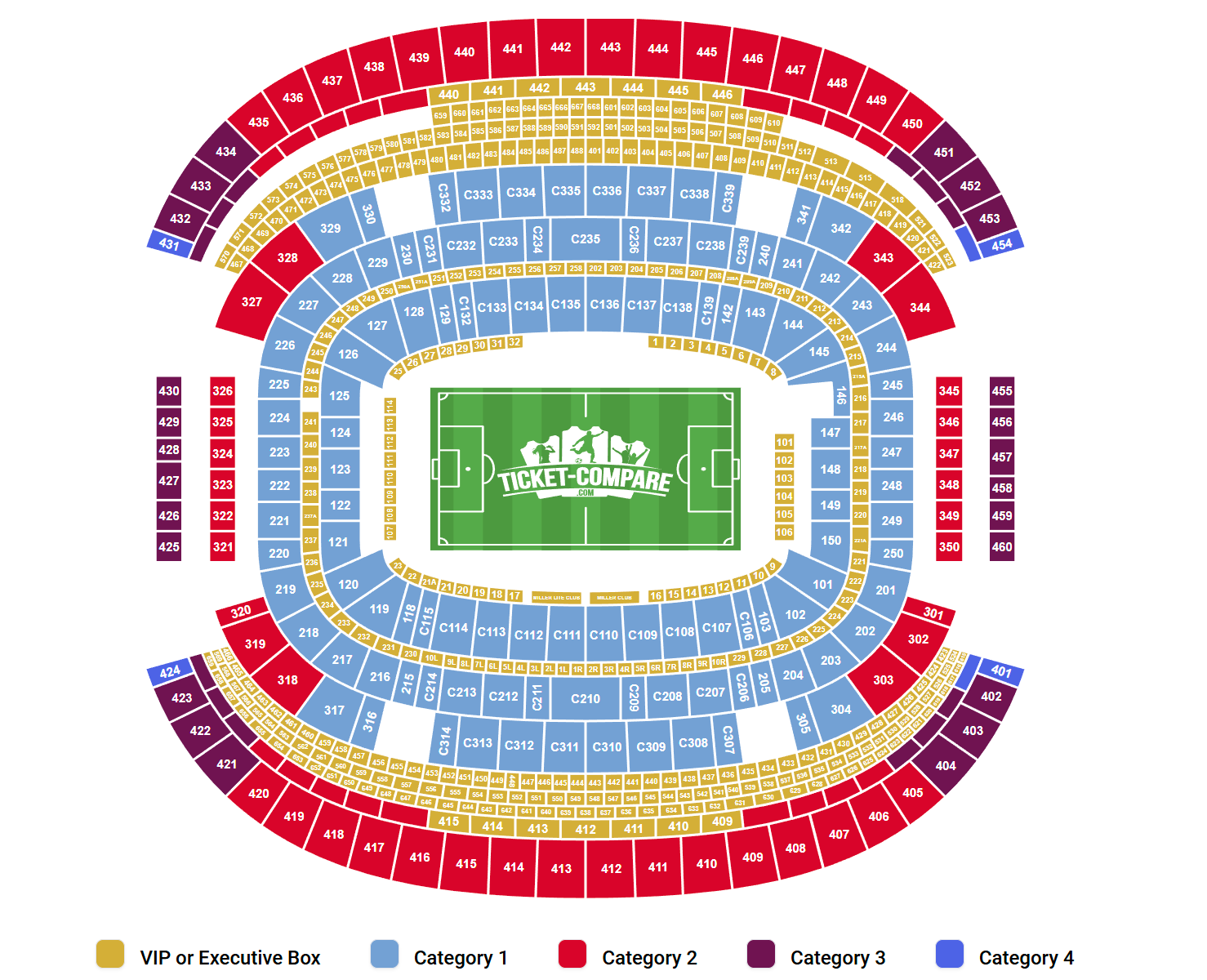
With a World Cup capacity of around 94,000, AT&T Stadium is one of the largest and most technologically ambitious venues in the tournament. Its retractable roof and vast single-span structure create an enclosed arena feel, while the centre-hung “Infinity Screen” dominates the interior, turning every match into a spectacle as much as a sporting event.
We have an AT&T Stadium seating plan so you can find your perfect seat.
3. FNB Stadium — 94,736 (Johannesburg, South Africa)
FNB Stadium stands apart not just for its scale, but for its place in South African history. It hosted the 2010 World Cup final and was the site of Nelson Mandela’s first major speech in Johannesburg after his release in 1990, as well as his memorial attended by global leaders. Known as “The Calabash” for its distinctive design, it is as much a national stage as a football venue.
2. Spotify Camp Nou — 105,000 projected (Barcelona, Spain)
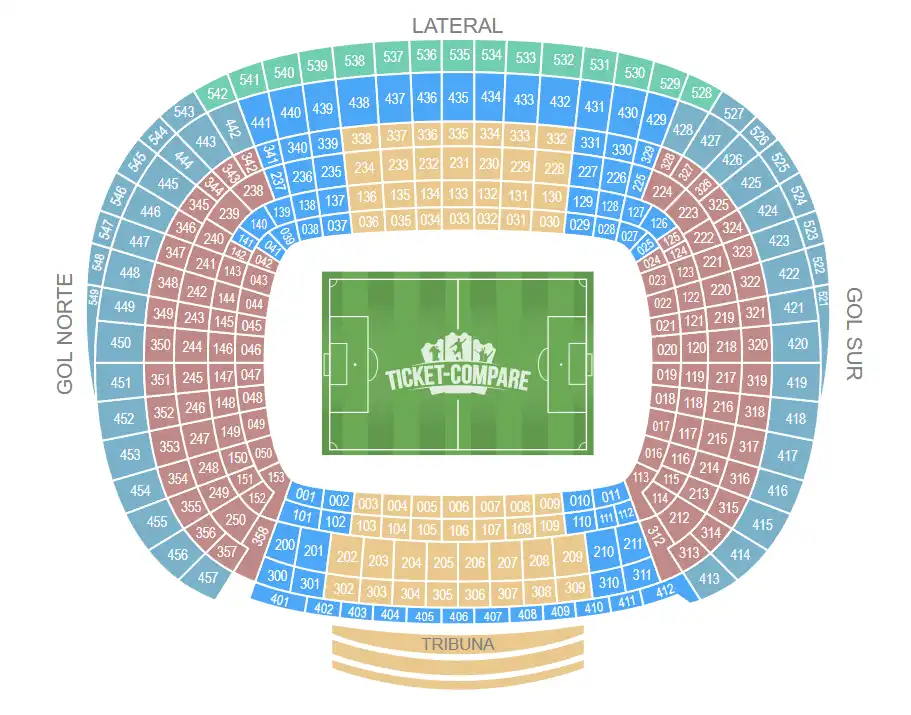
In redevelopment and opening in phases, Spotify Camp Nou is both an existing footballing icon and a future mega-stadium. Its projected capacity places it comfortably above every other club ground in Europe, combining football heritage with large-scale commercial ambition.
Get a better sense of the layout with our Camp Nou seating plan.
1. Rungrado 1st of May Stadium — 113,281 (Pyongyang, North Korea)
Claimed to be in a state of decay, Rungrado is the largest football stadium in the world by the most widely used current estimate.
Even that conservative figure puts it roughly 25 per cent above Wembley. The stadium sits on an island, spans over 2.2 million square feet, and features one of the most unusual roof structures ever built.
TIL the largest football (soccer) stadium in the world is the Rungrado 1st of May Stadium in North Korea, with a total capacity of 114,000
by u/SaltyPeter3434 in todayilearned
Unfortunately, this is one stadium that will probably have to stay un-ticked on the bucket list!
Top 25 Largest Football Stadiums in the World: What Have We Learned?
Some of the most interesting entries among the top 25 largest football stadiums are the venues that once held far more people but have been reworked for the modern era, with hospitality/premium areas far more important than ever.
Others are giant new projects designed to signal a nation or city’s ambition as much as host matches.
This is an ever-changing list, as the Hassan II Stadium cinder construction in Casablanca, Morocco, is expected to have 115,000 seats when it opens in 2028, in time for the 2030 World Cup.
For any footballing occasion, you can find tickets on Ticket-Compare.com. We compare prices across a lineup of carefully curated resale websites and clubs’ and nations’ official hospitality agents.
Related Articles:
World Cup 2026 Resale Ticket Prices Explained
How to Get Last-Minute World Cup 2026 Tickets Before They Sell Out
World Cup 2026 Resale Ticket Prices: Will They Drop or Continue Rising?
World Cup Ticket Prices: Qatar 2022 vs 2026 — How Costs Have Changed


