


Upcoming Events
Written by Aviran Zazon
The best place to sit at Madring depends on what you want from your race or weekend. Grandstands 1 and 2 are the obvious choices for the grid, pits, start, finish and podium, while Grandstands 5, 12, 13 and 16 place spectators closer to the circuit’s principal braking and overtaking areas.
Grandstands 9 and 10 should deliver the fullest view of the sure-to-be iconic La Monumental turn, and the covered Silver Plus stands around Turn 13 offer perhaps the strongest balance of racing action and comfort.
No single Madring grandstand combines every advantage. A main-straight ticket gives you the operational and ceremonial centre of the Grand Prix, yet the cars will spend much of each racing lap passing in a straight line. A seat beside Turn 5 or Turn 13 may show considerably more braking and wheel-to-wheel competition without the same view of the garages or podium.
This guide follows the current Madring seating plan around the circuit, beginning on the main straight and continuing through Hortaleza, Las Cárcavas, La Monumental and the Valdebebas linked corners.
Understanding The Madring Seating Plan
Madring is a clockwise, 5.4-kilometre circuit with 22 corners. Cars leave the main straight, negotiate the opening complex and accelerate through Hortaleza onto the longest high-speed section.
The lap then climbs through Las Cárcavas, drops towards El Búnker, passes the Turn 10–11 chicane and enters the long banked Turn 12 known as La Monumental.
After braking for Turn 13, drivers attack the flat-out Valdebebas linked corners before slowing heavily for Turn 17 and entering the tunnel section.
Turns 18 to 22 complete the lap around the IFEMA buildings, although the principal ordinary public grandstands end around Turn 17. The northern tunnel-exit area is used more heavily for hospitality viewing.
The grandstand numbers do not follow the lap in a perfectly sequential order. Grandstands 8, 8A and 13 are grouped around Turn 13, despite Grandstands 9 to 12 appearing earlier around La Monumental.
Lettered areas such as 2A, 8A, 9A and 15A should therefore be located on the latest seating map rather than understood only from their numbers.
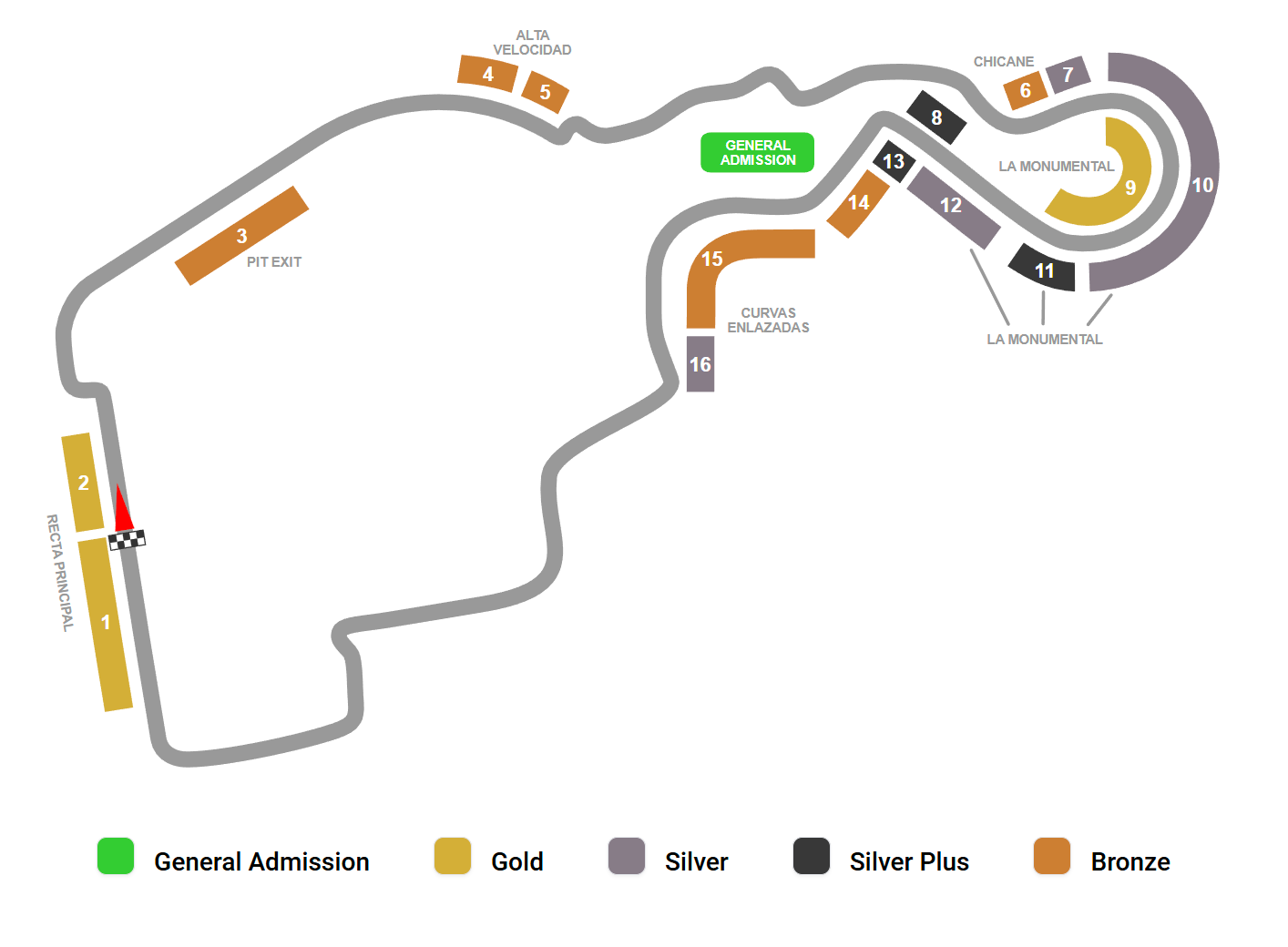
Madring ticket categories explained
| Category | Principal Public Areas | What the Category Generally Means |
|---|---|---|
| Gold | 1, 1 First Rows, 2 and 9 | Prominent main-straight or La Monumental locations, with enhanced facilities in some areas |
| Silver Plus | 8, 8A, 11 and 13 | Covered grandstands beside important technical or braking sections |
| Silver | 2A, 7, 9A, 10, 12 and 16 | Reserved uncovered seats around recognised corners and braking zones |
| Bronze | 3, 4, 5, 6, 14, 15 and 15A | Reserved uncovered seating focused on speed, gradients or technical sequences |
| Special Grandstand | 6A Team FIFTY5 | Carlos Sainz supporter section with a dedicated fan identity and supporter pack |
| Unreserved Viewing | Pelouse and Plataforma | General Admission areas or a separate standing platform without an allocated grandstand seat |
Gold should not be read as a guarantee of the finest racing view. Grandstands 1 and 2 command the main-straight occasion, and Grandstand 9 sits inside Madring’s defining corner complex.
An uncovered Silver seat at Turn 13 or Turn 17 may still produce a clearer view of braking and attempted overtakes.
Silver Plus is the most consistent category for weather protection. Grandstands 8, 8A, 11 and 13 are covered and sit near technically significant parts of the circuit. Bronze remains reserved grandstand seating, it is not another name for General Admission.
Public grandstand categories include access to giant screens distributed around the venue, though the precise position of temporary screens should be checked against the final event map.
Pelouse also has screens within the wider spectator area, yet a clear view from every patch should not be assumed.
Higher rows should generally produce a broader angle over fencing, pit-wall equipment and spectators in front. Lower rows bring the cars closer and strengthen the impression of speed, but may show less of the circuit.
The distinction is especially important in Grandstand 1, where the specially sold first rows may lie beyond the effective roof coverage.
Tickets are also linked to particular fan zones. The main public districts include Bulevar Cibeles, Paseo Pit Lane, Bulevar Sol, Barrio, Distrito and Monumental.
A grandstand F1 ticket does not ordinarily permit unrestricted movement through every stand or hospitality area, and spectators cannot leave the venue and return later on the same day.
Main Straight And Start-Finish Grandstands At Madring
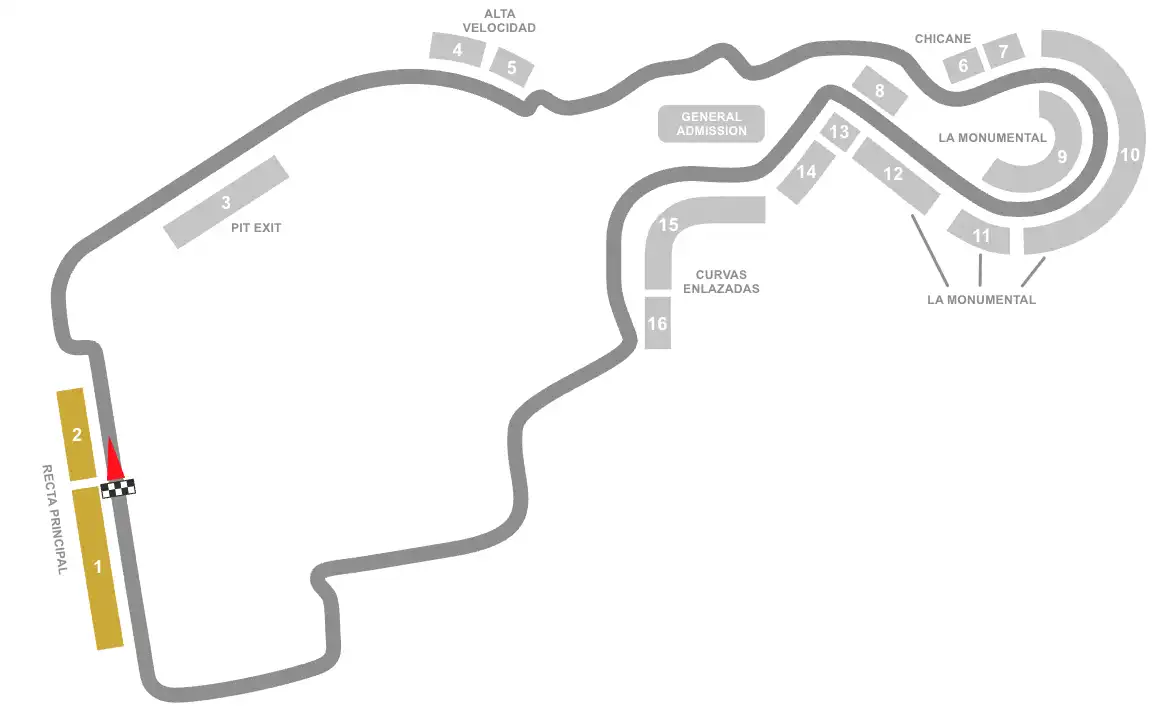
Grandstand 1 Gold
Grandstand 1 runs along the main straight opposite the starting grid, pit lane and Formula 1 garages. It should give the fullest public view of the grid being assembled, the start, pit stops, safety-car restarts, support-series grids and the organisation surrounding the finish.
The circuit’s first major braking point lies at the end of this straight. Drivers are expected to reach approximately 320 kilometres per hour before slowing to around 100 kilometres per hour for Turn 1. Seats towards the Turn 1 end of the long structure should naturally provide more context for that approach than seats farther back towards the grid.
This is primarily a seat for following the story of the Grand Prix. Even when no car is passing directly in front, spectators can watch garage activity, pit-wall operations and cars entering or leaving their boxes. During ordinary racing laps, the view becomes more fleeting because the cars are travelling in a largely straight line.
Most of Grandstand 1 is covered, and its ticket holders use the Bulevar Cibeles fan zone. A higher row should improve the angle over pit-wall structures, while a lower row brings the track and pit lane physically closer.
Grandstand 1 First Rows
The First Rows product occupies the front of Grandstand 1 rather than a separate circuit location.
Its main attraction is proximity. Cars, pit-wall personnel and pre-race activity should feel noticeably closer, making it potentially attractive for photographs of the pit lane and the physical sensation of cars passing at speed.
The compromise is visibility. Fencing, pit-wall installations, team personnel and trackside equipment are more likely to interrupt a low viewing angle. The first rows may also extend beyond the roof, so choosing this product for its closeness should not be confused with the cover provided further up.
Grandstand 2 Gold
Grandstand 2 also faces the main straight and pit lane, with its position placing greater emphasis on the finish line, parc fermé and podium end of the central complex.
It should be one of the strongest public choices for seeing the chequered flag and the sequence that follows the race. Depending on the exact block, spectators may be better aligned with the podium ceremony than those in parts of Grandstand 1.
The underlying trade-off remains similar. Grandstand 2 shows pit strategy, grid procedures and the formal centre of the event more clearly than it shows sustained corner action. Higher seats should offer the cleaner overall angle across the pit wall.
Grandstand 2 is covered and gives access to the Paseo Pit Lane fan zone.
Hortaleza And The Turn 5 Braking Zone
Grandstand 2A Silver
Grandstand 2A sits around Turns 2 and 3, close to the pit-lane exit. Cars negotiate the slower Turn 2 and then accelerate through the fast right-handed Hortaleza corner before beginning the circuit’s longest straight.
This should give spectators a more sustained view than the main straight. Cars arrive from the opening complex, change direction, apply power and then accelerate away. The pit exit adds interest throughout practice and qualifying, when cars regularly join the circuit, and during the race when drivers return to live traffic after a stop.
The opening lap may be particularly busy because the field should still be compressed after Turn 1. Its main strength is the combination of cornering, traction and pit-exit activity rather than one decisive overtaking point.
Grandstand 2A is uncovered and uses the Bulevar Sol fan zone.
Grandstand 3 Bronze
Grandstand 3 is positioned after Hortaleza, where cars accelerate onto the 837-metre straight leading towards Turns 4 and 5. The pit exit should remain within the broader scene.
This is primarily a speed grandstand. Spectators should see the cars applying power and rapidly building towards more than 300 kilometres per hour. It may also reveal which driver has gained the strongest traction out of Turn 3, particularly when one car begins closing on another before the braking zone.
Most passes are more likely to be completed farther along the straight or at Turn 5. Grandstand 3 is therefore better for acceleration and the development of an attack than for seeing the final braking move directly in front.
Grandstand 4 Bronze
Grandstand 4 lies farther along the high-speed section, around Turn 4 and the approach to Turn 5. Turn 4 is expected to be taken flat out, with cars reaching approximately 340 kilometres per hour before braking.
This should be one of the most effective areas for appreciating top speed. It may also show an overtaking attempt developing as a following driver uses the slipstream, moves out from behind the leading car and positions for the Turn 5 braking zone.
The view will change along the length of the stand. Seats closer to Turn 5 should concentrate more heavily on the braking contest, while seats farther back should communicate the speed and build-up more clearly.
Grandstand 5 Bronze
Grandstand 5 is centred on Turn 5, where cars are expected to slow from approximately 340 to 80 kilometres per hour. The circuit identifies this as one of its principal overtaking opportunities.
This should be among Madring’s clearest conventional racing grandstands. Spectators are positioned to see heavy braking, defensive lines, lock-ups, late lunges and attempts to obtain a better exit from the slow corner.
Cars will also be easier to identify and photograph at the apex than when they pass Grandstands 3 or 4 at full speed. The trade-off is a more concentrated sightline. Grandstand 5 should show the decisive part of the manoeuvre better than the long approach.
Las Cárcavas And The Chicane
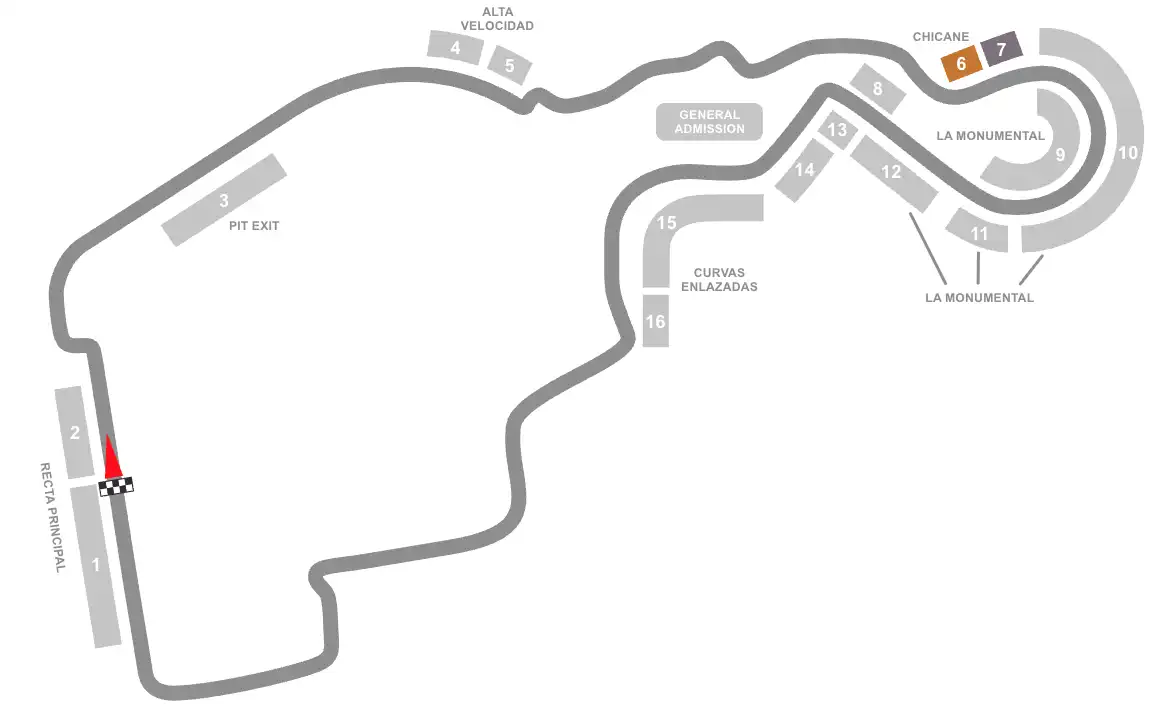
Grandstand 6 Bronze
Grandstand 6 overlooks the climb through Las Cárcavas. The circuit rises by roughly ten metres at a gradient of up to eight per cent, culminating at the blind Turn 7 before dropping downhill towards El Búnker.
This area should reveal the circuit’s elevation more clearly than television. Drivers must place the car while climbing towards a point where the next section is not yet fully visible, and the change from uphill compression to downhill movement should make the cars appear particularly active.
Its character is technical rather than overtaking-led. The terrain and blind crest may interrupt the continuous sightline from some positions, yet they also give the stand a visual identity that flat urban sections cannot reproduce.
Grandstand 6A Team FIFTY5
Grandstand 6A is the dedicated Carlos Sainz supporter section around Turns 8 and 9. Tickets include a Team FIFTY5 pack containing a cap and flag.
Cars descend from the Las Cárcavas crest, pass the corner known as El Búnker and continue through a fast right-hander. The direct sporting appeal lies in speed, car placement and the transition from downhill running into a technically demanding sequence.
Its defining distinction should be the crowd. Concentrating Sainz supporters in one area is likely to create coordinated flags, chants and a particularly strong reaction whenever he appears on track.
Passing opportunities may develop through this part of the lap, though routine side-by-side overtaking is more naturally associated with the heavier braking zones at Turns 5, 13 and 17.
Grandstand 7 Silver
Grandstand 7 overlooks the Turns 10 and 11 chicane immediately before La Monumental.
The chicane reduces speed before drivers enter the banking. Spectators should see the approach, braking, kerb use, rapid change of direction and acceleration into Turn 12, giving the stand several distinct phases of action rather than one short glimpse.
Its strongest quality is likely to be technical comparison. A driver who attacks the first kerb too aggressively may compromise the second part of the chicane and lose momentum into La Monumental. Different lines and levels of commitment should be relatively easy to distinguish.
The official description promotes Turn 11 as an action area, though the location may prove more valuable for car control and mistakes than for repeated conventional overtakes.
La Monumental Grandstands At Madring
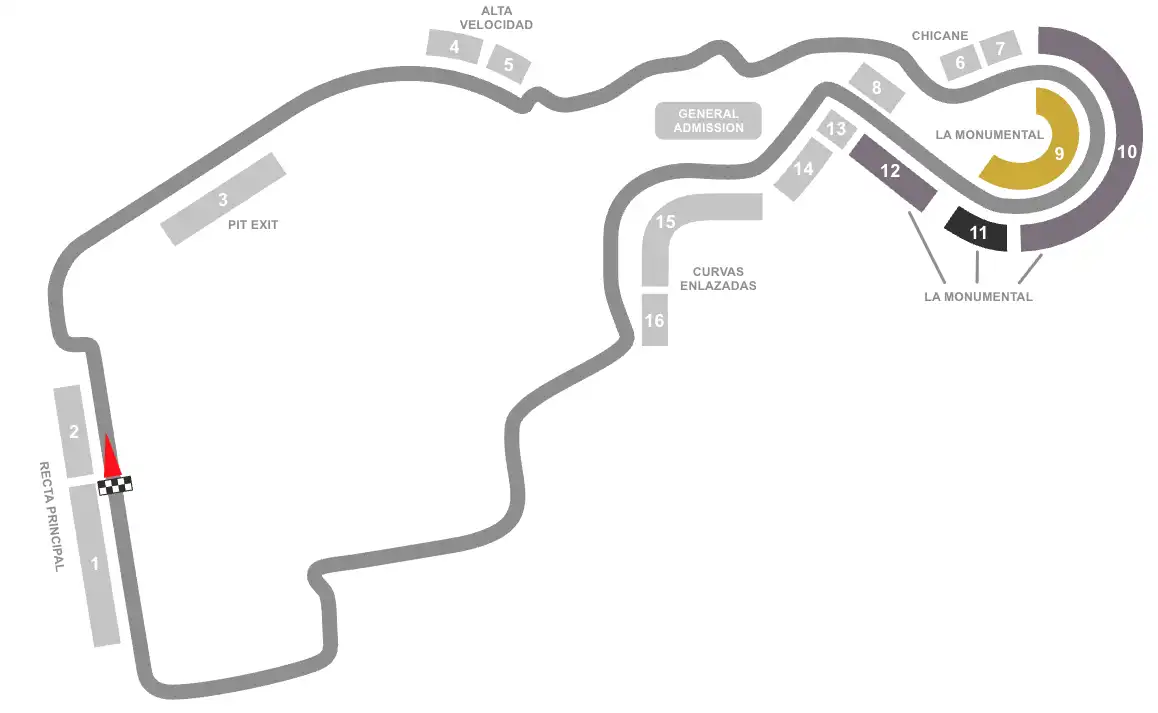
La Monumental is Madring’s defining corner. Turn 12 measures approximately 548 metres, carries banking of up to 24 per cent and is expected to keep cars in the corner for around six seconds.
The surrounding complex appears extremely impressive and has been designed for approximately 45,000 spectators.
Grandstand 9 Gold
Grandstand 9 is the principal Gold stand within the La Monumental complex. Unlike the Gold stands on the main straight, it is uncovered.
Its appeal comes from immersion. Spectators should be able to follow cars through a long sustained arc rather than watch them appear and disappear at a conventional short corner. The scale of the banking and surrounding seating may also create the circuit’s most stadium-like atmosphere.
Higher positions should provide the broadest picture of the banking and allow spectators to compare the lines taken by different drivers. Lower rows may create a stronger impression of speed and banking, though fencing will play a larger role.
Turn 12 may permit cars to run alongside one another, and the exit is important for preparing a move at Turn 13. Even so, Grandstand 9 should be selected primarily for the distinctive Madring setting rather than an expectation that every lap will contain an overtake.
Ticket holders can use both the Monumental and Distrito fan zones.
Grandstands 9A and 10
Grandstand 9A is an uncovered Silver section within the Monumental complex. It should share the fundamental appeal of Grandstand 9 which is a long view of cars committed to the banking and a large crowd gathered around the circuit’s defining feature.
Its exact angle may place greater emphasis on the entry or exit rather than the central sweep. It nevertheless remains a reserved numbered seat with access to the Monumental and Distrito fan zones.
Grandstand 10 sits outside La Monumental. Looking across the corner may make its complete shape easier to understand, with cars rising onto the banking, holding their curved trajectory and accelerating towards the exit.
This outside angle may also suit photography because cars should remain within the frame for longer than they would at a short braking corner. Grandstand 10 uses the Distrito fan zone and is uncovered.
Grandstand 11 Silver Plus
Grandstand 11 is covered and positioned at the exit of La Monumental.
The emphasis shifts from the full banked arc to the moment at which drivers unwind the steering, apply power and prepare for Turn 13. A car that loses momentum or runs wide through the banking may become vulnerable along this exit.
The stand should also present the cars at an attractive angle for viewing and photography rather than merely showing them side-on. Its roof makes it one of the more comfortable ways to experience the Monumental area, although the sun’s angle can still affect individual rows.
Grandstand 12 Silver
Grandstand 12 overlooks the approach and braking area before Turn 13. Cars are expected to arrive at more than 300 kilometres per hour and slow to approximately 140 kilometres per hour for a corner with a wide entry.
This should be one of the strongest uncovered grandstands for seeing an overtaking attempt being constructed. Drivers emerge from La Monumental, use the slipstream, move into position and choose a line before braking.
The wide entry may allow defensive positioning, alternative lines and attempts to complete a switchback. Grandstand 12 should show more of this approach than the later stages of the Turn 13 exit.
Turn 13 And The Valdebebas Linked Corners
Grandstand 13 Silver Plus
Grandstand 13 occupies a prominent covered position at Turn 13.
This may prove to be Madring’s strongest all-round public grandstand. It combines a substantial braking point, slower cars, possible overtaking and roof protection. Spectators should see drivers arriving from La Monumental, braking into the corner and beginning the acceleration towards the Valdebebas linked sequence.
Compared with Grandstand 12, the view should concentrate more heavily on turn-in, the apex and the decisive part of a move. Compared with Grandstands 8 and 8A, it is likely to offer a more focused corner view rather than as much of the subsequent technical sequence.
Grandstand 13 includes access to the Monumental and Distrito fan zones.
Grandstands 8 and 8A Silver Plus
Grandstand 8 is covered and overlooks the Turn 13 braking zone together with the opening part of the fast Valdebebas linked corners.
It should provide a broader technical picture than Grandstand 13. Spectators may be able to follow a braking move through its completion and then see how the driver immediately positions the car for the faster direction changes.
Grandstand 8A provides another covered angle across the Monumental exit, Turn 13 and the entrance to the linked sequence. Its experience should place greater emphasis on the transition from braking to speed rather than only the Turn 13 apex.
Block location will matter in both structures. Seats at one end may lean towards the braking contest, while those farther along may show more acceleration and the first linked corner.
Both stands include access to the Monumental and Distrito fan zones.
Grandstands 14, 15A and 15
Grandstand 14 sits at the beginning of the Valdebebas linked corners. Turns 14, 15 and 16 are designed as a flat-out sequence, making this more of a car-performance view than a conventional overtaking location.
Spectators should see rapid steering inputs, aerodynamic grip and the way a small error at the start of the sequence affects everything that follows. Cars will be travelling quickly, though their curved trajectory should keep them visible for longer than a simple straight would.
Grandstand 15A occupies the earlier Turn 14–15 portion of the complex and should offer a more concentrated view of the first changes of direction.
Grandstand 15 is much longer and potentially more varied. Some sections should favour Turns 14 and 15, while seats farther along may show Turn 16 and the approach to the Turn 17 braking zone. The strongest blocks could produce one of the longest continuous public sightlines at Madring.
That variation makes the exact block particularly important. A listing for Grandstand 15 should not automatically be read as one uniform view.
Grandstand 16 Silver
Grandstand 16 overlooks Turn 17, where cars slow from approximately 280 to 100 kilometres per hour after the flat-out Valdebebas sequence.
This should be another dependable action grandstand. A following driver may build momentum through Turns 14 to 16 before attempting a late-braking move at Turn 17. Spectators should see defensive lines, lock-ups, attempted passes and cars trying to cut back for the tunnel entry.
The cars will disappear into the tunnel relatively soon afterwards, so Grandstand 16 is more concentrated than panoramic. Its attraction lies in having a major braking manoeuvre directly in front of the seating.
General Admission At Madring
Pelouse
Pelouse is Madring’s conventional General Admission product. It gives access to designated open viewing areas rather than an allocated seat.
The official map places these areas around the upper technical portion of the circuit rather than beside the main straight.
Pelouse spectators can choose among available positions within their permitted area and use the Distrito fan zone, though this does not mean unrestricted access to grandstands, hospitality districts or every spectator section.
The best positions are likely to depend on elevation, fencing, advertising structures and how many people are standing immediately ahead. Early arrival should therefore matter, particularly on race day. Leaving a strong position for food, toilets or entertainment may also mean returning to find that someone else has occupied it.
Folding chairs, outdoor furniture and bulky coolers are prohibited under the published conditions. Spectators should be prepared to stand or sit directly on permitted ground areas and to carry only what the venue allows. Food and drink are available inside the circuit, while outside food and beverages are prohibited.
Screens are available within the wider General Admission area, although the precise relationship between each screen and every Pelouse pocket should be checked on the final spectator map.
Pelouse should suit mobile visitors who value atmosphere, flexibility and a less formal day. A reserved grandstand is the safer choice for families or groups who need guaranteed places together, dependable cover or certainty about the viewing angle.
Standing Viewing Platform
The Plataforma is a separate standing product at the exit of Turn 3. It overlooks cars accelerating out of Hortaleza towards the longest straight, with the pit-lane exit also within the area’s field of view.
It should offer a more defined and potentially more elevated base than an ordinary Pelouse patch, while retaining the informality of standing. The view concentrates on acceleration, pit exit and the development of moves down the straight rather than braking or apex action.
It is not a seated grandstand. Arriving early may still be necessary to obtain a preferred position near the front rail.
Pelouse and Plataforma should be treated as separate tickets. A Pelouse ticket gives access to Pelouse, while a platform ticket gives access to the standing platform unless a future ticket description explicitly combines the two.
Hospitality And Premium Viewing At Madring
Madring hospitality is spread across several circuit sectors, and the view changes substantially from one product to another.
Podium Stand attaches an indoor lounge and reserved hospitality grandstand to the main straight. It is the most obvious relaxed hospitality choice for the grid, pits, finish and podium.
Club 91 is the more exclusive main-straight environment, overlooking the start and finish, garages and approach to Turn 1. Its emphasis is luxury dining, entertainment, indoor comfort and Formula 1 operations rather than sustained corner action.
El Mirador and La Azotea are based around La Monumental. El Mirador creates an open-air, beach-club-style environment, while La Azotea provides a more elevated rooftop view across approximately Turns 10 to 13. Music, food and social spaces form a major part of both products.
Ignition Club sits around Turns 13 and 14 and should be the strongest locally promoted hospitality option for spectators prioritising braking, overtaking and technical track action.
Traction Club, La Terminal and Traction Suites use the tunnel-exit area around Turns 18 and 19. Traction Club has a polished members-club atmosphere, while La Terminal adds simulators, gaming, displays and other attractions that make it the clearest family-orientated hospitality product.
Formula 1 Experiences products are separate from Madring’s local hospitality programme. Depending on the package, they may combine a public grandstand seat with activities such as a guided track tour, pit-lane walk, trophy photograph or scheduled hospitality session. The Formula 1 Paddock Club focuses on the pit complex and main straight, while Champions Club adds hospitality and controlled experiential activities around the pit-exit and Turn 1 area.
A guided paddock tour or scheduled pit-lane activity should not be confused with unrestricted Paddock access. Package inclusions vary, so the actual viewing location and activities should be checked before purchase.
Best Places To Sit At Madring
Best seats for overtaking
Grandstand 5 is the clearest choice at the end of the circuit’s longest high-speed approach. It should show cars braking from around 340 to 80 kilometres per hour.
Grandstands 12 and 13 cover the approach and apex of Turn 13, while Grandstand 16 overlooks the heavy braking at Turn 17. Grandstand 13 adds the advantage of a covered structure.
Best seats for the start, pits and finish
Grandstand 1 should provide the broadest view of the grid, garages and pit operations. Grandstand 2 places greater emphasis on the finish, parc fermé and podium end of the main straight.
The First Rows of Grandstand 1 suit spectators who want proximity, though higher standard rows should provide a clearer overall angle.
Best seats for the signature Madring experience
Motorsport tickets in Grandstand 9 should give you the most immersive La Monumental atmosphere, while Grandstand 10 may make the complete shape of the banking easier to read.
Grandstand 11 is the stronger option for anyone who wants a covered seat and a view focused on the Monumental exit.
Best seats for technical driving
Grandstand 7 shows braking, kerb use and direction changes through the chicane before La Monumental.
Grandstands 8 and 8A combine Turn 13 with the opening of the Valdebebas sequence, while Grandstand 15 may provide the longest multi-corner sightline when the block is well positioned.
Best seats for speed
Grandstand 3 concentrates on acceleration out of Hortaleza, and Grandstand 4 shows cars approaching their projected top speed before Turn 5.
Grandstands 14 and 15 reveal high-speed lateral load and rapid changes of direction rather than ordinary straight-line speed.
Best covered seats
The main covered public options are:
- Grandstand 1, apart from parts of the first rows
- Grandstand 2
- Grandstand 8
- Grandstand 8A
- Grandstand 11
- Grandstand 13
A roof does not guarantee shade throughout the day. The row, stand orientation and position of the sun will still affect the protection received.
Best seats for a first visit
Grandstand 13 is arguably the strongest all-rounder because it combines a major braking zone, possible overtaking, slower cars and cover.
Grandstand 5 offers a straightforward heavy-braking view, while Grandstand 9 delivers the circuit feature most closely associated with Madring. Visitors who consider the grid and pit lane essential should choose Grandstand 1 or 2 instead.
Best seats for families
For an ordinary ticket, Grandstands 8, 8A, 11 and 13 combine reserved seating, cover and giant-screen provision around technically interesting sections.
Pelouse demands more standing, earlier arrival and greater effort to retain a useful position. Among the hospitality choices, La Terminal is the clearest family proposition because it combines a grandstand with indoor activities and large screens.
Madring Grandstands Compared
| Area | What You See | Best For | Main Trade-Off |
|---|---|---|---|
| Grandstand 1 | Grid, garages, pits, start and main straight | Complete race narrative | Cars pass quickly during racing laps |
| Grandstand 2 | Finish line, pit lane and podium end | Finish and celebrations | Limited sustained corner action |
| Grandstand 2A | Turns 2–3, traction and pit exit | Longer viewing and strategy | Not the heaviest braking point |
| Grandstands 3–4 | Acceleration, top speed and Turn 5 approach | Speed and developing attacks | Decisive move may happen farther ahead |
| Grandstand 5 | Heavy braking into Turn 5 | Overtaking and photography | More concentrated sightline |
| Grandstand 6 | Las Cárcavas climb and blind crest | Gradient and car control | Terrain may interrupt the view |
| Grandstand 6A | Turns 8–9 and Sainz supporter section | Atmosphere and high-speed driving | Fewer conventional braking moves |
| Grandstand 7 | Turn 10–11 chicane | Kerb use and technical viewing | Passing may be less frequent than promoted |
| Grandstands 9–10 | Full La Monumental experience | Banking, atmosphere and photography | Uncovered |
| Grandstand 11 | Monumental exit | Covered signature-corner view | Less of the complete banking |
| Grandstands 12–13 | Turn 13 approach and corner | Braking and overtaking | 12 is uncovered; 13 is more apex-focused |
| Grandstands 8–8A | Turn 13 and linked-corner transition | Broad technical viewing with cover | View balance varies by block |
| Grandstands 14–15 | Flat-out Valdebebas sequence | Qualifying and aerodynamic performance | Limited slow-corner action |
| Grandstand 16 | Heavy braking into Turn 17 | Overtaking attempts | Cars disappear into the tunnel soon after |
| Pelouse | Variable open viewing areas | Flexibility and informal atmosphere | No allocated position or guaranteed angle |
| Plataforma | Turn 3 exit, pit exit and longest straight | Purpose-built standing view | No seat and little braking action |
Where Should You Sit At Madring?
Choose Grandstand 13 for the strongest combination of braking, possible overtaking and cover. Grandstand 5 should appeal to spectators who want a concentrated heavy-braking view, while Grandstands 9 and 10 provide the experience most distinctive to Madring.
Grandstands 1 and 2 remain the better choice for anyone who regards the grid, pits, finish and podium as essential parts of attending a Formula 1 race.
Grandstands 7, 8, 8A and 15 offer specialised technical views, while Pelouse and the Standing Viewing Platform trade an allocated seat for a less formal experience.
Once the viewing priority is worked out, Ticket-Compare.com can be used to compare current Spanish Grand Prix ticket listings from multiple ticketing partners and pre-vetted resale sites.
The right Madring ticket is not simply the highest category available. It is the area that places you closest to the part of the race you most want to understand.
| Section | Blocks | Block Count |
|---|---|---|
| Bronze | 3, 4, 5, 6, 14, 15 3, 4, 5 | 6 |
| General Admission | GENERAL ADMISSION GENERAL ADMISSION | 1 |
| Gold | 1, 2, 9 1, 2, 9 | 3 |
| Silver | 7, 10, 12, 16 7, 10, 12 | 4 |
| Silver Plus | 8, 11, 13 8, 11, 13 | 3 |

Co-founder of Ticket-Compare.com, Aviran Zazon is a web developer, marketer and lifelong sports fan, inspired by the magic of Ronaldinho’s Barcelona.


