


Upcoming Events
Written by Aviran Zazon
Understanding The Monza Seating Plan
Monza is a 5.793-kilometre clockwise circuit. Cars leave the main straight and brake for Variante del Rettifilo, sweep through Curva Grande or Biassono, stop again for Variante della Roggia, pass the two Lesmo corners and accelerate through Serraglio.
They then brake for Ascari before reaching Curva Alboreto and returning to the main straight.
The official numbers do not follow the lap in a simple sequence. Stands 2, 3, 27, 28, 29 and 30 all belong to the Gradinate Traguardo family on the main straight, while stands numbered 12 to 18 are spread across different parts of Ascari. Newer structures such as 33A, 33B, 34 and 35A/B/C sit among older numbered stands.
Rows begin with A at the bottom and move upwards through the alphabet. Seat 1 is on the left when facing the stand from the front.
A higher row will often broaden the angle over fencing and spectators, while a lower row creates a stronger sense of speed and proximity. Neither is automatically better.
Monza tickets give you sightlines towards a giant screen for almost every numbered grandstand and for Gradinate Interno Parabolica, but stands 25 and 32 and ordinary General Admission do not give you a screen. However, note that Screen positions and temporary structures can change.
Main Straight And Pit Grandstands at Monza
Grandstand 1 Centrale
Location: Centrale sits on the main straight opposite the grid, garages and pit lane.
View: This is Monza’s principal public grandstand for the formal stages of the Grand Prix. It shows the grid forming, pre-race activity, the start, pit stops, the finish and much of the podium atmosphere.
The cars pass at such high speed during ordinary racing laps that it is not the best place for studying repeated cornering or overtaking attempts.
Best suited to: Spectators who prioritise the start, pits, finish, grid procedures and the central occasion of the Italian Grand Prix.
Practical note: Do not choose Centrale because you expect to sit opposite a particular team. Garage allocations can change.
Gradinate Traguardo 2 and 3
Location: These lower finish-line terraces sit beside Centrale on the main straight, closer to the start-line side of the central complex.
View: The emphasis is on the launch from the grid, straight-line speed and the finish rather than a lengthy view of a corner. The lower elevation creates a more immediate impression as the field accelerates past, though fencing and people in front may play a greater role than in the taller permanent stand.
Best suited to: Fans who want to remain close to the start and finish without choosing Centrale.
Grandstand 4 Laterale Sinistra
Location: Laterale Sinistra sits towards the Turn 1 end of the main straight, facing the run from the grid towards Variante del Rettifilo.
View: Cars are still travelling at very high speed directly in front of the stand, but its position offers a stronger sense of the approach to the braking zone than Centrale. It remains mainly a straight-line seat rather than a complete first-chicane view.
Best suited to: Visitors seeking a compromise between main-straight atmosphere, shelter and proximity to the first-chicane approach.
Grandstand 5 Piscina
Location: Piscina lies further towards the end of the main straight, between the central stands and the first-chicane complex.
View: This is principally a speed seat. Cars pass before the main braking and rotation phase becomes fully visible, so the grandstand is more revealing of acceleration, noise and closing speed than of an entire overtaking move.
Best suited to: Spectators who value the sensation of Monza’s main straight and want a numbered seat without paying for the central pit-facing structures.
Grandstands 26A, 26B and 26C Laterale Destra
Location: The Laterale Destra sections line the main straight on the podium and pit side of the central grandstand area.
View: These three sections should not be treated as one identical ticket.
Grandstand 26A is the strongest of the group for the grid, garages and start. 26B provides a more balanced relationship between the starting area, pits and podium zone.
26C lies closer to the ceremony end and has developed a reputation for strong post-race atmosphere and prominent Ferrari support.
Remember that during a normal lap, cars pass extremely quickly. These seats show the organisation of the race, pit strategy and the major Sunday rituals more clearly than they show sustained wheel-to-wheel action.
Best suited to: 26A for the grid and pits; 26B for the broadest compromise; 26C for podium atmosphere and a lower-priced route into the main-straight experience.
Practical note: Higher rows may receive more useful shade as the day progresses, while recent spectator accounts also warn that legroom can feel limited in parts of the structure.
Gradinate Traguardo 27, 28, 29 and 30
Location: These are lower finish-line structures in front of or alongside the permanent Laterale Destra complex.
View: They retain the main straight, finish and ceremony setting, though their lower height can make the view more dependent on fencing and the people immediately ahead. Grandstand 30 is closer to the podium end, while 27 lies nearer Centrale and the start-line side.
Recent spectators have particularly associated 27 with relatively direct post-race circuit access, though all track opening remains subject to the organiser’s instructions and stewarding on the day.
Best suited to: Fans who care about the finish and celebrations more than seat comfort or a high panoramic angle.
Grandstand 32 Junior Interna
Location: Junior Interna sits on the inside of the main-straight section, near the old junior circuit link and opposite part of the start and finish complex.
View: Public first-hand detail is limited. The official map confirms a position beside the inner straight rather than directly at the first-chicane apex, so it should be approached as a budget numbered seat for speed and straight-line viewing rather than an undocumented alternative to 6C or 8A.
Unlike most reserved stands, there is not currently a giant screen beside 32.
Best suited to: Visitors who want a fixed seat at a lower level of the official price structure and are comfortable accepting a less documented sightline.
First-Chicane Grandstands at Monza
Variante del Rettifilo is Monza’s most obvious location for braking and first-lap drama.
The pole position to Turn 1 braking point is approximately 472 metres, while the circuit describes cars arriving at more than 370 kilometres per hour and slowing to roughly 70–80 kilometres per hour.
That enormous change in speed makes the difference between entry, apex and exit seating especially important.
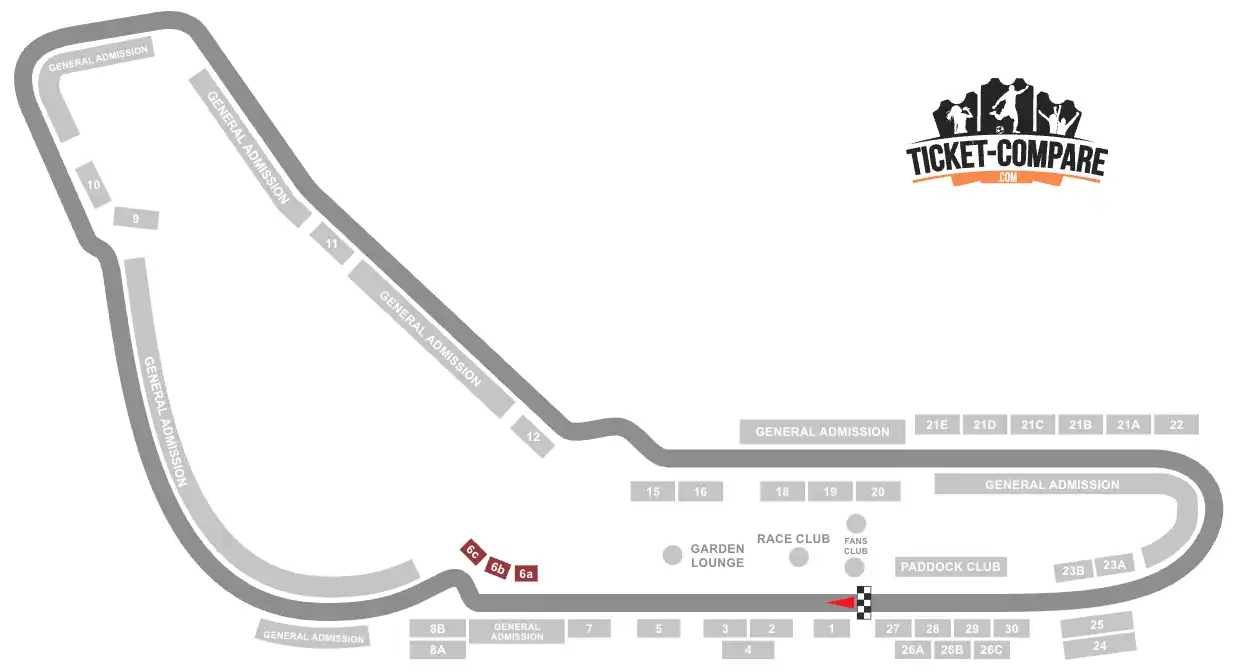
Grandstands 6A, 6B and 6C Alta Velocità
Location: The Alta Velocità stands sit on the inside of the first chicane.
View: Grandstand 6C is the closest of the group to the heart of the braking and rotation phase. It is generally the strongest choice for seeing drivers arrive under maximum braking, defend the inside and negotiate the tight right-left sequence.
Grandstand 6B moves slightly away from that ideal apex relationship but still shows much of the approach and chicane action.
From higher rows, spectators may also see further back along the main straight. Grandstand 6A is the more distant and normally less expensive member of the group, offering the same broad area with a less concentrated chicane angle.
Recent reports have been consistently positive about 6B, particularly from upper rows. One recurring practical warning concerns aisle seats, where staircase movement can interrupt the sightline.
Best suited to: 6C for the clearest premium Turn 1 view; 6B for strong action at a lower level; 6A for access to the same general sector at a more modest price.
Grandstands 8A and 8B Prima Variante Esterna
Location: These stands face the chicane from the outside of the circuit.
View: Whereas the Alta Velocità structures bring spectators closer to the inside and apex, 8A and 8B tend to give a broader picture of the braking contest. That can make it easier to follow several cars arriving side by side, missing the apex or using the escape road.
Recent spectators have also praised the nearby wooded space, food and drink access and the practical combination of direct track action with a screen.
Best suited to: First-time visitors who want an easily understood racing view rather than only the prestige of the main straight.
Grandstand 8 Bis Uscita Prima Variante
Location: Uscita Prima Variante sits further towards the exit of the chicane.
View: The emphasis shifts from the initial stop and attempted pass to the way cars complete the left-hand exit and accelerate towards Curva Grande. It may still catch contact or a compromised first corner, but it is not identical to 8A or 8B.
Best suited to: Fans who want a lower-priced first-chicane ticket and are more interested in exit traction than the exact braking point.
Curva Grande And Biassono at Monza
Grandstand 7 Biassono
Location: Biassono sits on the outside of the fast right-hand sweep after the first chicane.
View: Cars leave Variante del Rettifilo, accelerate hard and carry speed through a long curve which can be taken at full throttle. The stand therefore communicates Monza’s speed more effectively than its overtaking.
Spectators may see cars building a slipstream and positioning themselves for Roggia, though the decisive braking move usually happens further around the circuit.
Best suited to: People who would rather experience sustained acceleration and full-throttle commitment than sit at a conventional stop-and-turn overtaking zone.
Roggia And Seconda Variante at Monza
Cars approach Variante della Roggia after more than a kilometre of full throttle, including Curva Grande. Monza describes the braking phase as a reduction from roughly 335 kilometres per hour to 110–120 kilometres per hour for a tight left-right sequence.
Grandstands 9 and 10
Location: Grandstand 9 Seconda Variante and Grandstand 10 Roggia sit around the established Roggia chicane complex.
View: These are among the strongest seats for spectators interested in conventional race action. Cars arrive at high speed, attempt passes under braking, attack the kerbs and have to control the change of direction without compromising the run towards Lesmo.
The precise value depends on whether the seat faces more of the approach, the first apex or the exit. Grandstand 9 is associated more closely with the initial variant, while 10 sits around the Roggia side of the complex.
Best suited to: Racegoers who want tactically meaningful braking and overtaking without the visual compression or intense demand of Turn 1.
Grandstands 33A and 33B Seconda Variante
Location: The newer 33A and 33B structures sit on the approach side of the Roggia complex.
View: Grandstand 33B lies closer to the chicane, while 33A provides more of the build-up along the preceding straight. The difference is subtle but important as one prioritises the actual braking and turn-in point, while the other gives more context to the approach.
Best suited to: Spectators comparing a broader braking-zone view with a closer look at the chicane itself.
Lesmo Grandstands at Monza
The two Lesmo corners sit within Monza’s wooded parkland. They are less likely than the chicanes to produce repeated passing yet they show the car carrying lateral load, finding traction and using the available camber.
Monza describes Lesmo 1 as a right-hander taken at about 180 kilometres per hour and Lesmo 2 at approximately 160 kilometres per hour.
Grandstand 34 Lesmo 1 Esterna
Location: Grandstand 34 sits outside the first Lesmo corner.
View: This is a specialist seat for watching turn-in, balance and the car’s movement through a medium-fast right-hander. It does not offer the prolonged build-up of Roggia or the sequence of Ascari, but the proximity and wooded setting create a more focused trackside experience.
Best suited to: Repeat visitors and technically minded fans who care more about driver commitment than headline overtakes.
Grandstand 10 Bis Lesmo 2 Interno
Location: Lesmo 2 Interno sits on the inside of the second Lesmo bend.
View: Spectators see the car through the tighter second right-hander and towards the acceleration zone leading into Serraglio. Exit traction is important because the driver remains committed to the throttle for a long stretch towards Ascari.
Best suited to: Fans interested in traction, car control and a quieter part of the circuit.
Serraglio at Monza
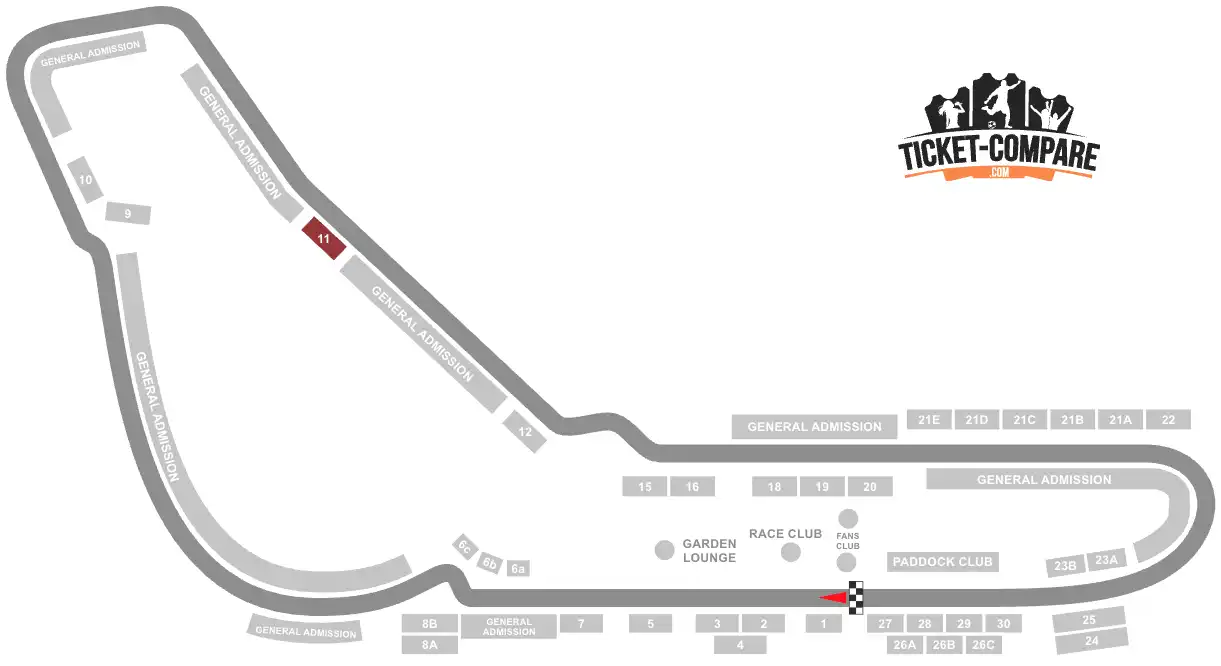
Grandstand 11 Serraglio
Location: Serraglio is positioned beside the high-speed run between Lesmo 2 and Ascari.
View: Cars remain at or close to full acceleration and pass quickly through a slight left-hand bend. This is not a major braking point, so the direct view may be brief. The giant screen becomes particularly useful for following the rest of the lap.
Best suited to: Spectators looking for a lower-cost numbered seat and the physical impression of straight-line Formula 1 speed.
Ascari Grandstands at Monza
Ascari is the most technically revealing grandstand family at Monza. Drivers approach at roughly 330 kilometres per hour, brake and then negotiate a left-right-left sequence at around 200 kilometres per hour.
Former Formula 1 driver Jolyon Palmer has described the opening part of Ascari as “the crucial area”, because getting the first change of direction right determines whether the rest of the sequence can be taken cleanly.
Grandstands 12, 13 and 14
Location: These stands sit around the traditional entry and central portion of Ascari.
View: Grandstand 12 Ascari 3 is angled towards the entry and initial commitment. Grandstand 13 Ascari 4 gives more emphasis to the cars moving through the sequence, while Grandstand 14 Ascari 2 offers a slightly wider and more removed perspective.
Best suited to: 12 for braking and entry; 13 for the direction changes; 14 for a broader overview.
Grandstand 16 Ascari
Location: Grandstand 16 sits on the inside of the Ascari section, around the established central and exit-side viewing area.
View: This is one of the premium Ascari tickets. Its angle gives spectators a strong impression of cars crossing the chicane, using the kerbs and preparing to launch down the following straight.
Best suited to: Fans who want Ascari’s technical view in one of the most established structures.
Grandstands 17A and 17B Ascari Esterna
Location: These stands sit outside the circuit towards the latter part of Ascari.
View: They concentrate less on the initial braking point and more on the exit, where drivers complete the left-right-left sequence and begin accelerating. Grandstand 17B sits further along the exit than 17A, producing a stronger launch and acceleration angle.
Best suited to: Spectators who want to see the car settle after the chicane and accelerate rather than focus exclusively on braking.
Grandstand 18 Uscita Ascari A
Location: Grandstand 18 is positioned on the inside of the Ascari exit.
View: Cars fire out of the final left-hand element and accelerate towards Curva Alboreto. It is a direct expression of Monza speed, with enough corner exit to make the view more informative than an ordinary straight.
Best suited to: Fans seeking an unusual combination of technical driving, acceleration and some weather protection.
Curva Alboreto, Parabolica And Vedano at Monza
The final corner is officially named Curva Alboreto, though Parabolica remains common in ticket listings and spectator conversation.
Cars approach at around 330 kilometres per hour, brake to roughly 180 kilometres per hour and then follow a long, progressively opening right-hand arc towards the main straight.
This is not usually as clear an overtaking location as Turn 1 or Roggia. Its appeal lies in watching braking, sustained corner load, pit entry and the acceleration that begins the next lap.
Grandstands 21A to 21E Laterale Parabolica
Location: The five Laterale Parabolica sections run along the outside approach to Curva Alboreto. Moving from 21E towards 21A brings the spectator progressively closer to the corner itself.
View: The distinctions within the group matter:
- 21A is closest to the apex and the body of the corner.
- 21B concentrates on the braking and turn-in area.
- 21C gives a useful compromise between approach and corner entry.
- 21D and 21E look further back along the straight from Ascari.
All five have giant screens. None is covered, and recent spectator reports repeatedly describe strong sun exposure, particularly in the middle of the day.
At the same time, sections 21C to 21E are often praised for combining atmosphere, useful direct track viewing and a more accessible price level than the premium chicane stands.
Best suited to:
21A/B for the corner itself; 21C for a balanced value choice; 21D/E for the approach and a lower entry point into the Parabolica grandstand family.
Grandstand 22 Parabolica
Location: Grandstand 22 sits outside Curva Alboreto beyond the 21 sections.
View: Its greater height and wider angle show more of the corner as a complete shape. Spectators can follow the braking phase, long arc and acceleration towards the straight.
The official 2026 list identifies 22 as covered. In practice, the exact protection can vary by row and sun angle, so it is better described as a more sheltered choice than a promise of all-day shade.
Best suited to: First-time visitors, families and spectators who want Parabolica atmosphere with greater comfort and a cleaner overall view.
Grandstands 23A and 23B Parabolica Interna
Location: These stands sit inside the final corner near the latter part of the arc and pit-entry side.
View: The cars are travelling more slowly than when passing the main straight, making them easier to follow and photograph. The position also gives useful context to pit entry and the way drivers open the steering before accelerating towards the line.
Grandstand 23B occupies the higher official ticket tier of the pair. Recent spectator reports particularly favour 23B for photography, while also noting that reaching and leaving the area can involve a long, hot walk.
Best suited to: Photographers, pit-entry observers and visitors looking for a less obvious alternative to the outside Parabolica stands.
Grandstand 24 Vedano
Location: Vedano sits outside the circuit after the final corner, close to the beginning of the main straight.
View: The emphasis is on the exit from Curva Alboreto, acceleration and the transition towards the finish. It does not show the full braking phase as clearly as 21 or 22.
Spectator accounts suggest that the usefulness of the roof changes with the angle of the sun.
Best suited to: Fans who want the final-corner atmosphere while remaining closer to the straight and in a covered structure.
Grandstand 25 Uscita Parabolica
Location: Grandstand 25 sits beside the outside exit of Curva Alboreto, between Vedano and the main-straight complex.
View: This is a budget view of cars accelerating out of the final corner. Its lower price position should not be mistaken for a complete Parabolica panorama, and current first-hand information is relatively limited.
Note that there may not be a view of a giant screen here.
Best suited to: Spectators seeking a fixed, low-cost base near the final corner and main straight.
Grandstands 35A, 35B and 35C Vedano
Location: These newer satellite structures sit around the Vedano side of the circuit, near Grandstand 24 and the Parabolica exit.
View: Their current official positioning suggests an exit and acceleration view rather than a complete look into the braking zone. Public review depth remains limited, so the exact subsection should be checked carefully rather than assuming all three face the same point.
Best suited to: Fans comparing lower-priced numbered seats around Vedano.
Gradinate Interno Parabolica at Monza
Location: Gradinate Interno Parabolica occupies a long, curved internal terrace within Curva Alboreto.
View: It provides more elevation and a more defined viewing base than ordinary General Admission. Spectators see sections of the long final corner.
It is not a numbered grandstand. Places are unreserved, so arriving early still matters, especially when a particular screen angle or part of the terrace is preferred. The experience is closer to a managed open bleacher than an assigned seat.
Recent accounts describe bench seating, strong sun exposure and competition for the better positions, balanced by nearby facilities and relatively direct post-race circuit access when organisers open the route.
Best suited to: Budget-conscious spectators who want more structure and certainty than General Admission without paying for a numbered grandstand.
General Admission at Monza
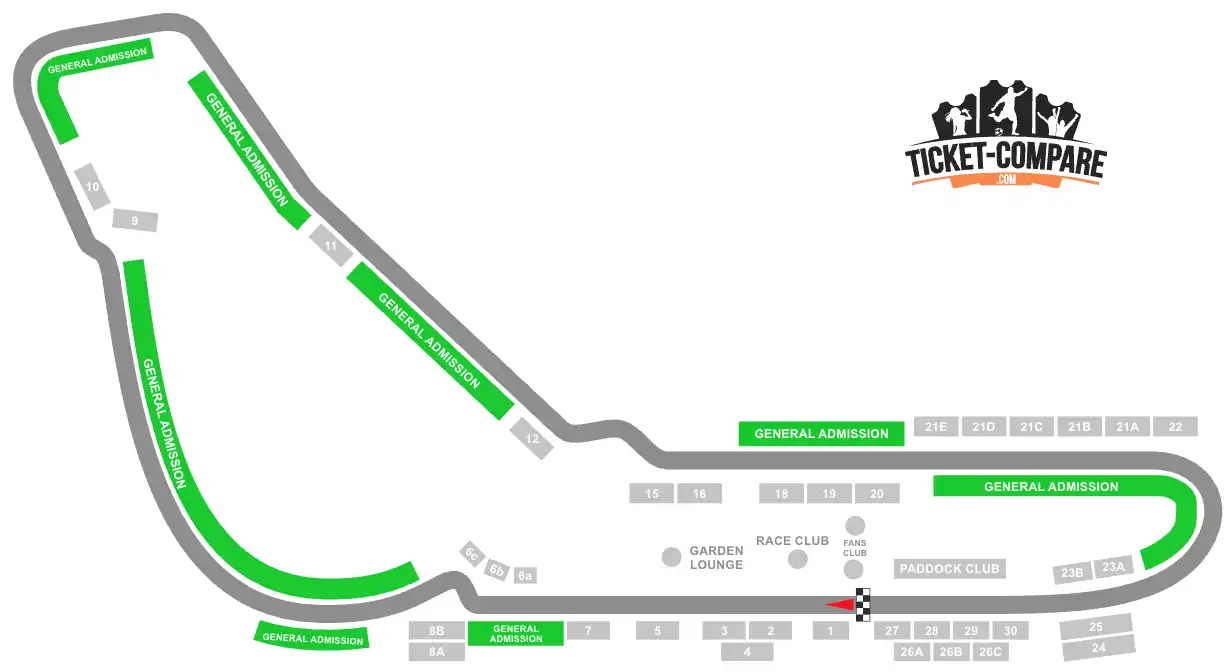
Location: Circolare Prato covers designated spectator areas around parts of the circuit rather than one unrestricted zone. The current official map shows lawn areas around Curva Grande, the Lesmo and Serraglio side, stretches towards Ascari and portions of the Parabolica approach.
View: The quality varies dramatically. Monza is relatively flat, and useful positions can be interrupted by fencing, trees, temporary structures and other spectators. A giant screen will never be promised with General Admission, but you may get a glimpse of one.
With these F1 tickets, Friday is the most useful day for exploring the available banks and fence-line positions. By Sunday, the most desirable areas can fill very early. Lesmo has produced some positive recent experiences, while the general consensus is that Monza demands more preparation than naturally elevated General Admission circuits.
Best suited to: Mobile, prepared visitors who prioritise price and atmosphere, are willing to walk and do not require an assigned view.
General Admission is less suitable for anyone who wants a screen, a guaranteed seat, straightforward group seating or the ability to arrive shortly before the Formula 1 session.
Hospitality and Premium Viewing at Monza
Hospitality at Monza is not confined to a single building. Different products attach comfort and service to very different parts of the circuit.
F1 Paddock Club at Monza
The Formula 1 Paddock Club is situated above the team garages on the main straight. It overlooks the pit lane and grid from a covered setting, combining the central race view with lounge hospitality, food, drinks, screens and scheduled pit-lane activities.
Exact inclusions depend on the package and should be checked rather than assumed.
It is suited to visitors who place comfort, pit activity and service above braking-zone action.
Circuit hospitality by viewing area
Monza’s own portfolio creates several more geographically specific choices:
- Race Club faces the starting grid and has reserved seating associated with its main-straight hospitality space.
- Garden Lounge links a covered reserved viewing position with the start-to-first-chicane part of the circuit.
- Fans Club combines a pit-lane-facing lounge with a numbered seat at the Ascari exit.
- Ultimate Hospitality sits between Ascari and Parabolica with a reserved grandstand reached directly from the lounge.
- Dolce Vita Lounge overlooks the Parabolica exit from a private trackside terrace.
- Green House is the Lesmo-side option.
- Schumacher Lounge is associated with the first-chicane area and Grandstand 6A.
These are not simply more expensive versions of the same seat. Race Club is primarily about the grid and pits, Fans Club combines two different viewing locations, and Ultimate Hospitality focuses much more directly on the racing line between Ascari and Curva Alboreto.
Best Places to Sit at Monza
The best Monza seat depends on the part of the weekend that matters most to you.
Best seats for overtaking
Start with 6C, 6B, 8A and 8B at the first chicane. They show Formula 1 cars attempting to share a narrow braking zone after the longest run from the grid.
The second choice is the Roggia family: 9, 10, 33A and 33B. Roggia provides another substantial stop, aggressive kerb use and the possibility of mistakes or passes without relying only on first-lap congestion.
Best seats for the start, pits and finish
Choose Centrale 1 for the broadest public view of the grid, pits and finish. 26A is strongest for the grid and garage side, 26B is the balanced Laterale Destra option, and 26C moves the emphasis towards the podium and tifosi atmosphere.
The lower Gradinate Traguardo structures keep spectators close to the finish and celebrations, though they sacrifice height and some comfort.
Best seats for technical driving
Ascari is the clearest answer. 12 emphasises entry, 13 shows more of the sequence, 16 is the premium classic choice and 17B or 18 concentrate on the exit.
For a quieter technical view, 34 at Lesmo 1 shows balance through a medium-fast corner, while 10 Bis at Lesmo 2 reveals traction onto the long run towards Ascari.
Best seats for speed
Grandstand 7 Biassono shows the acceleration through Curva Grande. Grandstand 11 Serraglio is a more specialist straight-line seat, while 18 Uscita Ascari combines acceleration with a genuine corner-exit view.
Best covered seats
The following grandstands at Monza are covered:
- Centrale 1
- Laterale Sinistra 4
- Uscita Ascari 18
- Parabolica 22
- Vedano 24
- Laterale Destra 26A, 26B and 26C
Covered does not always mean fully shaded. The roof position, row and direction of the sun can all affect how much protection the seat receives.
Best seats for a first visit
For an immediately understandable racing view, 8A or 8B are difficult to beat. They combine first-chicane action with a marked giant screen and a location that recent spectators have found relatively practical.
For a broader and more comfortable experience, Grandstand 22 combines Curva Alboreto, a screen and cover. For fans whose idea of Monza centres on the grid, Ferrari flags and the podium, 26B or 26C may be the more memorable first visit.
Monza Grandstands Compared
| Area | What You See | Best For | Main Trade-Off |
|---|---|---|---|
| Centrale | Grid, garages, pits, start, finish | Ceremony and strategy | Limited sustained corner action |
| Laterale Destra | Grid, pits, podium end | Tifosi atmosphere and main-straight moments | Cars pass extremely quickly |
| First chicane | Heavy braking, congestion, attempted passes | Overtaking and first-lap action | Exposed seating and intense demand |
| Biassono | Full acceleration through Curva Grande | Raw speed | Little conventional braking action |
| Roggia | Braking, kerbs and direction change | Race action and mistakes | Far from the main-straight ceremonies |
| Lesmo | Balance and traction | Technical viewing | Fewer overtaking attempts |
| Serraglio | High-speed acceleration | Sensation of speed and value | Short direct viewing time |
| Ascari | Braking and a left-right-left sequence | Car control and driver technique | Less podium atmosphere |
| Curva Alboreto | Braking, long corner, pit entry and acceleration | Broad final-corner view | Many sections are exposed |
| Gradinate Interno Parabolica | Unreserved raised terrace | Structured budget option | No assigned place |
| General Admission | Variable banks and standing areas | Price and flexibility | No guaranteed seat, screen or clear view |
| Paddock Club and hospitality | Pits, grid or a product-specific circuit sector | Comfort and service | Different category and cost from ordinary seating |
Monza Seating Plan | Frequently Asked Questions
What are the best seats at Monza?
For overtaking, the strongest options are 6C, 6B, 8A and 8B at the first chicane, followed by 9, 10, 33A and 33B at Roggia. Centrale and Laterale Destra are better for the grid, pits, finish and podium. Ascari is the leading choice for technical driving, while 21 and 22 are strong final-corner options.
Where should first-time visitors sit at Monza?
8A and 8B provide an easy-to-understand view of first-chicane braking and are marked for giant-screen viewing. Grandstand 22 is a more comfortable alternative around Curva Alboreto, while 26B or 26C suit visitors focused on the main Monza atmosphere.
Is Ascari a good place to sit at Monza?
Yes. Ascari is one of the best places to study braking, kerb use and rapid direction changes. Choose 12 for entry, 13 or 16 for more of the sequence, and 17B or 18 for the exit and acceleration.
Is Parabolica or Curva Alboreto a good place to sit?
Yes, particularly for spectators interested in the final braking phase, sustained cornering, pit entry and acceleration onto the main straight. Grandstand 22 gives a broad, covered view, while the 21 sections offer several different approach and apex angles.
Are any Monza grandstands covered?
Grandstands 1, 4, 18, 22, 24 and 26A/B/C are covered, according to the latest information.
Is General Admission worth it at Monza?
It can be worthwhile for fans prioritising price and atmosphere who are willing to arrive early, walk extensively and accept an uncertain view. It is less suitable for visitors who need a reserved seat, dependable screen or easy group arrangement.
What is Gradinate Interno Parabolica?
It is a separately ticketed, non-numbered terrace inside Curva Alboreto. It provides a more structured and elevated base than ordinary General Admission and is marked for a giant screen, though spectators must still arrive early to claim a preferred position.
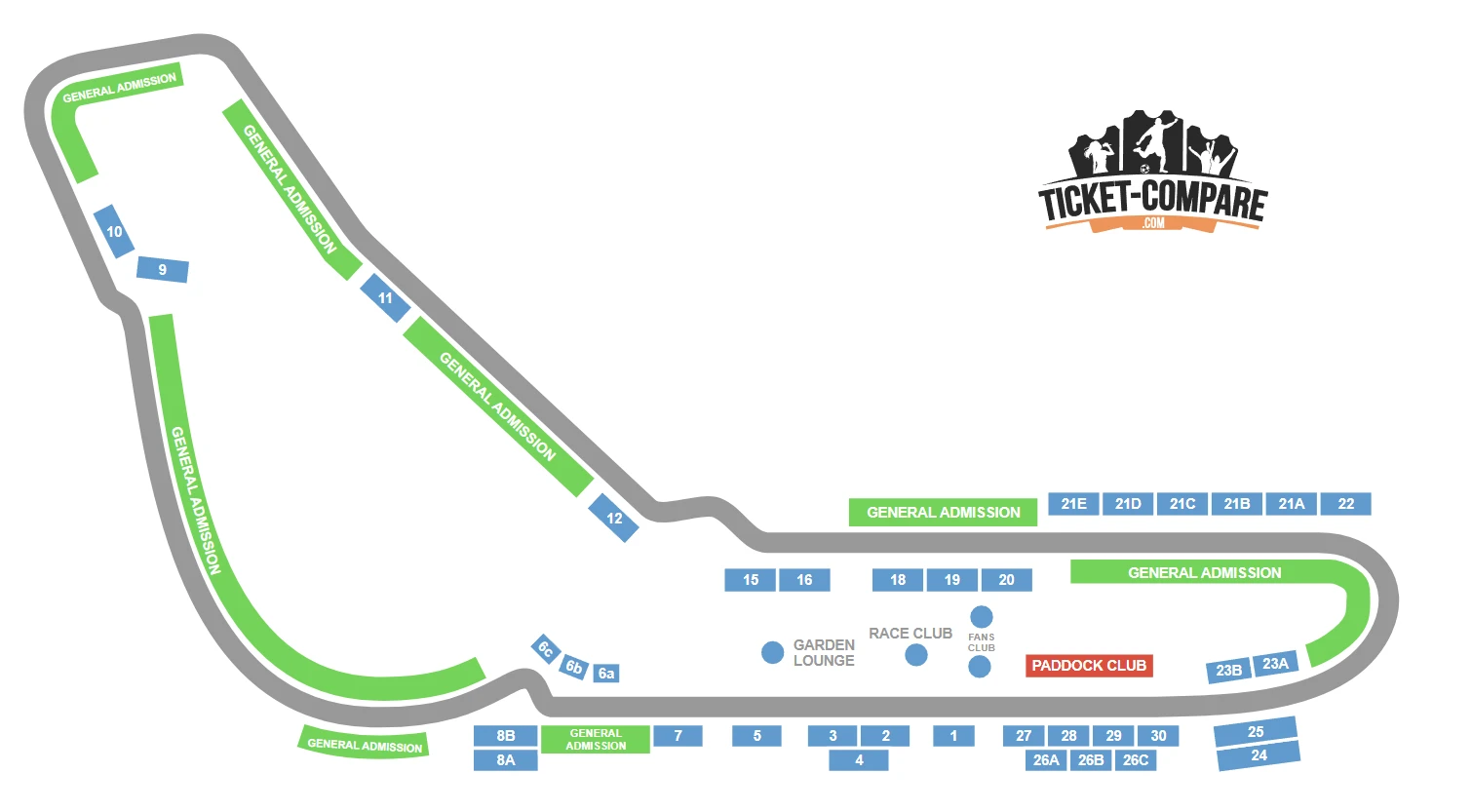
| Section | Blocks | Block Count |
|---|---|---|
| General Admission | General Admission General Admission | 1 |
| Grandstand | 1, 2, 10, 11, 12, 15, 16, 18, 19, 20, 21A, 21B, 21C, 21D, 21E, 23A, 23B, 3, 4, 5, 7, 9, 22, 24, 25, 26A, 26B, 26C, 27, 28, 29, 30, 6A, 6B, 6C, 8A, 8B 1, 2, 10 | 37 |
| Paddock Club | Paddock Club Paddock Club | 1 |
| Sectors | Fans Club, Garden Lounge, Race Club Fans Club, Garden Lounge, Race Club | 3 |

Co-founder of Ticket-Compare.com, Aviran Zazon is a web developer, marketer and lifelong sports fan, inspired by the magic of Ronaldinho’s Barcelona.


