



How To Watch Players Warm Up At Wimbledon
Written by Aviran Zazon
Yes, spectators can often watch players practise or warm up at Wimbledon, especially around the practice-court areas near Aorangi.
It is one of the most enjoyable parts of a day on the Grounds, because it can give ordinary visitors a closer look at how elite players prepare than they would usually get from a match seat.
The important word is ‘often; though. Wimbledon practice viewing is informal, crowded and unpredictable. You cannot buy certainty that a particular player will appear, and you should not treat the practice courts as a public meet-and-greet area.
The best approach is to enter the Grounds early, head towards the practice facility at Aorangi Park, use the Order of Play to make educated guesses, and treat any good sighting as a bonus rather than the whole purpose of the day.
This guide explains where players warm up, what a Grounds Pass can and cannot do, when to try, how to use the day’s schedule sensibly, and how to behave around practice courts without getting in the way of players, staff or other spectators.
Centre Court and No.1 Court
2027 Wimbledon - 1st Round - Men’s & Ladies (Centre Court)
Wimbledon・Wimbledon Tennis Club Centre CourtLondon, United Kingdomfrom $3,144116 available tickets2027 Wimbledon - 1st Round - Men’s & Ladies (No.1 Court)
Wimbledon・Wimbledon Tennis Club Court OneLondon, United Kingdomfrom $2,09348 available tickets2027 Wimbledon - 1st Round - Men’s & Ladies (No.1 Court)
Wimbledon・Wimbledon Tennis Club Court OneLondon, United Kingdomfrom $2,09840 available tickets2027 Wimbledon - 1st Round - Men’s & Ladies (Centre Court)
Wimbledon・Wimbledon Tennis Club Centre CourtLondon, United Kingdomfrom $2,75097 available tickets
In Brief: Can You Watch Players Warm Up At Wimbledon?
Spectators can often watch players practising at Wimbledon from the practice-court viewing areas within the Grounds, particularly around Aorangi.
The All England Lawn Tennis Club site includes 14 grass practice courts in Aorangi Park, with a further six temporary grass practice courts used during The Championships on the Croquet Lawns.
The simplest strategy is:
- Arrive as early as your ticket or Queue plan allows
- Head towards Aorangi and the Players’ Practice Courts
- Check the Wimbledon Order of Play before you go
- Look for players scheduled later in the day
- Expect queues, partial sightlines and stewarded movement
- Avoid planning your entire visit around one named player
A Wimbledon Grounds Pass may be enough for this experience because practice-court viewing is part of the wider Grounds day, not a reserved show-court seat.
A Centre Court or No.1 Court ticket is only needed if you want to watch the short pre-match warm-up on that specific court before a match you are ticketed to attend.
Where Do Players Warm Up At Wimbledon?
There are several different kinds of warm-up at Wimbledon, and they are easy to confuse.
The first is a proper practice-court session. This is what most fans mean when they ask how to watch players warm up.
A player might hit with another player, a coach or a hitting partner, working through serves, returns, rhythm rallies, movement patterns, volleys or short point-play. These sessions usually happen on practice courts rather than on Centre Court or No.1 Court.
The second is the short pre-match knock-up on the match court. If you have a seat for a match on Centre Court, No.1 Court or another court, you can watch the players warm up immediately before play starts.
That is a useful part of the match-day experience, but it is brief and functional. It is not the same as watching a longer practice session.
The third category is off-court physical preparation. Players stretch, cycle, use resistance bands, work with physios and move through activation drills away from public-facing courts.
You may glimpse some of this around the wider player areas, but it should not be treated as a spectator attraction. If a player is warming up physically, walking with their team or heading into a restricted area, give them space.
There is also occasional hitting on numbered outside courts when they are not in match use. Fan accounts sometimes mention players practising on outside courts, but this should be treated as a possibility rather than a rule. The safest answer for a first-time visitor is still Aorangi.
Can Spectators Access The Practice Courts?
Spectators can access parts of the Grounds from which practice courts can be viewed, but access depends on crowd levels, stewarding and the day’s operation.
Wimbledon is not laid out like some tournaments with large practice-court grandstands and published practice schedules. Aorangi can feel close and exciting, but it can also mean narrow viewing areas, moving queues and short glimpses rather than a settled seat for a full session.
A Grounds Pass is often enough if your aim is to visit the practice-court area, watch outside-court tennis, spend time around the Grounds and see what is happening near Aorangi. It does not guarantee a view of a specific practice court, a particular player, or a long viewing window.
Show-court tickets work differently. A Centre Court ticket gives you access to your Centre Court seat for that day, not automatic access to No.1 Court or every other reserved court.
If you want to watch the pre-match warm-up on Centre Court, you need access to Centre Court for that session. If you want to watch a longer practice session, Aorangi is usually the more relevant area.
| Area | What You Might See | Access Reality | Best For |
|---|---|---|---|
| Aorangi practice courts | Longer hitting sessions, coaches, hitting partners, player routines | Grounds access may be enough, but views can be restricted or stewarded | Seeing practice up close |
| Centre Court / No.1 Court | Short pre-match knock-up before a scheduled match | Requires the right court ticket and seat access | Watching warm-up before a match |
| Outside courts at Wimbledon | Matches, occasional practice or hitting when courts are free | Depends on court use, crowding and stewarding | Flexible wandering and close tennis |
| Off-court preparation areas | Stretching, movement, physio or transit glimpses | Often private or restricted | Not a spectator target |
Best Times To Watch Players Practise
Morning is usually the most useful window. Wimbledon states that the Grounds open at 10am, outside-court play starts at 11am, No.1 Court starts at 1pm, and Centre Court starts at 1.30pm from Day 1 to Day 12.
That creates a natural practice window after the Grounds open and before the main show-court matches begin.
Players scheduled later on Centre Court or No.1 Court may have time for a visible hit during the morning, while outside-court players who are first on at 11am may have completed much of their preparation before many spectators are settled inside the Grounds.
Late morning and early afternoon can also be useful, especially for players scheduled second or third on a show court.
The trade-off is that the Grounds will be busier, and practice-court viewing areas may be harder to access once more people have arrived.
Mid-to-late afternoon is less predictable. Players may practise after matches, prepare for doubles, hit on rest days or adjust plans because earlier matches have run long. It can still be worth walking past Aorangi, but it is harder to plan around.
Best Days To Try
The first few days and the wider first week are usually the best days to attend Wimbledon to catch warm-ups. More singles players are still in the draw, more doubles matches are active, more outside courts are in use, and more players are trying to adjust to grass-court rhythm.
The middle weekend and early second week can still be rewarding, especially because doubles, juniors, wheelchair events and invitational matches keep the Grounds active. The singles field is smaller, so there are fewer top singles players moving through practice routines, but serious tennis watchers may still find plenty to enjoy.
Semi-final and final days are less efficient if practice-court watching is your main goal. Fewer players remain, preparation may be more controlled, and the focus of the Grounds shifts towards the biggest matches.
How To Use The Order Of Play To Plan
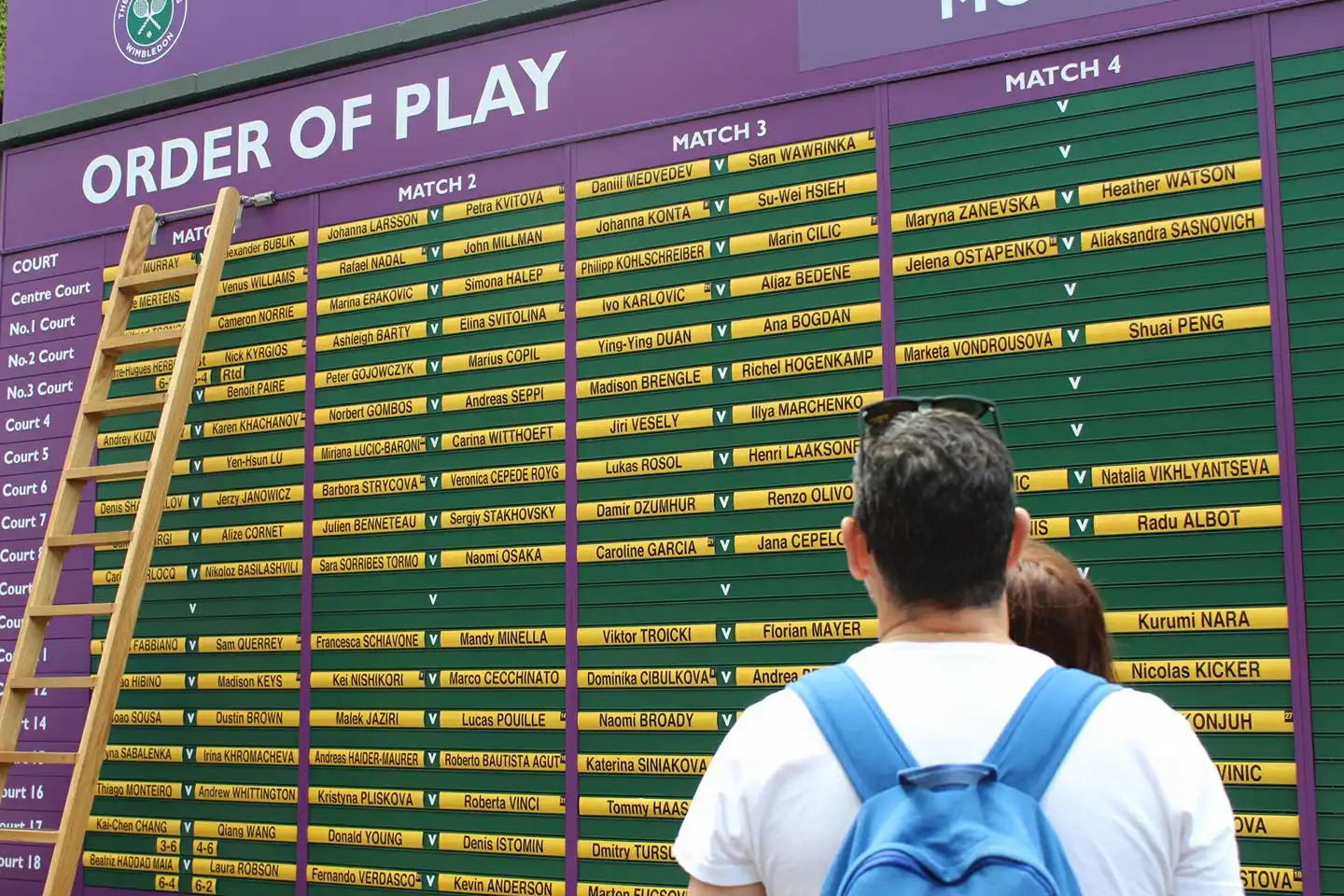
The Order of Play is not a practice schedule, but it is still useful. It tells you who is playing, where they are playing and roughly how their day might be shaped.
Start by checking the Order of Play the night before your visit. Players first on outside courts at 11am may be difficult to catch unless you are inside quickly.
Players scheduled later on Centre Court or No.1 Court may have a more plausible morning practice window, because their match does not begin until later in the day.
For second or third matches if you have show court tickets, think in ranges rather than exact times. A player might hit in the morning, wait to see how earlier matches develop, practise privately, or skip a visible session altogether. The schedule gives clues, not certainty.
Do not ignore doubles, juniors and wheelchair players. If your real interest is watching elite preparation rather than seeing one famous face, these sessions can be fascinating.
You may notice serve patterns, return drills, racquet changes, coaching conversations and grass-court footwork in a way that is harder during a match.
Grounds Pass Strategy For Warm-Up Watching
A good Grounds Pass strategy is to make Aorangi one part of the day, not the whole day.
After entering, head towards the practice-court area and see what the crowd looks like. If there is a manageable queue or an obvious player on court, it may be worth staying. If the area is packed or nothing much is happening, move on to an outside court, check the Hill, get your bearings and return later.
This is also where ticket choice matters. A Grounds Pass can be excellent for a flexible day built around practice courts, outside-court tennis and the wider Wimbledon atmosphere. A reserved Centre Court or No.1 Court ticket suits a different aim: watching specific show-court matches from a guaranteed seat.
Readers who want that guaranteed show-court element alongside a grounds-based practice-court experience may compare available Wimbledon ticket options in advance. Ticket-Compare.com is a ticket comparison platform, not a seller, and it lists tickets from pre-vetted resale sites and official ticketing partners, often including hospitality.
It helps fans compare price, availability and ticket types in one place before clicking through to the relevant provider if they choose to buy.
What The Aorangi Practice-Court Experience Is Really Like
Fan discussion around Wimbledon practice courts tends to be consistent: it can be brilliant, but it is not effortless. The area may be crowded, sightlines may be partial, and stewards may need to keep people moving.
A recent Reddit thread captures the practical question many first-time visitors have:
Where do they warm up? by u/True_Initiative1635 in wimbledon
The useful takeaway is not that there is a secret route or guaranteed player list. It is that practice-court viewing is a real part of the Wimbledon day, but one that depends on timing, patience and the way the Grounds are being managed at that moment.
A good outcome might be a ten-minute close view of a recognisable player hitting. A very good outcome might be seeing several players over an hour or two. A normal disappointing outcome might be a crowd, a distant angle, a player leaving just as you arrive, or a session involving someone you do not know well.
Practice-Court Etiquette
The simplest rule is to remember that players are working. A practice court is visible to spectators, but it is not a stage for interaction.
Keep noise low, especially during serves, drills and coaching conversations. Do not shout a player’s name repeatedly, lean over barriers, block walkways, push into children’s sightlines or try to start a conversation mid-session. If stewards ask a queue to move or a viewing area to clear, follow the instruction quickly.
Photography should be occasional and respectful. Wimbledon advises that flash photography from the stands is forbidden, and spectators should avoid using phones or cameras in ways that inconvenience others. A sensible practice-court version of that rule is simple: no flash, no filming long clips of drills, no phones shoved towards players, and no blocking another spectator’s view to get a better shot.
Autographs are possible only when a player clearly chooses to engage with fans. The right time to ask is when they have stopped, turned towards spectators and are voluntarily signing. The wrong time is while they are hitting, walking with their team, eating, receiving treatment, cooling down or leaving through a restricted route.
Families should be especially mindful around practice courts. Crowds can compress quickly when a famous player appears.
Children may enjoy the view, but adults should not push them against barriers, place them where they block others for long periods, or encourage them to chase players.
Common Mistakes First-Time Visitors Make
The biggest mistake is arriving with one named player in mind and treating anything else as failure. Wimbledon practice-court viewing rewards curiosity. You may learn more by watching a coach feed repeated backhands to a lower-ranked player than by seeing a superstar for two minutes through a crowd.
Another mistake is assuming Centre Court is the place to see warm-ups. The pre-match knock-up happens there, but only for people with access to that court. Longer practice activity is more closely associated with Aorangi and the practice courts.
Visitors also lose time by waiting too long to check the practice area. If warm-up watching matters to you, look early, then keep it flexible. Aorangi is worth revisiting, but it should not stop you enjoying outside-court matches and the rest of the Grounds.
Finally, avoid over-filming and autograph chasing. The most rewarding way to watch practice is to notice the tennis: the movement, serve targets, hitting partner, coach feedback, surface adjustment and body language.
How To Watch Players Warm Up At Wimbledon | FAQs
Where are the Wimbledon practice courts?
The main practice courts are associated with Aorangi Park. The All England Lawn Tennis Club says the main site includes 14 grass practice courts located in Aorangi Park, with six further temporary practice courts during The Championships on the Croquet Lawns.
Do you need a Centre Court ticket to watch players practise?
Not usually for practice-court viewing around Aorangi. You need access to the Grounds, but not necessarily a Centre Court ticket. To watch the short pre-match warm-up on Centre Court itself, you do need the correct Centre Court ticket and seat access.
What time do players warm up at Wimbledon?
Morning is usually the best general window, especially soon after the Grounds open. Outside-court play starts at 11am, while No.1 Court and Centre Court begin later on most tournament days, so players scheduled later may practise during the morning or late morning.
Can you see top players on the practice courts?
Yes, top players do practise around Wimbledon, and Aorangi can be one of the best places to see elite players at close range. The caveat is important; there is no guarantee of seeing a specific player, and famous practice sessions can attract heavy crowds.
Is a Grounds Pass enough to watch player warm-ups?
A Grounds Pass can be enough if your aim is to check the practice-court areas, watch outside-court tennis and explore the Grounds. It does not guarantee a specific view, a named player, or access to reserved show courts such as Centre Court or No.1 Court tickets.
Does Wimbledon publish a practice-court schedule?
Spectators should not rely on a detailed public practice schedule for named players. Wimbledon directs fans towards the daily Order of Play for match scheduling, but practice sessions are more fluid and can change according to player preference, weather, match timing and operational needs.
Can you take photos of players practising?
Personal photos may be part of the spectator experience, but they should be discreet. Do not use flash, block other people, film long drills, or treat off-court preparation as content. Practice courts are public-facing, but players are still preparing for competition.
Conclusion: Is Watching Players Warm Up At Wimbledon Worth Trying?
Watching players warm up at Wimbledon is absolutely worth trying, provided you approach it realistically. Enter the Grounds early, head towards Aorangi, use the Order of Play for clues, and stay flexible.
A Grounds Pass may be enough for this kind of day, while reserved show-court tickets are better for fans who want guaranteed access to Centre Court or No.1 Court matches.
The best Wimbledon practice-court experience is not about chasing a signature or forcing a sighting of one player. It is about seeing the preparation behind the matches, the footwork, rhythm, coaching, serving patterns and quiet routines that shape what later happens on court.
For visitors comparing broader Wimbledon ticket options before they go, Ticket-Compare.com can be a practical way to review available listings across providers, but the warm-up experience itself still depends on timing, patience and a little luck.
As you read this, there are 1,957 tickets for Wimbledon available via Ticket-Compare.com.
Related Articles:
Which is Better: Centre Court or No.1 Court?
Can You Upgrade Wimbledon Tickets on the Day?
What is the Dress Code for Wimbledon?


