



Best Days To Attend Wimbledon: When To Go For The Best Matches And Tickets
Written by Aviran Zazon
If you can only choose one Wimbledon day, the strongest all-round answer is probably Day 8, the second Monday of the Championships.
That day gives you a rare balance of high-quality, meaningful matches without losing the wider feel of a full Wimbledon day.
That said, there is no single perfect answer for everyone. The best day depends on what you care about most.
Some visitors want as many matches as possible, others want to see the biggest players, and others simply want a smoother, more relaxed day with easier access.
Wimbledon changes noticeably as the tournament progresses, and understanding that shift is what helps you choose well.
Every Day Available!
Best Days To Attend Wimbledon: In Brief
| Priority | Best days | Why they stand out |
|---|---|---|
| Most matches | Days 3–4 | The grounds are still full of live matches, with slightly less chaos than opening days |
| Best overall experience | Day 8 | Fourth-round quality with a still-busy, full-site atmosphere |
| Best Grounds Pass value | Days 3–4 | Strong roaming day with active outside courts and player visibility |
| Best show-court value | Days 5–8 | Better match quality than early rounds without final-stage pricing |
| Biggest atmosphere | Days 1–2 | Opening buzz and anticipation across the entire site |
| Most prestigious tennis | Days 11–14 | Semi-finals and finals carry the most significance, but less overall activity |
| Easier access | Later days | Fewer queue pressures, but also less tennis across the grounds |
In simple terms, the first week is about volume and exploration, the second week is about prestige and focus, and the best balance sits between the two.
How Wimbledon Changes Across The Two Weeks
Wimbledon unfolds in stages. The first few days are dominated by first- and second-round singles, followed by third-round matches, then fourth-round play at the start of week two, and finally the quarter-finals, semi-finals and finals.
The biggest shift is in how much tennis is happening across the grounds.
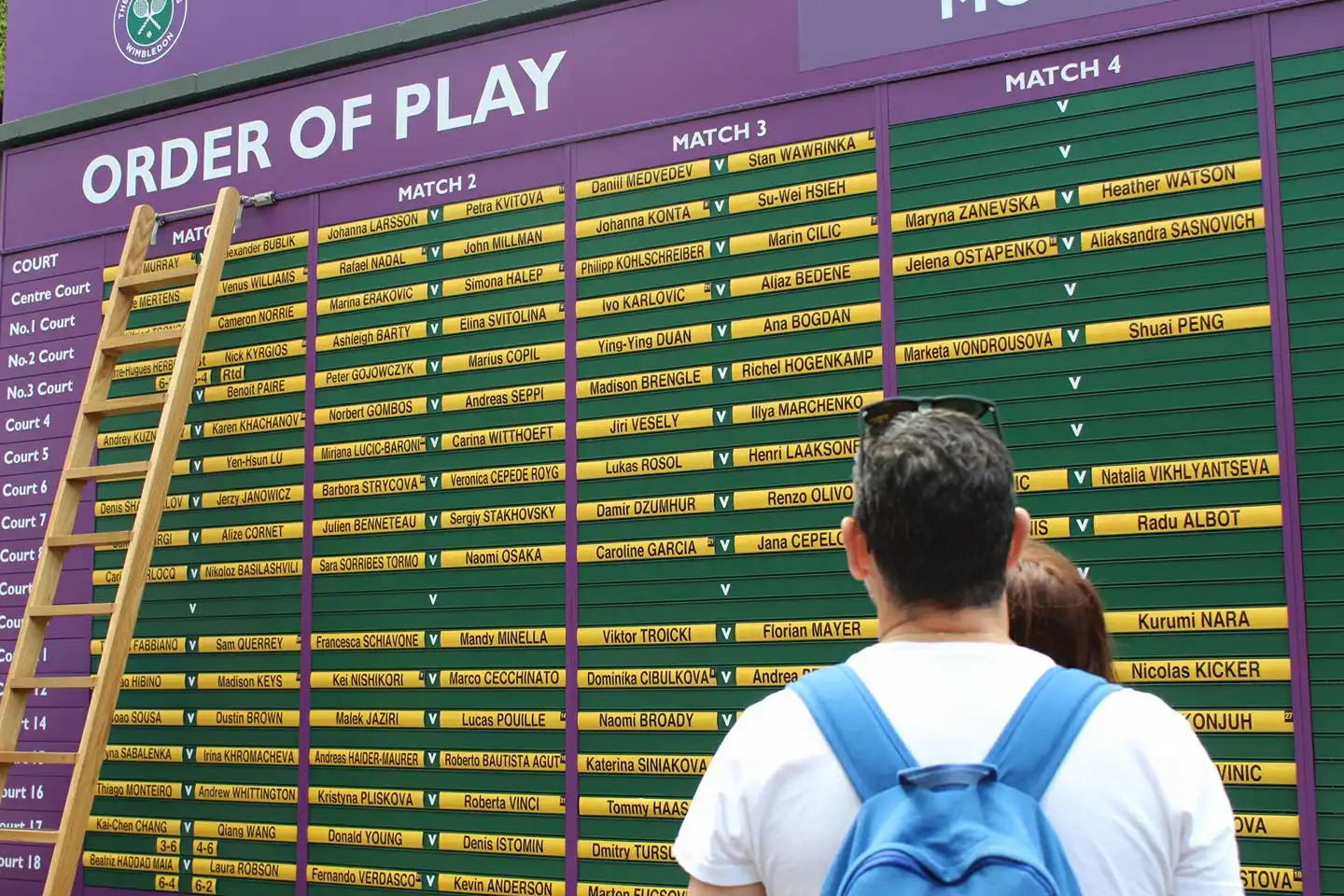
Early in the tournament, almost every court is in use. You can walk from match to match, stop at smaller courts, and discover top players outside the main stadiums.
By the time you reach the quarter-finals, that spread has narrowed significantly. Most of the meaningful action is concentrated on Centre Court and No.1 Court.
At the same time, the quality of matches increases. Early rounds include more uneven contests, while later rounds bring tighter match-ups and higher stakes.
This creates a clear trade-off of more matches versus more important matches.
First Week vs Second Week
Why first week suits more people than they expect
The first week is when Wimbledon feels most alive. There are more matches, more movement around the grounds, and more reasons to explore. If you enjoy wandering between courts and discovering matches rather than sitting in one seat all day, this is the best time to go.
It is also when a Grounds Pass offers the most value. With so many matches taking place across outside courts, you can build a full day without needing a reserved seat.
The downside is demand. Opening days, in particular, can involve long queues and more competition for entry.
Why second week is more focused but…sparser
The second week is about significance. Matches carry more weight, and the names are bigger on paper.
The experience, though, becomes more concentrated. There are fewer matches happening at once, and much of the action takes place on the main show courts. If your goal is to watch top-level singles matches in a reserved seat, this works well. If you want a full day of movement and variety, it can feel more limited.
That is why the best compromise tends to fall at the start of the second week rather than the end.
Best Wimbledon Days For Different Priorities
Most matches and movement
If your goal is to see as much tennis as possible, Days 3 and 4 are the best choice. The schedule is still packed across the site, and the early tournament chaos has settled slightly compared to the opening days.
Seeing top players in meaningful matches
For a balance between quality and experience, Day 8 stands out. By this point, the tournament has filtered down to stronger match-ups, but the grounds still feel active and varied.
Atmosphere
For pure energy, the opening days are hard to beat. Everything feels new, and every match carries a sense of possibility.
For a more tennis-focused atmosphere, the end of the first week into early second week is stronger. The crowd becomes more engaged in the matches themselves rather than the occasion.
Value
For reserved seats, Days 5 to 8 tend to offer the best value. Match quality has improved, but prices have not yet reached their peak.
Many experienced attendees arrive at similar conclusions when comparing days, especially when focusing on Centre Court and No.1 Court ticket value rather than just prestige.
Here’s a recent fan-led ranking of Wimbledon days from a show-court perspective:
This lines up closely with the broader pattern. Late in the first week into early second week tends to deliver the strongest combination of match quality and full-day experience. The main difference today is that Monday is no longer uniquely overloaded, but it still sits right in that optimal window.
Meanwhile, for Grounds Pass holders, Days 3 and 4 are the sweet spot. You are still in the busiest phase of the tournament, with plenty happening across the courts.
Crowd Levels, Queue Pressure And Quieter Days
Crowds at Wimbledon follow demand patterns rather than simple logic.
Opening days are often the busiest for entry, as many people want to experience the start of the tournament. Wimbledon Queue conditions can be demanding, especially if you arrive late.
Later days can feel easier in terms of access, but they are not necessarily quieter overall. High-profile matches and later rounds still attract large crowds, even if fewer matches are taking place.
For a more balanced experience, mid-first week is often the most comfortable. You avoid the opening rush while still getting a full day of tennis.
Ticket Availability And Price Comparison
Ticket availability changes throughout the tournament.
Early in the event, the challenge is often getting in at all or finding a good seat. Later on, the issue shifts to scarcity on premium courts, especially for the biggest matches.
This is where comparison can be useful, especially when you’re dealing with debenture tickets at the upper end of the pricing spectrum. Ticket-Compare.com is a ticket comparison platform rather than a seller.
It lists Wimbledon tickets from pre-vetted resale sites and official partners, often including hospitality options, so you can see what is available in one place instead of searching across multiple websites.
You can then choose the listing that suits you and complete your purchase with the provider.
This approach becomes particularly helpful for Centre Court and No.1 Court tickets on high-demand days, where availability and pricing can vary significantly.
What Are the Best Days to Attend Wimbledon? | Frequently Asked Questions
What is the best day to attend Wimbledon for the most matches?
Days 3 and 4 offer the highest match density across the grounds. Second-round singles are underway, most players are still in the draw, and outside courts are busy all day. If you are comparing last-minute Wimbledon ticket options, platforms like Ticket-Compare.com can help you see which days still have accessible entry points.
Is it better to go to Wimbledon in the first week or second week?
First week is better for variety, movement, and seeing multiple matches across different courts. Second week suits those focused on high-stakes singles on Centre Court or No.1 Court. Many visitors find the best balance at the end of week one or start of week two.
Which days are best for a Wimbledon Grounds Pass?
Days 3 and 4 are the sweet spot. The grounds are still full of singles matches, practice courts are active, and unreserved seating areas are in constant use.
Later in the event, fewer matches take place outside the main courts, which reduces the value of a Grounds Pass.
What are the least crowded days at Wimbledon?
Mid-first week, especially Days 3–4, often feels more manageable than the opening days, when demand peaks. Later in the tournament, entry can be easier, but the grounds are less active. Crowd levels remain high on major match days, even with fewer matches overall.
When are Wimbledon tickets cheapest?
If you’re looking for the cheapest Wimbledon tickets, Grounds Pass prices drop in the second week, reflecting fewer matches across outside courts. Show court tickets are cheapest early on but rise sharply for later rounds.
If you are weighing price against availability, Ticket-Compare.com can help you compare tickets for different days across multiple providers in one place.
Is Day 8 still the best choice with the current schedule?
Yes. Even with the fourth round split across Sunday and Monday, Day 8 still offers the best mix of match quality and a full-site experience.
You get meaningful singles matches without the reduced activity that comes later in the tournament.
Are finals weekend tickets the best Wimbledon tickets?
They are the most prestigious, but not the most complete day out. Finals weekend centres on one or two headline matches, with limited action elsewhere.
If you want a fuller Wimbledon experience, earlier rounds often offer more variety, even if they carry less status.
When Is The Best Time To Go To Wimbledon?
The best time to go to Wimbledon depends on what you want from the day.
If you want the fullest experience with lots of matches and movement, go in the middle of the first week, especially Days 3 and 4.
If you want the best balance between quality and atmosphere, aim for Day 8 or the surrounding days. If your focus is purely on prestige, then the final stages will appeal more, even though they offer a narrower experience.
For many visitors, the ideal answer sits between those extremes. That is where Wimbledon feels both alive and meaningful.
And if you are weighing up different dates and want to see what is actually available across official and resale routes, using a comparison platform like Ticket-Compare.com can help you view your options in one place before deciding which day works best.
Related Articles:
How the Wimbledon Ballot Works
Wimbledon Order of Play Explained
What Is Henman Hill at Wimbledon?
How to See the Biggest Players at Wimbledon
Why Wimbledon Tickets Look So Expensive


