


The Wimbledon Draw: What It Can Tell You Before A Ball Is Struck
Written by Aviran Zazon
The Wimbledon draw cannot tell you exactly who will win, which players will appear on Centre Court or whether an anticipated quarter-final will ever take place.
What it does reveal is each player’s possible route through the tournament, their first opponent, the earliest stage at which leading seeds could meet and the part of the fortnight in which they are likely to play.
For spectators, this is the first moment when a ticket date can be connected meaningfully with particular players. Someone choosing between adjacent first-week days may learn which one is capable of featuring a favourite, while someone with tickets for Centre Court or No.1 Court can begin assessing the pool of possible matches.
The draw therefore brings much greater clarity. Yet to understand it properly, you need to know what the bracket confirms, what remains conditional and what only the daily Order of Play can settle.
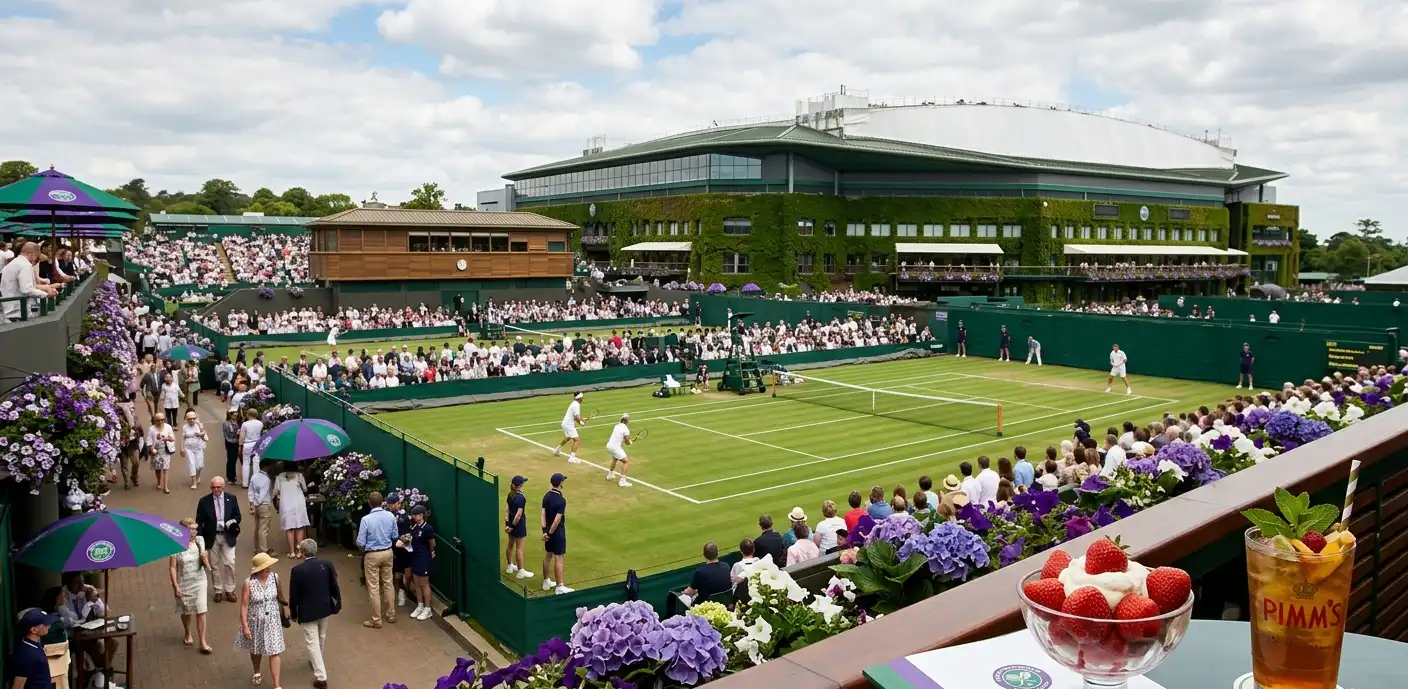
Centre Court and No.1 Court
The Wimbledon Draw in Brief
The draw reveals:
- Every player’s first-round opponent;
- Which half, quarter and smaller section contains each player;
- The earliest round in which particular seeds can meet;
- A player’s possible route towards the final;
- Potentially difficult clusters of seeds, former champions and dangerous unseeded players;
- The likely alternating series of tournament days associated with each section.
It does not reveal:
- Whether players will advance to their projected meetings;
- The exact court on which they will appear;
- The order or start time of their matches;
- Whether injuries, withdrawals, weather or scheduling changes will alter the expected route.
The simplest distinction is that the draw tells you who could play and when their section is likely to progress; the Order of Play tells you where and in what order the matches will actually be staged.
What Is the Wimbledon Draw?
The Wimbledon draw is the knockout bracket for each competition. The gentlemen’s and ladies’ singles draws normally contain 128 players, with a champion needing seven consecutive victories to win the title.
Under the standard Grand Slam composition, a 128-player singles field contains 104 direct acceptances, 16 qualifiers and eight wild cards. Within that overall field, Wimbledon uses 32 seeded positions to keep the highest-ranked entrants apart during the early rounds.
Every line in the bracket leads into another. Two first-round winners meet in the second round, two surviving second-round players meet in the third, and the field continues narrowing until the winners of the two halves contest the final.
Only the opening opponent is certain when the draw is published. A player’s second-round opponent could be either of two people, their third-round opponent could come from a group of four, and their potential finalist could be any one of 64 players in the opposite half.
When Does the Wimbledon Draw Take Place?
The singles draw is normally conducted shortly before the opening day, once the entry list, seedings and qualifying competition are close to completion.
For 2026, it is scheduled for 10am BST on Friday 26 June, three days before the main tournament begins on Monday 29 June. Qualifying runs from Monday to Thursday at Roehampton, which should allow the successful qualifiers to be placed into the main bracket before Friday’s ceremony.
Those calendar dates change from year to year. The lasting principle is that the draw appears at the end of qualifying week and shortly before Day 1, giving players, journalists and spectators a brief window in which to examine the possible routes.
How to Read the Wimbledon Draw
A large bracket becomes easier to follow when viewed as a set of progressively smaller sections.
A half contains 64 players. The winner of the top half meets the winner of the bottom half in the final.
A quarter contains 32 players. Its winner reaches the semi-finals.
An eighth contains 16 players and produces one quarter-finalist, while a smaller eight-player section produces one fourth-round player.
To follow a particular entrant, begin with their first-round line and trace the bracket inward. The two players immediately beside them lead towards round two. The next joined section contains their possible third-round opponents, followed by increasingly broad groups for the fourth round, quarter-final, semi-final and final.
This is why bracket language needs care. Two players in the same quarter are not scheduled to meet. They are simply capable of meeting in the quarter-final if both win four matches.
Seeds, Rankings and Draw Placement
A ranking measures a player’s recent results across the professional tour. A seeding gives that player a protected position within a particular tournament draw.
Grand Slam seed selection is based on a ranking list from approximately seven days before the tournament, and Wimbledon no longer applies its former separate grass-court seeding formula. The seedings do not become official until the final draw is made.
Seed No.1 is placed at the top of the bracket and No.2 at the bottom. Seeds No.3 and No.4 are drawn into separate halves, while the remaining seeds are distributed through progressively smaller sections.
| Seed Band | Earliest Possible Meeting With a Higher-Band Seed |
|---|---|
| No.1 and No.2 | Final |
| No.3 and No.4 | Semi-finals |
| No.5 to No.8 | Quarter-finals |
| No.9 to No.16 | Fourth round |
| No.17 to No.32 | Third round |
This means the top two seeds cannot meet before the final, while the first possible seed-against-seed matches arrive in round three.
Seeding offers protection from other seeds. It does not protect a leading player from a strong unseeded opponent, a grass-court specialist, an improving youngster or somebody returning from injury.
Dangerous Unseeded Players, Qualifiers and Wild Cards
Unseeded does not mean weak. It simply means a player is outside the 32 protected positions.
A former finalist returning after an absence may be unseeded despite remaining highly effective on grass. A younger player may be improving faster than their ranking can reflect, while a qualifier arrives having already won several competitive matches on the surface.
The structure also means that 32 of the 96 unseeded positions sit directly opposite seeds. As a simple mathematical consequence, an unseeded player has roughly a one-in-three chance of drawing a seed in the first round.
Qualifiers win their places through the Roehampton competition. Wild cards are discretionary entries, often awarded because of past Wimbledon performance or British interest, and a wildcard entrant may still be seeded when their ranking is high enough.
The qualifying draw itself produces the first wave of fan analysis before the main bracket is known.
Wimbledon Qualifying draw - Gentlemen's Singles by u/major-couch-potato in tennis
The discussion illustrates how quickly people identify difficult routes, surface suitability and possible main-draw threats. Qualifying form can make a player dangerous, although their eventual place in the main bracket is determined separately once the qualifying positions are filled.
A particularly striking 2026 example is Serena Williams, who has entered the ladies’ singles as an unseeded wildcard. Her seven Wimbledon singles titles make her far more significant to spectators and schedulers than her lack of a seed number might suggest, yet the draw could still place her opposite almost anyone in the field.
How to Spot a Difficult or Favourable Section
The first opponent is the most concrete measure of draw difficulty, although the ranking beside a name rarely tells the full story.
When assessing a section, look for:
- Proven grass-court results;
- Former champions or finalists outside the leading seed bands;
- Players returning from injury;
- Qualifiers with several wins behind them;
- Strong servers and aggressive first-strike players;
- Several difficult possible opponents in consecutive rounds;
- A leading seed carrying a fitness concern.
A so-called open quarter may contain fewer famous names, yet still feature several closely matched players. Conversely, a quarter packed with former champions may open suddenly after one withdrawal and two early defeats.
A good or bad draw is therefore an assessment of risk, not an objective verdict.
Potential Quarter-Finals, Semi-Finals and Finals
Projected later-round matches are normally constructed by assuming that every seed reaches the stage indicated by their number.
That produces a useful framework. It shows which top-eight seed could meet which top-four seed in the quarter-finals, and which leading players share a half.
It is not a forecast that all those matches will happen. A projected quarter-final requires each player to win four times. Injuries, withdrawals, inspired qualifiers and ordinary early-round upsets can dismantle the expected bracket within days.
The safest language is that two players could meet, are projected to meet, or have been placed in the same quarter. Calling it a scheduled quarter-final gives the draw more certainty than it really possesses.
We cover this topic in a bit more detail in our guide on the best days to attend Wimbledon.
What Storylines Emerge From the Draw?
The first analysis usually centres on a handful of questions:
- Which leading contenders share a half?
- Where have the dangerous unseeded players landed?
- Does a British player face an established seed immediately?
- Which former champion has received the hardest opening match?
- Is one quarter noticeably deeper than the others?
- Could a major rivalry resume in the second week?
- Which anticipated clash depends on several uncertain results?
The defending champions’ routes attract particular interest, as do the positions of British players and major former winners.
Yet some of the most important placements appear modest at first. One unseeded grass specialist placed beside a leading seed can change the prospects of an entire section, even when the headline names remain evenly distributed.
What Can Ticket Holders Learn From the Draw?
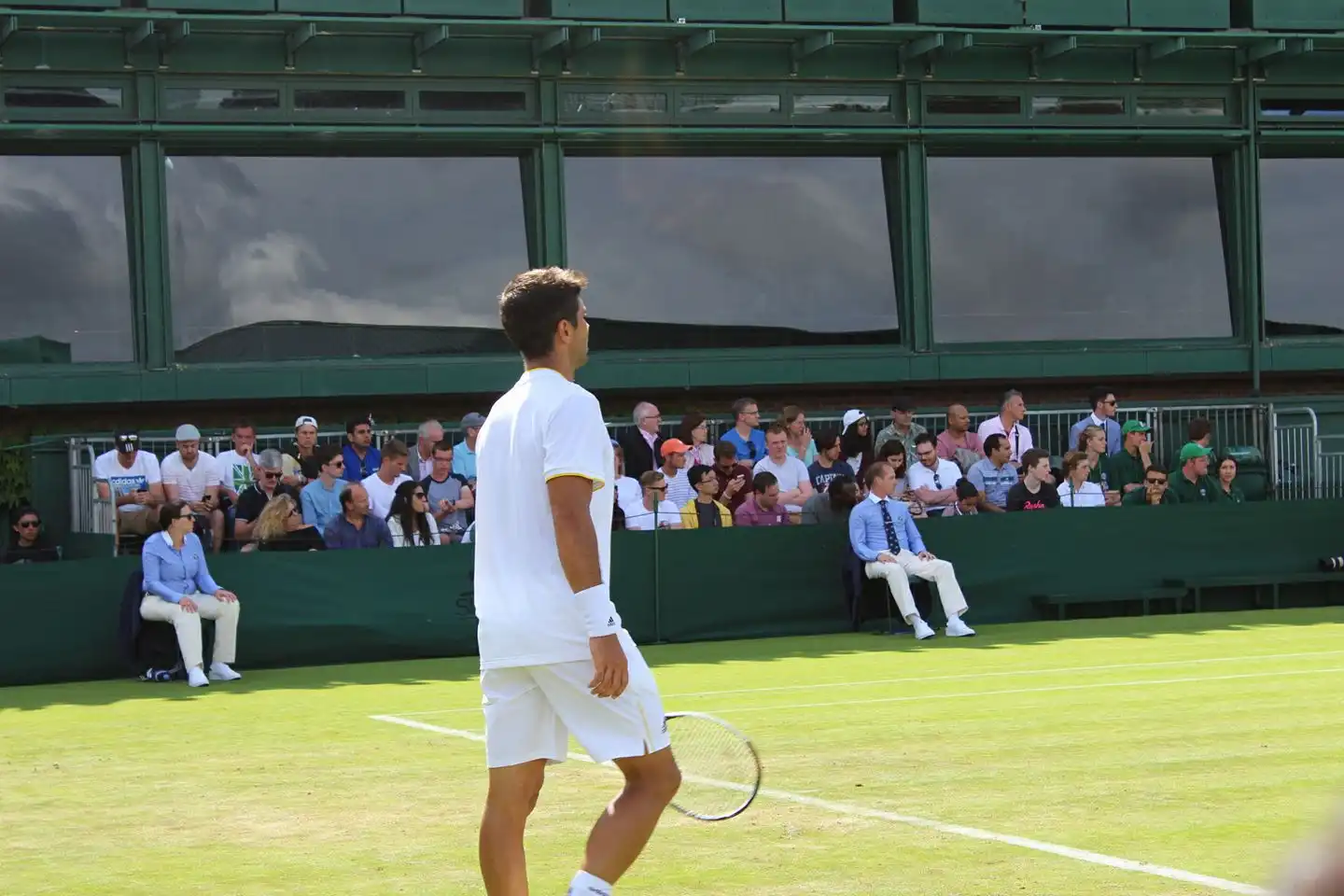
Before the draw, a Wimbledon ticket largely identifies a date, court and scheduled tournament stage. Once the bracket is published, spectators can begin associating that date with a possible group of players.
During the opening rounds, players from each sector are normally progressed on the same day wherever possible. This produces an alternating pattern, allowing followers to trace likely Day 1, Day 3 and Day 5 appearances, or the corresponding Day 2, Day 4 and Day 6 sequence. Weather and scheduling needs can still disturb it.
This is most useful when choosing between adjacent dates. It is less useful when choosing between Centre Court and No.1 Court, because the bracket does not divide players between them.
A Grounds Pass holder may also identify a particularly appealing collection of first-round matches. With 128 singles matches spread across the first two days, many seeds, qualifiers, emerging players and recognisable unseeded names must appear away from the two principal courts. The assignment and available capacity remain unknown until the daily programme is released.
How the Draw May Influence Centre Court and No.1 Court Scheduling
Wimbledon does not fill Centre Court by simply selecting the highest-ranked available players.
The Referee as well as the Order of Play Committee consider competitiveness, match duration, player recovery, weather, doubles commitments, broadcast interest and the overall balance of the programme.
British players may receive some preference where appropriate, and the committee also tries to distribute top players’ appearances fairly between Centre Court and No.1 Court.
A crowded section containing several major attractions can make No.1 Court tickets particularly interesting because all the leading matches cannot fit on Centre Court. That still does not allow a ticket holder to identify which player will be assigned there.
Centre Court generally carries the greatest prestige and concentration of major names. No.1 Court can receive an equally competitive contest, a prominent seed or a leading British player, and some spectators prefer its programme when Centre Court contains more famous but apparently one-sided matches.
The Draw vs the Provisional Schedule vs the Order of Play
| Information Source | What It Can Tell You | What It Cannot Tell You |
|---|---|---|
| Provisional tournament schedule | Which rounds or competitions are planned for each day | The players, individual matches, courts or match order |
| The draw | First-round opponents, bracket sections, possible routes, earliest seeded meetings and likely day sequences | Exact courts, start times, future opponents or whether players will advance |
| Daily Order of Play | Confirmed court assignments and match order for the published day | Whether matches will begin exactly on time or proceed unchanged |
| Live tournament results | Who has advanced and which next-round match has become definite | Future results, match duration or later scheduling decisions |
The Wimbledon draw and the Order of Play are therefore separate publications with different purposes. The draw builds the tournament’s conditional structure. The Order of Play converts one day of that structure into an actual court programme.
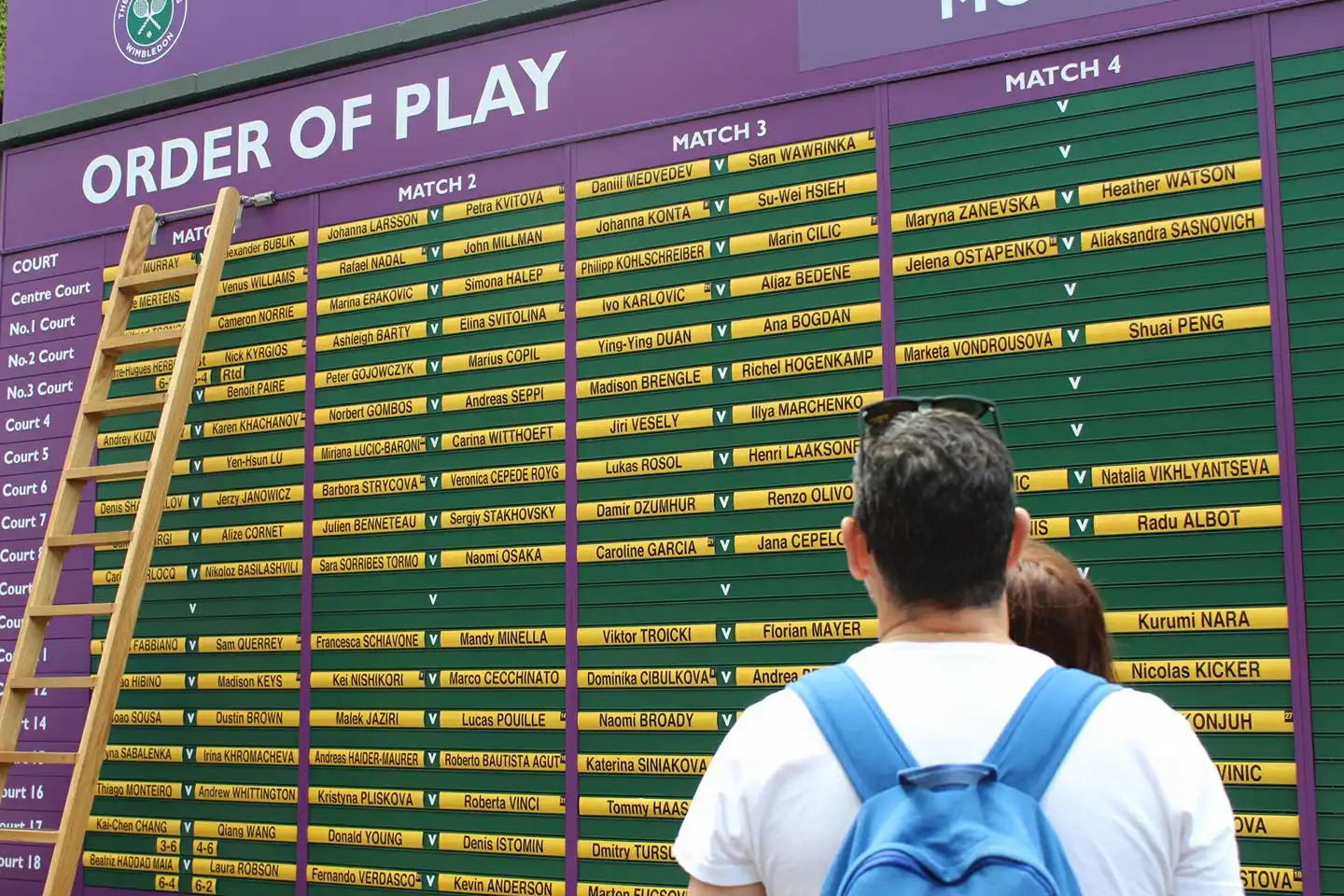
Wimbledon displays both the full draws and daily schedules around the Grounds, while the current Order of Play is also made available through its website and app.
Historical Lessons From Wimbledon Draws
History repeatedly shows why a difficult-looking route should not be mistaken for a fixed destiny.
In 2001, Goran Ivanišević entered the gentlemen’s singles as a wildcard and won the championship. His entry status and ranking did not capture the threat posed by a former finalist with a game suited to grass.
Two years later, defending champion Lleyton Hewitt lost in the opening round to qualifier Ivo Karlović, who was ranked outside the world’s top 200. A section that had appeared to belong to the reigning champion was transformed on the first day.
These examples matter because they expose the limits of projected brackets. The draw establishes who can meet. The players decide which parts of that map remain relevant.
Common Misconceptions About the Wimbledon Draw
- The draw tells you who will play on Centre Court. It does not. Court assignments arrive with the Order of Play.
- The No.1 seed automatically receives the easiest route. The leading seed receives structural protection from other seeds, but may still face the most dangerous unseeded player in the field.
- A projected quarter-final is a confirmed fixture. Both players must win four matches before it can happen.
- Wildcards and qualifiers are always weak opponents. Entry status describes how someone reached the field, not how well suited they are to grass.
- The bracket becomes fixed in every detail once it is published. Withdrawals and lucky-loser substitutions can still alter individual positions. Before the first Order of Play is released, the Grand Slam rules also contain procedures for moving replacement seeds into certain vacancies.
How Experienced Fans Use the Draw
Regular followers rarely try to predict all seven rounds. They begin with the most dependable information.
They identify a player’s first opponent, inspect the surrounding four-player section and note the first possible seeded meeting. They then look more broadly at the eighth and quarter for surface specialists, former champions and other credible threats.
Spectators add a second layer by tracing the likely playing-day sequence. Once the daily Order of Play appears, they replace the earlier assumptions with confirmed court information.
Used this way, the draw is not a fortune-telling device. It is a framework for understanding why certain matches are possible, why some routes appear harder and how the shape of the tournament changes after every result.
How the Draw Can Help With Ticket Planning
The draw is particularly valuable when someone still has a choice between neighbouring tournament days. It can establish that one day is capable of featuring a family favourite player, while the other is not.
It can also make a particular round more attractive. A quarter containing several strong grass players may increase interest in the corresponding quarter-final day, while a crowded opening-round player pool can improve the possibilities for both show courts and the outside courts.
Anyone comparing availability after the draw can use Ticket-Compare.com to view Wimbledon listings from multiple pre-vetted resale sites and official ticketing partners in one place. Ticket-Compare.com is a comparison platform rather than the ticket seller; users click through to the respective provider to purchase.
This can reduce the need to open several separate tabs when comparing dates, Centre Court and No.1 Court options.
The key limitation remains unchanged: a ticket for a court and date is not a guarantee that one named player will appear. Even a correct reading of the likely date sequence cannot account for defeat, withdrawal or a different court allocation.
The Wimbledon Draw | Frequently Asked Questions
What is the Wimbledon draw?
The Wimbledon draw is the knockout bracket that places players into first-round matches and maps every possible route to the final. It confirms each player’s opening opponent and section of the field, while later opponents remain conditional on the results of preceding matches.
When does the Wimbledon draw take place?
It normally takes place on the Friday before the main tournament begins, near the end of qualifying week. The precise annual date should always be checked. In 2026, the draw is scheduled for Friday 26 June before play starts on Monday 29 June.
How do you read the Wimbledon draw?
Find the player’s name and follow the connecting bracket lines inward. Their first-round opponent is confirmed. The adjoining pair contains two possible second-round opponents, with larger connected sections showing the possible third-round, fourth-round and later opposition.
How are seeded players placed in the Wimbledon draw?
Seed No.1 is placed at the top and No.2 at the bottom. Seeds No.3 and No.4 are drawn into opposite halves, with subsequent bands distributed through the quarters and smaller sections. This delays meetings between the highest seeds without guaranteeing them easy opponents.
Can the top two seeds meet before the final?
No. The No.1 and No.2 seeds are positioned at opposite ends of the bracket, so they can meet only in the final. Either player can still lose earlier to another seed or an unseeded opponent.
Does the Wimbledon draw tell you which court a player will be on?
No. It identifies a player’s section and helps indicate the likely day on which that section will progress. Centre Court, No.1 Court and outside-court assignments are decided later and confirmed through the daily Order of Play.
What is the difference between the draw and the Order of Play?
The draw maps the entire tournament and its possible matchups. The Order of Play covers a particular day and confirms which matches have been assigned to each court and the order in which they are due to begin.
Can the Wimbledon draw affect ticket demand?
Yes. A day may attract more interest when the draw places several famous players or compelling possible matchups into the same playing sequence. The effect is not automatic, because availability, price, withdrawals and subsequent results also influence demand.
Can a qualifier or wildcard be seeded?
A wildcard can be seeded when their ranking merits a protected position. Qualifiers are normally placed into the remaining draw positions after qualifying, although entry status alone does not indicate how dangerous the player may be.
Does a favourable draw guarantee a long run?
No. It is an assessment based on the information available before play. Form, fitness, playing style and unexpected results can turn an apparently comfortable route into a difficult one, or clear a path that initially looked crowded.
What the Wimbledon Draw Really Tells You
The Wimbledon draw is the tournament’s first useful map, not its final timetable. It confirms opening matches, divides the field into sections, reveals the earliest possible meetings between seeds and helps spectators identify the days on which particular players are likely to be active.
What it cannot do is promise that those players will survive, place them on Centre Court or turn projected matches into fixtures.
That knowledge arrives gradually through results and court assignments, through the daily Order of Play.
For ticket planning, the draw can make a choice of date much more informed. Readers comparing Centre Court, No.1 Court or round-specific availability through Ticket-Compare.com should still judge the possible programme as a whole rather than treating one player’s projected route as a guarantee.
As you read this there are 2,155 Wimbledon tickets available through Ticket-Compare.com.
Related Articles:
How to See the Biggest Players at Wimbledon
Which is Better: Centre Court or No.1 Court?


