

 English











Worst Place to Sit at Portman Road
Written by Aviran Zazon
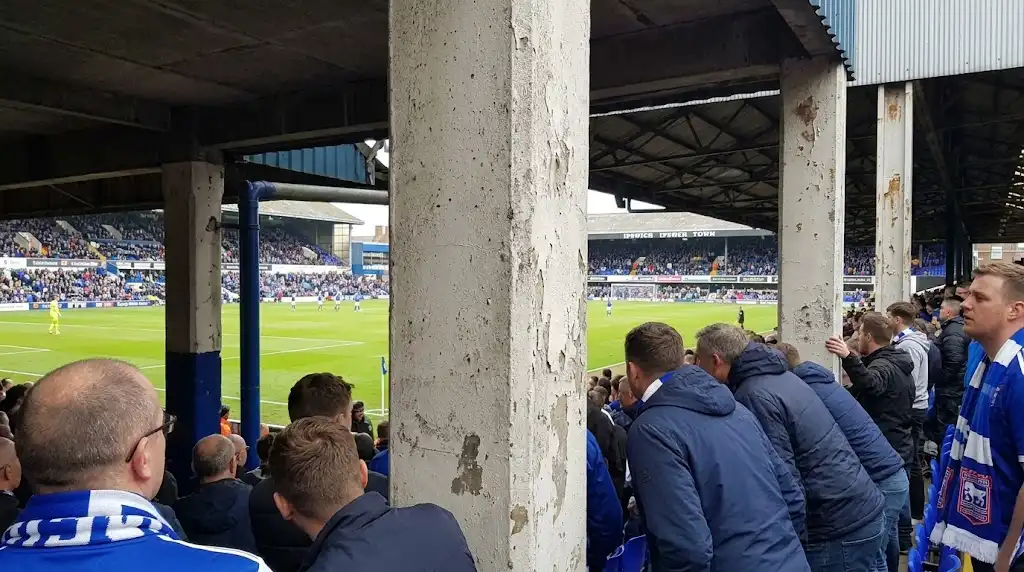
If you need to see the whole match clearly, the worst places to sit at Portman Road are generally found towards the rear of the Cobbold Stand and behind the roof-support columns in the West Stand.
The Cobbold contains the stadium's most severe documented restrictions. Its low roof and older structure create a substantial restricted-view risk across parts of the rear upper tier, with some tickets officially classified as severely restricted.
The West Stand has a different problem: a network of support columns means significant groups of seats can have a pole cutting across part of the pitch.
That does not make either stand uniformly poor. Both contain plenty of good seats, and the issues in Portman Road come down to the exact row and position within a block.
When choosing Portman Road tickets, moving a few rows forward or sideways can make a considerable difference.
Find Your Ideal Seat
Ipswich vs Everton FC
Premier League・Portman Road StadiumIpswich, United Kingdomfrom $196124 available ticketsIpswich vs Manchester City
Premier League・Portman Road StadiumIpswich, United Kingdomfrom $175236 available ticketsIpswich vs Leeds United
Premier League・Portman Road StadiumIpswich, United Kingdomfrom $200120 available ticketsIpswich vs Manchester United
Premier League・Portman Road StadiumIpswich, United Kingdomfrom $293343 available tickets
What Is the Worst Place to Sit at Portman Road?
The clearest way to judge Portman Road is by separating genuine obstructions from areas that simply will not suit every supporter.
| Area | Main problem | How serious is it? |
|---|---|---|
| Rear Cobbold Upper, Rows U to X in Blocks A, B, C, and VU1, VU2 and VU3 | Low roof, overhang and structural restrictions | Arguably the worst overall area |
| Cobbold Upper generally | Tight legroom and difficult upper-tier access | Comfort and accessibility issue |
| West Stand seats behind roof-support columns in Rows R to W in Blocks K, L, M, N, O, P, Q, R and Y | Pillars can remove parts of the pitch from view | Significant and relatively widespread risk |
| Extreme upper corners of the end stands | Neighbouring roofs can interfere with sightlines | Localised rather than stand-wide |
| Upper end stands | Steep rake and considerable height | Mostly personal preference |
| Sir Bobby Robson Lower | Safe standing throughout the lower tier | Important if you need or prefer to sit |
Of course, we note the contrast between a seat where the stadium physically prevents you from seeing the football and one whose height, atmosphere or standing arrangements simply do not suit you.
By that measure, the old Cobbold and West stands account for most of Portman Road's genuine problem areas.
Cobbold Upper: Portman Road's Biggest Restricted-View Risk
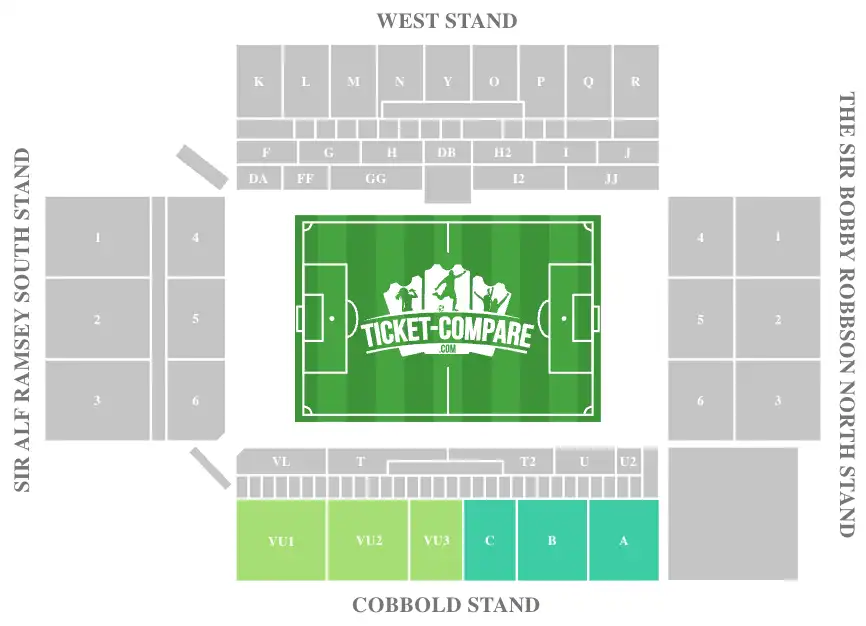
The Cobbold Stand is the first place to approach carefully. Built in 1971, it remains the major surviving section of old Portman Road, and its age shows most clearly towards the rear of the upper tier.
The roof hangs relatively low over the seating, while the structure supporting it can enter sightlines from a much wider area than one particular restricted-view seat.
In Blocks, A, B, C, and VU1, VU2 and VU3, this is noticeable from row U, and continues back to row X, worsening the higher you go.
So it’s no surprise that here in the final few rows of the upper Cobbold there’s a concentration of restricted-view seats. Some lower restrictions are relatively modest, while others are severe enough for tickets to be formally distinguished as severely restricted.
The rear rows can lose substantial parts of the pitch
The problem is not simply that a roof edge appears at the top of your vision. From particularly poor positions, the combination of overhang and stadium structure can remove a sizeable section of the playing surface.
One documented supporter in the rear of V2 reported being able to see only around half of the pitch, while another seat in the same back-row environment received an exceptionally poor review.
Those individual examples are useful because they demonstrate the potential severity of a wider architectural problem. They should not be read as meaning that only those precise seats are affected.
Again, the farther back you move in parts of the Cobbold Upper, the greater the risk that the roof or its supporting structure starts to compromise the view.
The upper away section has good views as well as bad ones
Naturally, the problem is identical in the away section at Portman Road in Blocks A, B and C. Away supporters occupy the Cobbold end towards the Sir Bobby Robson Stand, and the viewing experience can change considerably according to row.
The better seats offer exactly what many people want from a football ground: an elevated side-on perspective with a clear view of both goals. Poorer rear positions can introduce the low roof and structural restrictions described above.
The result is an unusually wide range of experiences within the same stand. It would therefore be misleading to describe the Portman Road away end itself as having a bad view.
The rear of the upper tier is the risk, rather than the away allocation as a whole.
Cobbold legroom can be poor even with a clear view
The Cobbold has another drawback that has nothing to do with restricted sightlines.
Supporters regularly describe the rows as narrow, with very limited legroom. One visitor measuring only 5ft 3in reported having their knees against the seat in front, while others have found moving along the rows difficult around half-time and full-time.
For taller supporters, that means a perfectly clear pitch view can still come with an uncomfortable match.
The upper away area also includes safe standing, and access deserves consideration. There is no lift to the upper Cobbold, while supporters who need or prefer to remain seated are directed towards the lower allocation.
So the Cobbold presents three separate considerations:
- Rear upper rows: Genuine restricted and severely restricted views.
- Upper away areas: Safe standing and cramped old seating geometry.
- Upper-tier access: Steep stair access with no lift.
Those should not be collapsed into one idea of a bad seat because they affect different supporters in different ways.
Upper West Stand: Pillars Become a Problem
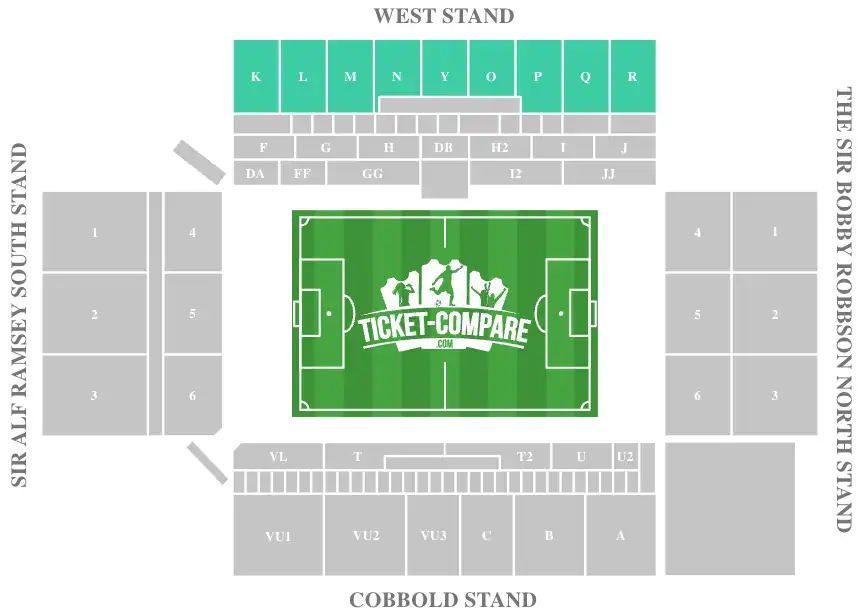
The West Stand contains Portman Road's most widespread traditional football-ground obstruction.
There are roof-support columns sitting between spectators and the pitch in the back six rows (R to W) of every block, including K, L, M, N, O, P, Q, R and Y.
Unlike an unusually poor seat at the edge of a stand, a pillar creates a cone of affected sightlines behind it.
The exact portion of the pitch that disappears changes as you move sideways or backwards, which means several rows and groups of seats can be inconvenienced by the same column.
Block Y shows how several seats can share the same obstruction
A recent report from Block Y describes supporters across roughly four adjacent seats having to lean from side to side to see around a column.
That is more useful than treating one seat number as the problem. The column is fixed and the obstruction spreads backwards and diagonally through the seating behind it.
Other reports from Block Y show the same structure lining up differently according to position. In one location a pole slightly obscures a goal, while farther back another supporter has part of one side of the pitch cut by the column. The severity changes, but the underlying risk remains the same.
The rear West Stand adds a second problem
Towards the back of the stand, the pillars are not necessarily the only concern.
The roof and overhang can begin to interfere with the near side of the pitch, producing seats where the view is compromised both horizontally by a column and vertically by the structure above.
Current supporter evidence suggests that restricted-view seats become increasingly common in the rearmost rows.
Again, this does not justify writing off the back of the West Stand as uniformly poor. It does justify treating it as a higher-risk area where the precise seat deserves checking before purchase.
The current improvements to the West Stand do not remove that issue. Recent work has concentrated on accessibility, concourses and supporter facilities rather than replacing the existing roof and its columns.
Sir Bobby Robson Stand: Mostly Good Views With a Few Exceptions
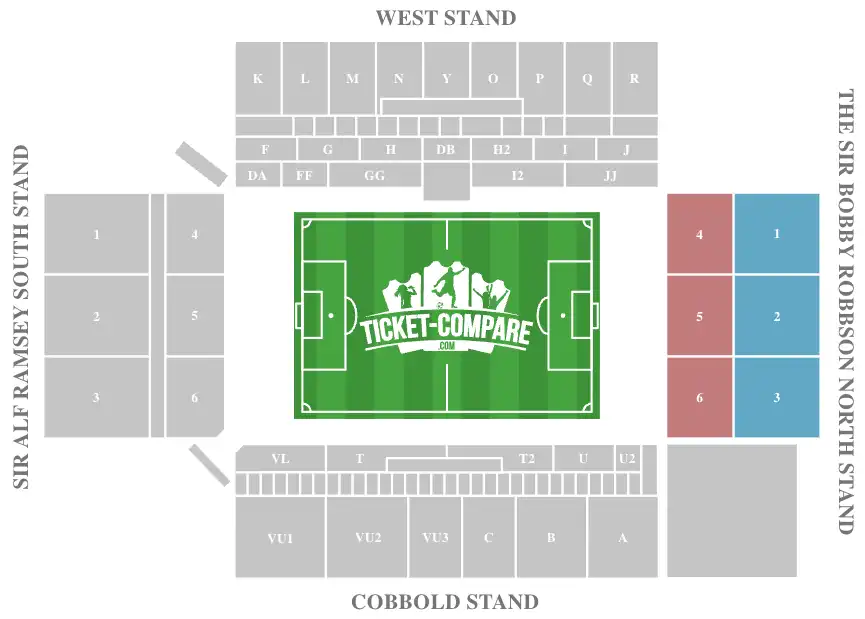
The Sir Bobby Robson Stand is considerably newer than the Cobbold and West stands, and its basic sightlines are generally much better.
Thanks to the roof design, there is no equivalent pillar problem. The main restricted-view risk appears at the extreme upper corners, where the geometry of the newer end stand meets Portman Road's older side stands.
Extreme upper corners can meet the neighbouring roof
A heavily restricted view has been documented at the very edge of SBR1, where an upper-tier seat sits underneath an overhang close to the junction with the adjacent stand.
The significance is architectural rather than seat-specific. Current supporter evidence suggests that a small number of seats in the upper corners can have their sightlines interrupted by the roofs of the older Cobbold and West stands.
That creates an awkward meeting point between different generations of Portman Road construction. Most of Sir Bobby Robson Upper does not share that problem. Clear whole-pitch views are much more typical.
The entire lower tier is now safe standing
One important change for 2026/27 is that safe standing now extends across the whole lower tier of the Sir Bobby Robson Stand.
For supporters looking for the strongest home atmosphere, singing and a place behind the goal, that can make it one of the most attractive areas in the stadium.
It may be one of the least suitable for somebody who:
- wants to sit for most of the match;
- has difficulty standing for prolonged periods;
- is attending with a child who may struggle to see over adults;
- prefers a quieter matchday experience.
Safe standing is not a bad view in itself. It is a question of whether the area matches the way you want or need to watch the game.
Sir Alf Ramsey Stand: Few Genuine Sightline Problems
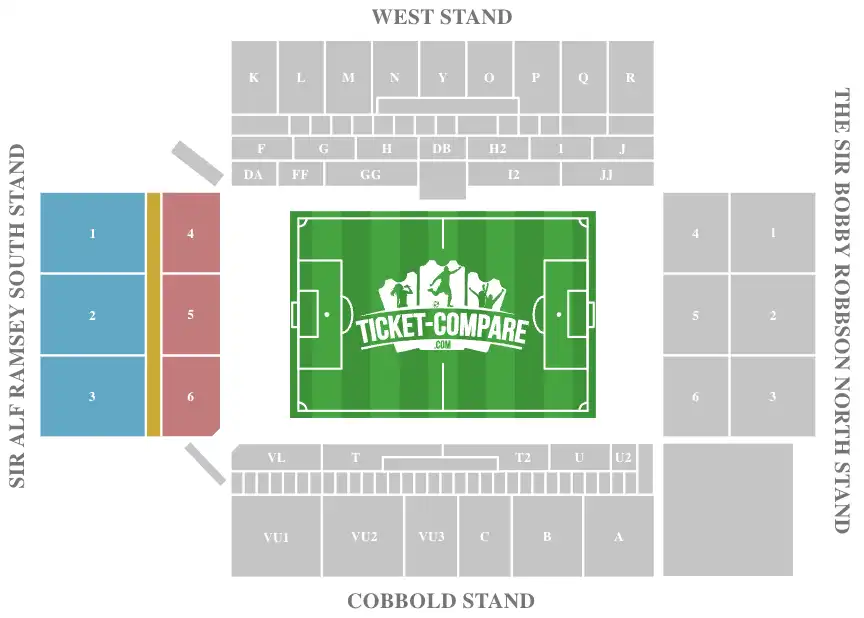
The Sir Alf Ramsey Stand is probably the safest part of Portman Road if avoiding structural obstructions is the priority.
Current seat evidence is overwhelmingly positive, with supporters in different upper-tier rows reporting clear views of the whole pitch.
There is some evidence that seats at the extreme upper edges can be affected where the stand meets the roofs of its older neighbours. The evidence is much weaker than in the Cobbold or West Stand, so this is best treated as a reason to inspect an extreme-corner ticket rather than a general warning about the stand.
The upper tier is high and steep
The clearer consideration in the Sir Alf Ramsey Upper is its height.
Ipswich explicitly warns supporters that the upper-tier accommodation at Portman Road is particularly steep. The football view itself can be excellent, yet the climb and rake may make it uncomfortable for anyone uneasy with heights or steep stairs.
Some high seats can also lose sight of the main stadium screen. That is worth knowing before buying, although blocked scoreboard is not a restricted view of the match.
How We Judged the Worst Seats at Portman Road
The most weight goes to how much football you physically cannot see.
Structural obstructions therefore come first: roofs, overhangs and pillars that remove meaningful sections of the playing surface.
Next come practical sightline problems, such as needing to lean repeatedly around a column or having the near touchline hidden from a rear position.
Comfort and suitability follow after that. Tight legroom, safe standing, steep upper tiers and noisy sections can all make a seat unsuitable for a particular supporter without making the underlying view objectively poor.
That is why the rear Cobbold ranks much higher than the Sir Bobby Robson Lower. One can physically prevent you from seeing a large proportion of the match; the other may simply be exactly the sort of area you do or do not enjoy.
How to Avoid a Poor Seat at Portman Road
The safest approach is to pay close attention to row and position within the block, particularly in the Cobbold and West stands.
A Portman Road seating plan can establish where you are in relation to the pitch, while seat photographs become especially useful when considering:
- the back rows of the Cobbold Upper;
- rear West Stand seats;
- positions behind a West Stand support column;
- extreme upper-corner seats beside an older neighbouring roof.
Do not assume that every ticket marked restricted will be terrible. Equally, Portman Road contains enough severe examples that the description should not simply be dismissed as a minor inconvenience.
If official availability becomes limited, Ipswich Town tickets can also be compared through Ticket-Compare.com. Ticket-Compare.com is a comparison platform displaying ticket options pre-vetted resale sites and official ticketing partners into one place before supporters click through to purchase from the relevant provider.
Worst Place to Sit at Portman Road | Frequently Asked Questions
Are there restricted-view seats at Portman Road?
Yes. Restricted and severely restricted tickets remain part of Portman Road's current seating inventory.
The biggest concentration is towards the rear of the Cobbold Upper, rows U to X, while the West Stand (rows R to W) contains a separate network of restricted views created by its roof-support columns.
Small numbers of awkward seats can also be found around the extreme upper corners where newer and older stands meet.
Which part of the Cobbold Stand should I avoid?
The rearmost rows of the upper tier carry the greatest restricted-view risk.
The low roof and supporting structure can interfere with substantial sections of the pitch from some positions. That does not make every rear seat equally poor, and plenty of Cobbold Upper seats farther forward have excellent views.
If two otherwise similar tickets are available, moving several rows forward is generally the safer choice.
Do away fans get restricted-view seats at Portman Road?
Yes. The Cobbold away allocation includes restricted and severely restricted inventory.
That does not mean the away view at Portman Road is generally poor. Many upper-tier away seats have excellent elevated side-on views, with the most significant risk concentrated towards particular rear positions.
Are the pillars in the West Stand a problem?
They can be.
Because the columns support the roof, each one can affect a group of seats behind it rather than a single position. The severity depends on your angle: one supporter may lose only a corner of the pitch, while another farther back or differently aligned may have a goal or larger section obscured.
The safest approach is to check whether your position sits directly or diagonally behind a support column.
Is the Sir Bobby Robson Lower a bad place to sit?
Not because of the basic pitch view.
The entire lower tier is now safe standing, making it particularly attractive to supporters looking for atmosphere behind the goal. It is less suitable for somebody who needs or strongly prefers to remain seated throughout the match.
Is Portman Road's upper tier very steep?
Ipswich itself warns that the upper-tier accommodation is particularly steep.
The Sir Bobby Robson and Sir Alf Ramsey upper tiers can provide excellent views, so steepness is primarily an access and comfort consideration rather than a sightline problem.
Is the Cobbold Stand being replaced?
Not yet. Longer-term plans around Portman Road leave scope for a future expansion or replacement of the Cobbold Stand, with the new multi-storey car park forming part of the enabling work.
For supporters attending in 2026/27, the existing Cobbold remains in place and its current restricted-view issues remain relevant.
So, Where Is the Worst Place to Sit at Portman Road?
Towards the very back of the Cobbold Upper, in rows U to X, there are genuine severe sightline problems. The low roof and supporting structure create a concentration of restricted seats, and the worst documented examples show just how much of the playing surface can disappear.
The West Stand comes next, particularly where support columns line up with the pitch in Rows R to W, and then towards the rear where the roof creates an additional restriction.
The important point here is that the pillars create a wider area of risk across the rows and seats behind it, with severity changing according to the viewing angle.
The newer Sir Bobby Robson and Sir Alf Ramsey stands are considerably less problematic. Their drawbacks are concentrated around isolated upper corners, safe standing, steepness and personal preference rather than widespread structural restrictions.
So at Portman Road, be particularly cautious towards the rear of the Cobbold and behind the columns in the West Stand. In both areas, moving several rows forward or a few seats sideways can turn a compromised view into one from which you can properly watch the match.
As we speak there are 3,931 Ipswich Town tickets for sale, starting from $52. One Ipswich Town match selling fast today is Ticket-Compare.com is Ipswich vs Nottingham Forest at $68.
Related Articles:
Blind-Sided: The Worst Places to Sit at a Football Stadium


