

 English








Should You Buy World Cup Final Tickets Before the Teams Are Known?
Written by Aviran Zazon
Buying World Cup Final tickets before the finalists are known can make sense when attending the Final itself is the objective, your New York or New Jersey travel plans are fixed and you have found an acceptable seat within budget.
Waiting makes more sense when your interest depends on a particular country or matchup, provided you can accept the risk of higher prices, fewer seats together and only a few days to organise the trip.
There is no universally cheapest moment. Ticket-Compare.com data shows that the lowest surfaced Match 104 price fell during the early knockout stage before recovering slightly as the field narrowed. The outcome of the semi-finals could bring another slight fall, a sharp increase or different movements across different seating categories.
The Final is already fixed for Sunday 19 July 2026 at New York/New Jersey Stadium, the tournament name for MetLife Stadium in East Rutherford. Only the teams are missing.
The complete fixture will not be known until the second semi-final ends on 15 July, and buyers should expect the market to begin reacting before that final whistle.
Semi-Finals and Final!
Fast Answer: Should You Buy World Cup Final Tickets Before the Teams Are Known?
The decision depends on which uncertainty counts most for you.
| Buyer Priority | When to Consider Buying | Main Reason |
|---|---|---|
| Attending any World Cup Final | Before the semi-finals | The stage matters more than the matchup |
| Following one country | After that country qualifies | Avoids buying an expensive ticket for an unwanted Final |
| Wanting some team certainty | Between the two semi-finals | One finalist is known, but the full supporter rush has not yet begun |
| Needing several adjacent seats | Earlier rather than later | Useful groups may disappear before single seats |
| New York travel already booked | Before the full matchup | Ticket certainty may matter more than finding the market bottom |
| Flexible local or solo buyer | After the semi-finals or later | Can accept limited choice and the possibility of missing out |
| Buyer seeking a particular category | When a suitable seat is affordable | Category-level prices do not always follow the headline minimum |
| Hospitality buyer | Before finalists qualify | Premium inventory may tighten when team and corporate demand activates |
Buying early gives you greater certainty over attendance, seat selection and travel. Its main risk is paying a price partly based on attractive possible finalists who never qualify.
Waiting gives you certainty over the sporting value of the matchup. Its main risk is that supporters of one or both finalists enter the market before you, taking the cheapest tickets, better locations and useful groups of seats.
The World Cup 2026 Final Explained
The World Cup Final will take place at New York/New Jersey Stadium on Sunday 19 July, kicking off at 15:00 local time.
Match 101 between France and Spain on Tuesday 14 July produces the first finalist. Match 102 between England and Argentina on Wednesday 15 July completes the fixture.
A standard Match 104 ticket is attached to the event, not to a national team. It remains valid regardless of which countries win the semi-finals.
Buyers purchasing before the teams are known are securing a fixed date, venue and stage rather than a guarantee that France or Spain or England or Argentina will appear.
That differs from a conditional team-linked product, where access depends on a named country progressing. Someone who wants to attend only if their country reaches the Final should not treat an ordinary Match 104 ticket as though it offers the same protection.
Why World Cup Final Tickets Are Difficult to Source
The Final has a stronger base level of demand than any other match. Even an unexpected pairing still delivers the trophy match, presentation ceremony and defining occasion of the tournament.
Demand can come from:
- Supporters of both finalists
- Neutral football fans
- International visitors already in the New York area
- Sponsors, corporate guests and hospitality buyers
- Collectors of major sporting experiences
- Buyers who care more about the occasion than the teams
MetLife Stadium holds roughly 80,000 people, but its full capacity does not become ordinary publicly available inventory. Seats are distributed across team and federation allocations, sponsors, media, hospitality, operational needs and other tournament commitments.
There is also no alternative Final. Semi-final buyers can choose between two matches in different cities. Everybody seeking the trophy match is competing for Match 104 at one venue on one afternoon.
Before the teams are known, its price reflects both the inherent value of the event and the possibility of a particularly desirable matchup. When the bracket changes, some of that possibility premium can disappear, while a newly confirmed finalist can introduce a fresh team premium.
What the Ticket-Compare.com Final Data Shows
We’ve taken Ticket-Compare.com pricing snapshots from 24 June, 30 June and 8 July.
| Snapshot | Teams Remaining | Overall Minimum | Category 1 Minimum | Category 2 Minimum | Category 3 Minimum | Recorded Inventory |
|---|---|---|---|---|---|---|
| 24 June | Group stage unresolved | $9,000.00 | $13,376.70 | $9,000.00 | $9,000.00 | 3,429 |
| 30 June | Knockout stage under way | $7,970.09 | $13,140.00 | $9,296.51 | $7,970.09 | 4,175 |
| 8 July | Eight teams remaining | $8,150.36 | $10,982.18 | $8,363.37 | $8,150.36 | 4,346 |
The headline minimum fell by 11.4% between 24 and 30 June, from $9,000 to $7,970.09. It then rose by 2.3% to $8,150.36 on 8 July, leaving it 9.4% below its original level.
That does not amount to a simple downward trend. Waiting through the first part of the knockout stage generally improved the entry price, but the latest snapshot suggests the lower end of the market may have begun to firm as the number of possible finalists narrowed.
Category 1 followed a different path. Its minimum fell throughout the period, reaching $10,982.18 on 8 July. That was 17.9% lower than on 24 June, even though the cheapest overall listing had already started to recover.
Category 2 initially became more expensive before falling to $8,363.37. By 8 July it was only $213.01 above Category 3, potentially making it the more attractive option for buyers who found a meaningfully better location for a relatively small additional amount.
Combined Category 1–3 inventory increased from 3,429 to 4,346, a rise of 26.7%. Category 1 recorded the largest increase, growing by 39.2% alongside its substantial price reduction.
These quantities are best understood as surfaced database inventory. They should not automatically be treated as a count of unique seats because listings can differ by provider, grouping and configuration.
The exports do not contain a reliable average price, so no average-price trend can be calculated. Extreme maximum listings have also been excluded from the central analysis because very high asking prices reveal little about the cost at which an ordinary buyer can realistically enter the stadium.
Why the Cheapest Ticket Does Not Tell the Whole Story
The lowest displayed price can change because one ticket is bought, withdrawn or newly listed. It does not necessarily mean hundreds of comparable seats have become more or less expensive.
Between 30 June and 8 July, recorded inventory rose from 4,175 to 4,346 while the minimum also rose from $7,970.09 to $8,150.36. More tickets appeared, yet the cheapest option became slightly more expensive.
That could happen because the lowest listing disappeared while new inventory entered above it. It could also reflect more premium tickets, a change in category composition or newly surfaced listings that did not help a price-sensitive buyer.
Quantity is key as well when it comes to World Cup Final ticket prices. A cheap isolated seat may be of no use to a couple or family. Buyers should look beyond the headline figure and check:
- The price for the number of tickets required
- Whether seats are guaranteed together
- Category, section and row
- The jump from the cheapest listing to the next available options
- Delivery terms and fees
- Whether the inventory is standard admission or hospitality
A falling minimum accompanied by only one qualifying ticket is a much weaker market signal than dozens of new seats appearing below the same price threshold.
Buying Before Either Finalist Is Known
Buying before the semi-finals is most defensible when you would attend regardless of the matchup.
You protect yourself against a heavily supported finalist, such as Argentina who come with an observed premium, creating an immediate surge.
You also retain more choice over categories, locations and groups of seats. You also avoid making a high-value decision during the four days between the second semi-final and the Final.
The cost of that certainty is sporting uncertainty. Part of the current price may reflect the possibility of a globally attractive pairing that never materialises. Earlier 2026 knockout matches have shown how quickly anticipated host-nation, superstar or heavyweight premiums can disappear once the bracket takes shape.
Buy early only when the current ticket works for you without relying on a future resale or price increase. FIFA marketplace fees and the short selling window mean that purchasing with the assumption that you can simply recover the money later carries significant risk.
Waiting Until One Finalist Is Known
The period between the semi-finals offers a useful middle strategy.
After Match 101, one team is guaranteed to appear and only two possible opponents remain. A buyer gains meaningful information without necessarily waiting for the full supporter rush that could follow Match 102.
This approach may suit someone whose preferred country plays in the first semi-final, or a neutral who would be pleased with the confirmed finalist and wants to act before the complete matchup becomes public.
It still carries uncertainty. The second result could create a particularly desirable rivalry or eliminate the final combination you wanted. Prices may also have started moving during Match 101 as the likely winner became clearer.
Waiting Until Both Finalists Are Confirmed
Waiting for both results makes the most sense when team identity determines whether you want to attend.
You avoid paying thousands for a Final that no longer interests you and can assess the actual sporting and emotional value of the matchup. Two losing semi-finalist fanbases may also introduce new supply as supporters change plans or list ordinary Match 104 tickets they no longer wish to use.
The trade-off is reduced choice. Supporters of both finalists, neutral buyers and corporate purchasers will be responding at the same time. The obvious low-priced listings and useful pairs may disappear before the overall minimum visibly changes.
Waiting also leaves only a few days to arrange international travel. It is most practical for locals, solo attendees, flexible travellers and buyers who are genuinely willing to miss the match if prices remain too high.
Travel Costs Can Count More Than the Ticket Movement
The cheapest ticket does not necessarily produce the cheapest Final trip.
Someone waiting for a $500 or $1,000 ticket reduction may face a larger increase in flights or accommodation.
The full matchup is confirmed only four days before the Final, leaving little time for international supporters to arrange travel, annual leave, entry requirements and suitable hotels.
MetLife Stadium is in East Rutherford, New Jersey, rather than central Manhattan. Transport to and from the venue also needs to be incorporated into the plan.
Buyers travelling long distances should compare the complete cost of buying early with refundable travel against the complete cost of reacting after qualification. Locals and travellers already in the region can afford to treat the ticket as a separate last-minute decision. An overseas family usually cannot.
How Ticket-Compare.com Helps You Track World Cup Final Tickets
Ticket-Compare.com is a comparison platform rather than a ticket seller. It brings together Match 104 options from pre-vetted source sites and ticketing partners, which may include standard resale and hospitality-style inventory where available.
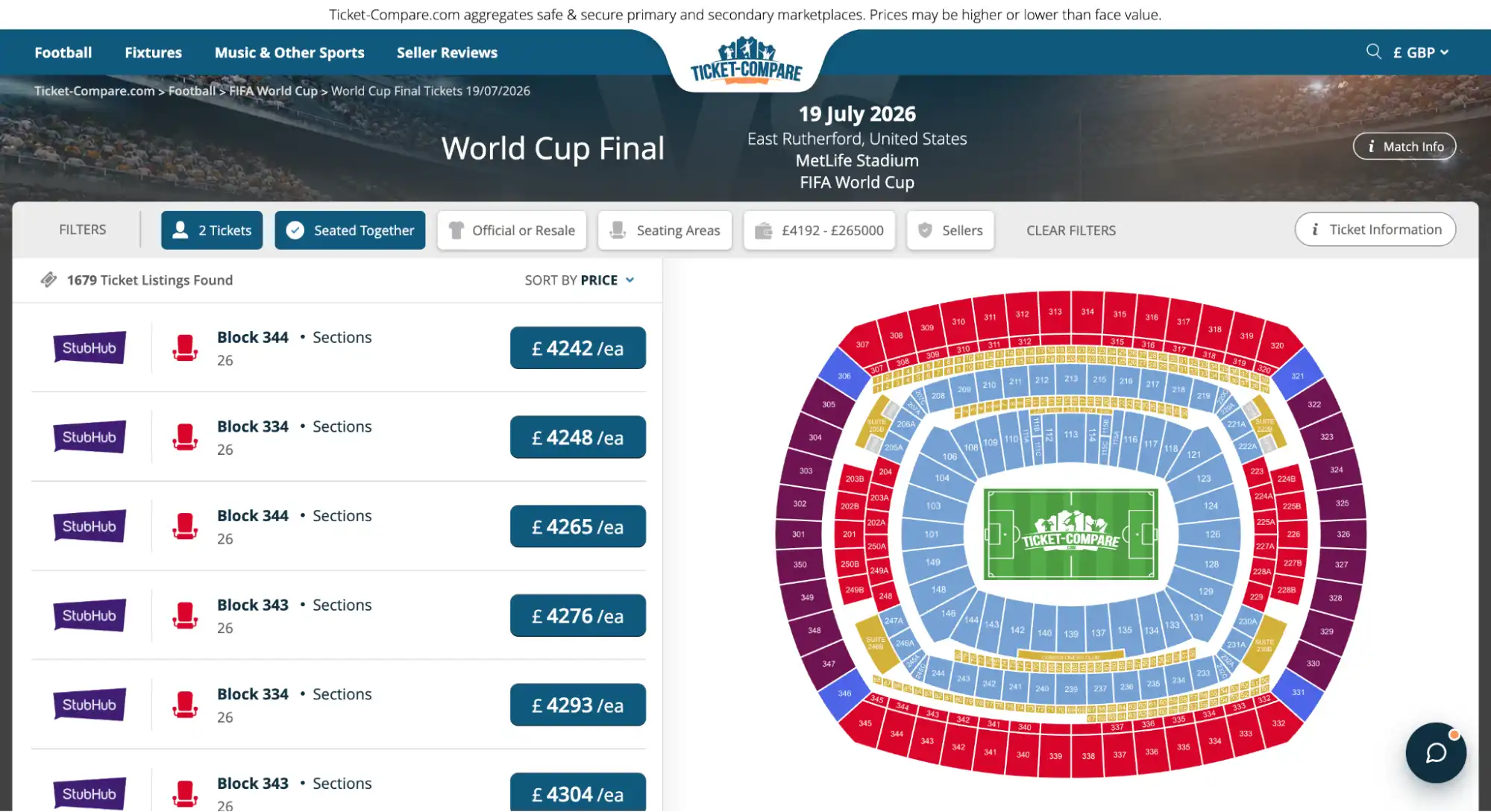
Buyers can compare prices, categories, quantities, seating locations and seller options in one place before deciding whether to click through to the respective site. This is more useful than checking the cheapest ticket once and assuming that figure represents the market.
Around the semi-finals, monitoring the minimum alongside inventory and seat quantity can help reveal whether the market is genuinely becoming more affordable or whether one isolated cheap ticket has simply appeared or disappeared.
For a sense of where to sit for the big game, check our MetLife Stadium seating plan.
Conclusion: Should You Buy World Cup Final Tickets Before the Teams Are Known?
Buy early when the Final itself is the attraction, your New York or New Jersey plans work, the current price is affordable and certainty matters more than knowing the matchup.
Waiting until the first finalist is known can offer a sensible middle ground when partial team certainty would materially improve the decision.
Waiting for both finalists is more appropriate when a particular country or matchup is essential and you can accept a possible price increase, reduced seat choice and limited adjacent inventory.
Remember that Match 104 prices may begin moving during both semi-finals. Entering only after the second final whistle could mean acting after other buyers and sellers have already responded.
Ticket-Compare.com can help you monitor prices, categories, quantities and recorded inventory across pre-vetted source sites, but no dataset can guarantee which direction the market will move.
The simplest rule remains the most useful: Buy early for the occasion; wait when you are buying for the teams.
As you read this there are hundreds of World Cup 2026 tickets on sale through Ticket-Compare.com, starting from from $1,125.
Related Articles:
Should You Buy World Cup Semi-Final Tickets Before the Teams Are Known?


