

 English











How A $2 Million 2026 FIFA World Cup Ticket Is Even Possible
Written by Aviran Zazon
A 2026 FIFA World Cup ticket can be listed for more than $2 million because, in certain resale contexts, the seller can set the asking price. That does not mean FIFA priced the ticket at $2 million, and it does not mean anyone has paid that amount.
The viral case involved four tickets for the World Cup final on 19 July 2026 at MetLife Stadium.
AP reported that they were listed on FIFA’s official Resale/Exchange Marketplace for $2299998.85 each, despite being ordinary lower-deck seats behind a goal rather than hospitality packages or private boxes.
When it comes to resale pricing for the World Cup, an asking price is not the same as a paid price. A seller can ask for an absurd amount; the market only becomes real when a buyer agrees to pay.
Compare Prices!
In Brief: How Can A World Cup Ticket Be Listed For $2 Million?
A $2 million-plus World Cup ticket listing can happen when:
| Factor | What It Means | What Buyers Should Understand |
| Seller-set resale pricing | The ticket holder chooses the asking price | FIFA did not necessarily set that figure |
| No practical cap in some markets | United States and Canada residents may list at any price on FIFA’s resale marketplace | Extreme prices can appear even if they are unrealistic |
| Scarce final inventory | A World Cup final has fixed supply and huge global demand | Scarcity encourages speculative pricing |
| Platform fees | FIFA’s resale marketplace applies 15% fees on relevant resale transactions | Very high prices make the fee economics look dramatic |
| Viral attention | Huge listings attract headlines | Publicity does not prove a sale happened |
The practical answer is simple: a holder listed the ticket at a huge price, and the marketplace allowed that ask to appear.
How A $2 Million World Cup Ticket Listing Can Happen
The viral listing was not a mystery package or a luxury hospitality suite. AP identified the tickets as block 124, row 45, seats 33–36 at MetLife Stadium, behind a goal in the lower deck.
That matters because it strips away the obvious explanation. This was not a private dining product, a player-access experience, or a once-in-a-lifetime hospitality bundle. It was a resale listing for standard match tickets at an extraordinary asking price.
The mechanics are familiar to anyone who has watched modern ticketing change over the last two decades.
As we explain in our guide to resale marketplaces: A buyer gets a ticket through the primary market, then lists it again on a resale platform. The seller chooses an asking price, the platform displays it, and another buyer can decide whether to pay.
In the FIFA World Cup 2026 case, the mind-boggling detail is that the listing appeared on FIFA’s own official resale marketplace, not only on an outside resale site. That gives the figure more visibility, even though FIFA says resale prices are seller-set in the relevant markets.
A Reddit discussion helped spread the story among football supporters, largely because the number looked so far removed from what most fans would consider normal.
World Cup final tickets listed for more than $2m on Fifa’s resale site by u/el_randolph in soccer
The important clarification is that the listing shows what one seller asked for. It does not show whether, while World Cup final tickets are reaching record highs, it’s what buyers are generally paying, or what FIFA charged in the original sale.
Asking Price Vs Real Market Price
A huge resale figure can be useful evidence, but only if it is read properly.
| Price Type | Who Sets It | What It Tells You | What It Does Not Prove |
| Face-value price | FIFA or the official ticketing route | The original official price | The current resale value |
| Resale asking price | The ticket holder or seller | What someone hopes to receive | That a buyer will pay it |
| Completed resale price | Buyer and seller through a transaction | A real market-clearing price | That all similar seats are worth the same |
| Viral listing price | Usually one extreme listing | How far speculation can stretch | The normal price of attending |
That is why the AP comparables matter. Alongside the $2299998.85 listing, AP reported other extreme asks, including $207000 for a lower-deck aisle seat and $138000 for an upper-deck category-two seat, while the lowest visible final resale tickets were around $10923.85.
Even that lower figure is expensive for most supporters, but it shows how misleading one headline number can be. The market was not simply $2 million tickets everywhere; it was a wide resale spread with one spectacular outlier at the top.
FIFA’s Official Resale Platform, Fees, And Price-Setting Rules
FIFA’s own help material says residents of Mexico may list tickets on the FIFA Exchange Marketplace for no more than the original purchase price, while residents of Canada and the United States may list tickets at any price on the Resale Marketplace.
That cross-border distinction is central. It means the same tournament can have different resale behaviour depending on the seller’s market and the applicable rules.
The fee structure also explains why the story caused such a reaction. FIFA’s help pages state that the purchase fee on the Resale/Exchange Marketplace is 15%, and the fee for reselling or exchanging tickets is also 15% of the total price, inclusive of taxes.
AP also reported the two-sided structure as a 15% purchase fee from the buyer and a 15% resale fee from the seller.
On a normal resale ticket, those percentages are already meaningful. On a theoretical $2.3 million transaction, they become extraordinary. A 15% fee on $2299998.85 is roughly $345000 on one side of the transaction, before even considering the other side.
The exact visible total depends on whether a platform display shows the seller ask, the buyer’s all-in cost, or another fee-inclusive figure. The wider point is still clear, percentage-based fees become much more controversial when seller-set prices become extreme.
Why The $2 Million Figure Does Not Mean Someone Will Pay It
A viral resale listing can exist for several reasons. It might be a speculative seller testing the market. It might be someone hoping for a wealthy buyer. It might be an attempt to attract attention, anchor perceptions, or simply see what happens.
FIFA’s own resale help page also says there is no guarantee a listed ticket will be resold, because resale depends on demand from other buyers.
That line matters. A listing can sit there indefinitely. It can become a headline without becoming a transaction.
This is why buyers should not treat the highest visible listing as the market. The better questions are:
- What are comparable seats listed for?
- Are there cheaper seats in nearby blocks?
- Are fees included in the displayed price?
- How many tickets are available together?
- Is the listing official resale, hospitality, or a third-party resale option?
- Does the seat location justify the premium?
A single viral price is a signal. It is not a valuation.
Why Comparing The Secondary Market Is A Must
This article is about secondary-market behaviour, not a standard FIFA face-value ticket guide. Once tickets are being resold, prices can move sharply because seat location, demand, timing, platform rules and seller expectations all interact.
That is where comparison becomes useful. Ticket-Compare.com is a ticket comparison platform, not a seller. It brings together listings from pre-vetted resale sites and official ticketing partners, often including hospitality options, so supporters can compare what is available without opening several sites one by one.
Right now there are thousands of World Cup 2026 tickets available on Ticket-Compare.com.
The point is not that every resale ticket is cheap, or that every high price is justified. The point is that a market with wild outliers is easier to understand when cheaper, mid-range and premium listings can all be viewed together.
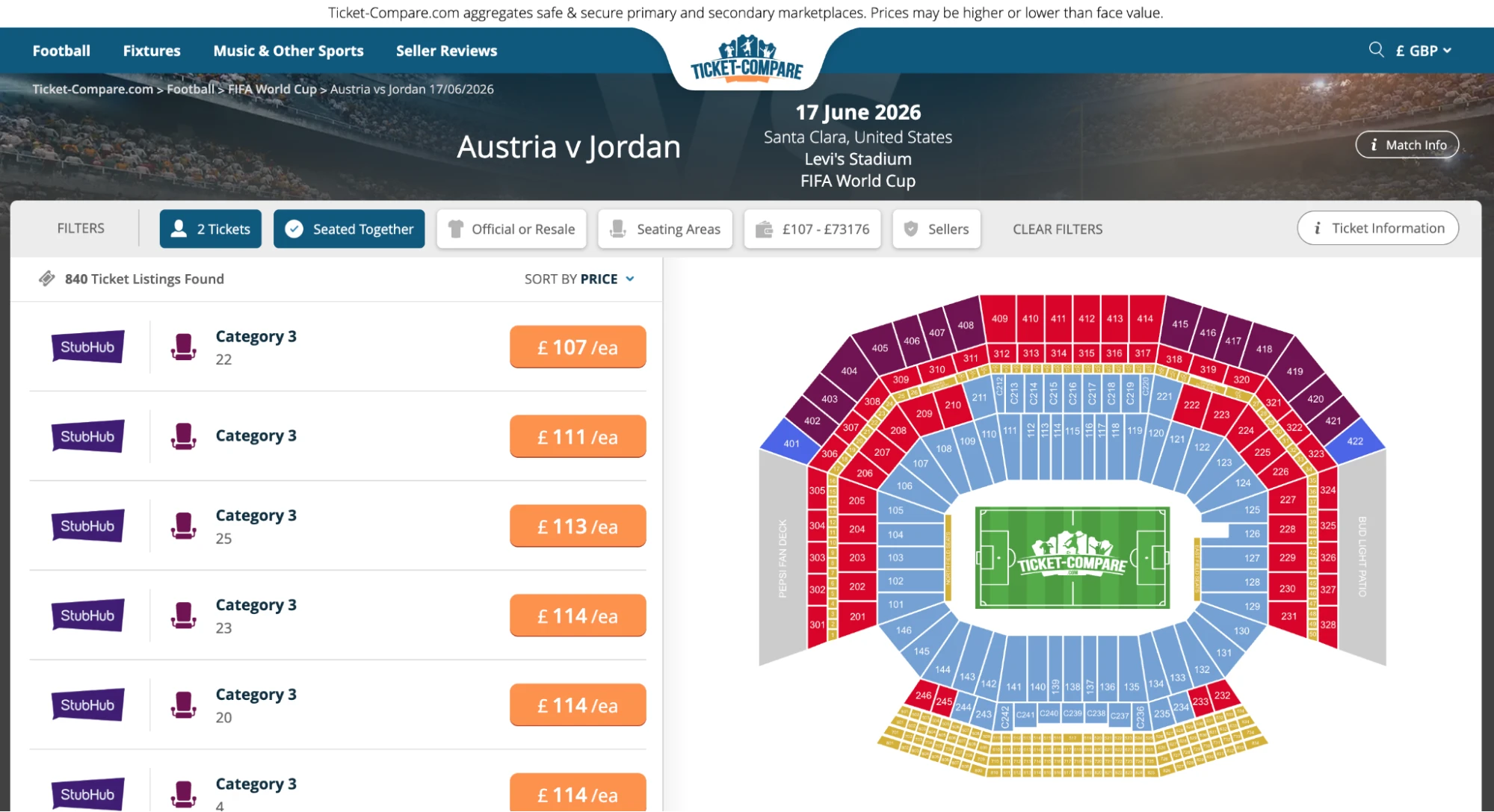
Ticket-Compare.com also helps users compare price points and seat locations, including through stadium-map functionality where available. Once a supporter chooses an option, they click through to buy from the relevant provider.
We also have a thorough MetLife stadium seating plan, so you can choose your ideal seats in advance.
Prices for World Cup 2026 tickets start from $100 across Ticket-Compare.com lineup of sellers.
What This Means For Buyers
A buyer looking at the 2026 World Cup secondary market should treat viral prices as outliers unless there is evidence of completed sales at similar levels. Asking prices can be emotional, opportunistic, speculative or deliberately attention-grabbing.
Seat location also matters. Four seats together can command a different price from a single seat. A lower-deck seat behind a goal is not the same proposition as a central seat, a hospitality package, or a restricted-view option. Fees can change the real cost, and timing can alter availability.
That is the real lesson of the $2 million listing. It does not tell supporters that the final costs $2 million to attend. It tells them that, in a lightly capped resale environment, some sellers can post astonishing asks. Buyers then need to step back, compare the wider market, and separate spectacle from substance.
FAQ
How can a World Cup 2026 ticket be listed for $2 million?
Because resale sellers in some markets can set their own asking price. For United States and Canada residents, FIFA’s help page says tickets may be listed at any price on the Resale Marketplace.
Has anyone actually paid $2 million for a World Cup ticket?
There is no verified evidence in the supplied research or AP reporting that the ticket sold for that amount. The figure refers to a listing price.
Did FIFA set the $2.3 million price?
No. AP reported that FIFA does not control asking prices on its Resale/Exchange Marketplace.
Does FIFA charge fees on resale tickets?
Yes. FIFA’s help pages state a 15% purchase fee and a 15% resale/exchange fee on the official Resale/Exchange Marketplace.
Why would a seller ask for such a high price?
A seller may be speculating, testing demand, trying to attract attention, or hoping for an unusually wealthy buyer. A high asking price does not prove genuine market value.
Is a viral listing a reliable guide to the real market?
No. A viral listing shows what one seller asked for. Buyers need comparable listings, seat-location context, fee clarity and evidence of actual transactions to understand the market properly.
What is the safest way to compare resale ticket prices?
Compare several listings, check seat locations, understand fees, and use reputable official or vetted routes. Ticket-Compare.com helps by showing multiple resale and hospitality options in one place, while purchases are completed through the respective provider.
Why do some fans use Ticket-Compare.com instead of checking sites one by one?
It reduces the need to open multiple tabs and lets supporters compare availability, prices and seat locations across different providers from one place.
Conclusion: How A $2 Million World Cup Ticket Is Possible Without Being The Real Market
A $2 million-plus 2026 FIFA World Cup ticket is possible because a seller can place an extreme asking price on a resale marketplace, especially where there is no practical price ceiling for that seller’s market.
That does not make it a FIFA face-value ticket. It does not prove anyone has paid that amount. It does not show the normal cost of World Cup final tickets.
It shows how modern resale markets behave when scarce inventory, global demand, seller-set pricing and percentage-based fees meet in one high-profile tournament. For supporters, the useful response is to compare the full spread of available tickets, not react to the loudest number.
Ticket-Compare.com fits that moment as a practical comparison platform: it is not the seller, but it helps fans view resale and hospitality options together, assess seat locations, and click through to the provider that matches their budget and preference.
Related Articles:
World Cup Ticket Prices: Qatar 2022 vs 2026 — How Costs Have Changed
How to Get Last-Minute World Cup 2026 Tickets Before They Sell Out
World Cup 2026 Resale Ticket Prices: Will They Drop or Continue Rising?
How To Transfer FIFA World Cup Tickets


