

 English







World Cup 2026 Resale Ticket Prices Explained: Why Some Matches Cost 5x More Than Others
Written by Aviran Zazon
Why does one World Cup 2026 match start around $172 on the secondary market while another starts above $2,647, and World Cup final tickets are listed from $9,986?
In spring 2026, weeks before the tournament, the price gap is not random at all. It is being driven by a clear mix of tournament stage, host-nation demand, city premium, team pull, and the kind of symbolic weight a fixture carries.
Using Ticket-Compare.com pricing data for the secondary market, finding the lowest prices across all 104 matches, you can already spot consistent patterns weeks before kick-off:
Knockout football gets expensive quickly, host matches are inflated well above the field, and some cities behave more like destination events than ordinary football venues.
This is important because supporters are not choosing between abstract price bands. They are looking at a live resale market that shifts by match, by city, and by perceived prestige.
A comparison platform such as Ticket-Compare.com helps by showing listings from pre-vetted resale sites and official hospitality partners in one place, so fans can compare what tickets are on the market without opening tab after tab.
Compare Prices
The Fast Answer On Why Some Matches Cost So Much More
The biggest driver is still the round.
Once the tournament moves beyond the group stage, scarcity kicks in and prices climb sharply. In the supplied snapshot, the median get-in rises from $679 in the groups to $817 in the Round of 32, $1,109 in the Round of 16, $1,997 in the quarter-finals, $2,701 in the semi-finals, and $9,986 for the final.
Host-nation matches are the next big force.
Games involving Mexico, the United States, or Canada are priced far above ordinary group-stage fixtures, with host-nation matches at around $1,432 on median against $768 for matches without a host. Mexico’s effect looks especially strong.
City and team profile count too.
Ciudad de México, Zapopan, Miami Gardens, and East Rutherford are repeatedly expensive markets. Brazil, Mexico, the United States, England and Argentina also pull harder than most of the field.
Why Some World Cup 2026 Matches Cost Far More Than Others
The first thing to understand is that World Cup 2026 has been built to create more meaningful late-stage scarcity. FIFA’s expanded format means 48 teams and 104 matches, feeding into a new Round of 32 instead of the classic 16.
As the knockout rounds approach, fewer matches remain, more travelling supporters lock onto specific fixtures, and the secondary market starts charging accordingly.
That progression shows up very cleanly in the supplied data. Group-stage football still gives buyers a wide spread of options, from Cape Verde vs Saudi Arabia at $172 to Mexico vs South Africa at $2,671.
By the time you reach the quarter-finals, the cheapest listed prices are already clustered between $1,686 and $2,047. Then the semi-finals jump again to $2,881 and $2,520, before the final breaks away entirely at $9,986.
The biggest price drivers at a glance
| Pricing Driver | What The Data Shows | Why It Pushes Prices Up | Where Fans Feel It Most |
|---|---|---|---|
| Tournament round | Median rises from $679 in the group stage to $9,986 for the final | Later rounds bring real scarcity and higher-stakes demand | Quarter-finals onward, especially semi-finals and final |
| Host-nation involvement | Host matches sit around $1,432 on median versus $768 for others | Domestic demand and travel planning concentrate early around host teams | Mexico, Canada and USA tickets |
| City premium | Ciudad de México, Zapopan, Miami Gardens and East Rutherford run hot | Some cities behave like destination markets as well as football markets | Opener, final, premium tourist hubs |
| Team pull | Mexico, Brazil, USA, England and Argentina tickets draw stronger prices | Big support bases and broader neutral demand lift floors | Marquee group games and crossover fixtures |
| Match symbolism | The opener and final outperform normal stage expectations | Ceremonial or once-only status creates extra urgency | Mexico vs South Africa, World Cup Final |
| Visible inventory | High listing counts do not automatically soften prices | Demand can still outrun supply even when the market looks deep | Host games and premium-city fixtures |
Host-nation demand and early group-stage pricing
Host-nation involvement is probably the most important group-stage clue for buyers.
Mexico’s opening match against South Africa opens at $2,671, which is extraordinary for a group game, and Mexico’s second group match against South Korea is still $1,806.
Canada vs Bosnia and Herzegovina sits at $1,673. United States vs Paraguay starts at $1,408, while United States vs Australia is $1,432.
That is not just team quality. It is the force of home support, travel planning, national occasion, and fixed anticipation. FIFA locked the three host nations into the draw structure early, which made those fixtures easier for supporters to build trips around long before the wider market settled.
Mexico is especially interesting because the host-country premium does not simply come from volume. Mexico hosts 13 matches, the same as Canada, while the United States hosts 78.
Yet Mexico is the priciest host-country market in the group stage. That tells you something important. Perhaps the smaller host-country supply, the opener in Mexico City, and intense domestic demand can outweigh the broader scale of the American market.
Why certain cities carry a premium
City also reshapes prices more than many supporters expect. East Rutherford is the clearest example because it carries the final and a wider halo of global-event demand.
New York New Jersey Stadium is the biggest official venue in the tournament at 78,576, yet it still behaves like a premium market.
Mexico City Stadium is also huge at 72,766, while Los Angeles Stadium holds 69,650 and Toronto Stadium 44,315. So this is not just a story about the smallest grounds being squeezed hardest.
It is also a story about where people most want to be.
That helps explain why Miami Gardens keeps showing up in the expensive bracket. Scotland vs Brazil is $1,734 there. Colombia vs Portugal is $2,078. Even before the very top knockout rounds, some venues are clearly attracting a destination premium on top of football demand.
How team demand fits into the pricing picture
Big teams usually mean big prices, just not in a simple one-team formula. Brazil, Argentina and England tickets all have high floors:
- England vs Croatia is $1,125
- England vs Ghana is $794
- Argentina vs Austria is $1,323
- Jordan vs Argentina is $876
- Brazil vs Morocco is $1,412
- Scotland vs Brazil rises to $1,734
You can feel the hierarchy in the market, yet the supplied notes make a useful distinction: host nations come first, heavyweights second, everybody else after that.
As you read this, there are thousands of World Cup 2026 tickets on sale through on Ticket-Compare.com.
Why Prices Do Not Always Follow Simple Logic
We should warn against easy assumptions.
A match can show thousands of listed tickets and still be expensive. At the time we write this, Mexico vs South Africa has 3,610 tickets listed and still starts at $2,671.
Argentina vs Algeria has 3,106 available and still opens at $875. Uzbekistan vs Colombia shows 3,375 and still comes in at $643. In other words, deep visible inventory does not automatically turn into cheap entry.
That is partly because the resale layer is thin compared with the full stadium picture. Official venue capacities range from 44,315 in Toronto to 78,576 in East Rutherford.
A few thousand tickets may sound plentiful when you are browsing listings, yet in a 60,000 to 70,000-seat event it can still be a small fraction of the overall live market.
Why some matches stay affordable
Some lower-profile games remain affordable because they miss several of the strongest demand triggers at once. They are:
- Group matches
- In softer pricing markets
- Without a host nation involved
- Without one of the biggest global draws
That is how you end up with prices such as $172 for Cape Verde vs Saudi Arabia, $270 for Austria vs Jordan, $285 for Czech Republic vs South Africa, and $287 for Jordan vs Algeria.
Prices for World Cup 2026 tickets currently start from $192, and as you can see, that price is heavily affected by the tournament stage, matchup and location.
The weekday effect is another place where instinct can mislead. In this snapshot, the group-stage weekend median price is actually lower than the weekday median:
Weekends cost roughly $557 and weekdays at $725. That does not mean weekends are a discount in principle. It means the expensive fixtures in this sample happen to cluster on certain weekdays because of where the hosts and marquee teams land.
What The Secondary Market Is Showing Buyers In Spring 2026
This article is about the resale market, not FIFA’s face-value structure.
It’s important to point this out because buyers are not only comparing one seller’s price list; they are looking at a live ecosystem where official and non-official routes are both active.
The FIFA resale and exchange marketplace remains open until one hour before kick-off, and FIFA has also moved through a final first-come, first-served sales phase for the tournament.
The official market is not static either. In early April, reports on the latest sale window showed FIFA’s top official final ticket rising to $10990 under dynamic pricing.
That is why the secondary market is useful as an explanatory lens rather than just a fallback. It shows what supporters are being asked to pay match by match, city by city, right now.
A site such as Ticket-Compare.com fits into that picture as a comparison platform rather than a seller.
It pulls together listings from pre-vetted resale sites and official ticketing partners, often including hospitality inventory, so supporters can compare seat areas, price ranges and current availability in one place before clicking through to buy from the provider.
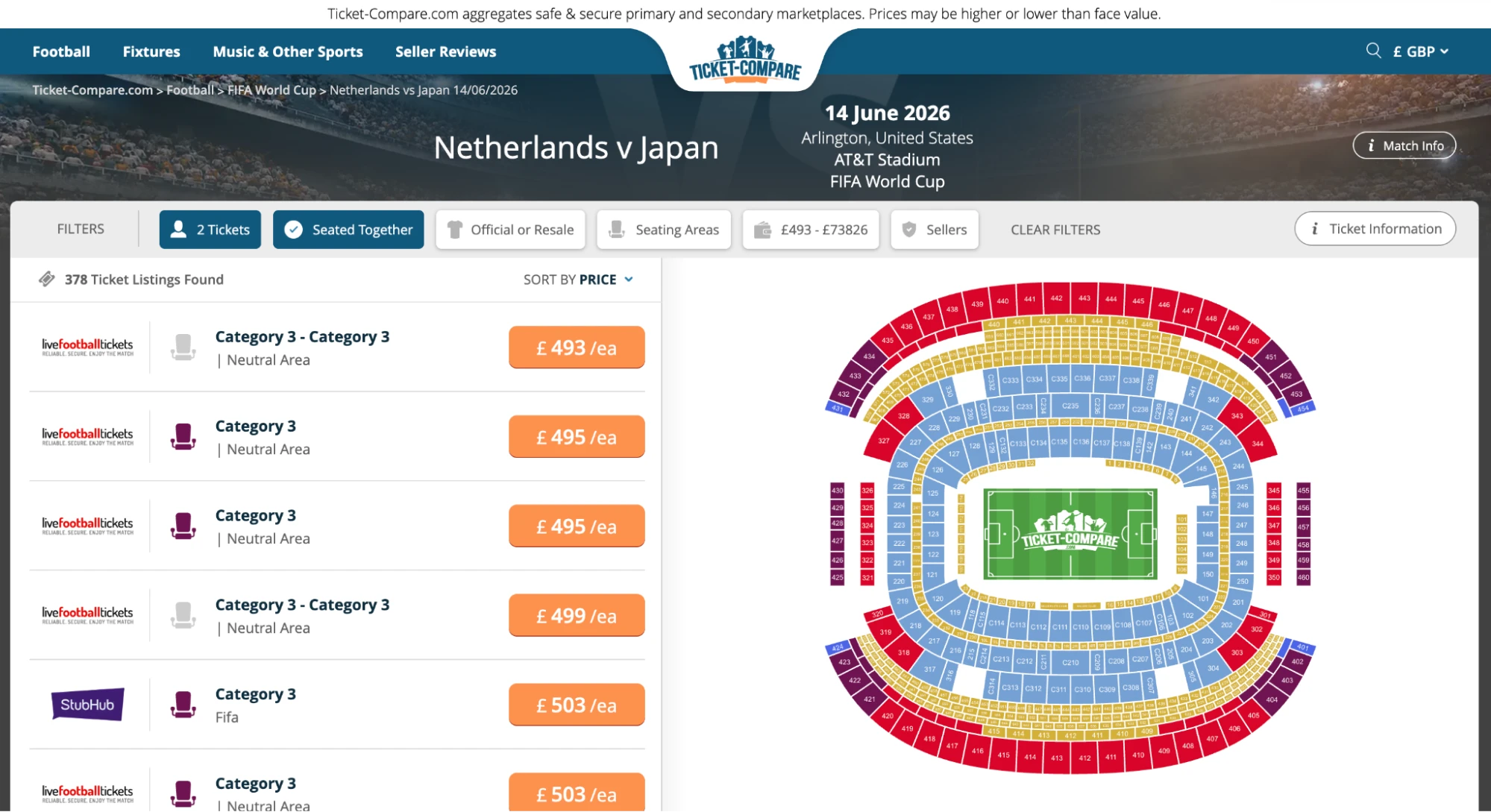
When price gaps are this wide, that kind of market-wide view becomes more useful than checking isolated listings.
Before the next example, it is worth noting that fan reaction has followed the same pattern as the data: people are not just reacting to high prices in the abstract, they are reacting to the sheer spread between ordinary matches and premium ones.
Resale prices for the 2026 World Cup reach up to $77,700 by u/nolesfan2011 in football
The important clarification after numbers like that is simple; headline outliers can be real without being typical. The supplied Ticket-Compare.com snapshot shows a far more useful everyday pattern for most buyers.
The market is steep at the top end, especially for the final and host-driven premium matches, yet the broader story is about structured price tiers rather than one universal resale frenzy.
What This Means For Buyers Comparing World Cup Matches
The cheapest part of the market is still the lower-profile group stage. If value matters most, that is where the broadest range of realistic entry points sits.
The expensive end is more predictable than it first appears. Knockout rounds, host-nation games, premium cities, and heavyweight teams all push prices up, and when two or three of those drivers land together the jump can be dramatic.
That is why comparing multiple listings matters. A match may look expensive in general terms, yet the spread across different providers, seat locations and hospitality options can still be meaningful.
Ticket-Compare.com is useful here precisely because it lets supporters scan those differences in one place rather than piecing the market together site by site.
Frequently Asked Questions
Why are some World Cup 2026 tickets five times more expensive than others?
Because several pricing drivers stack together. Tournament round is the biggest one, then host-nation involvement, city premium and team demand. Once a fixture carries more than one of those signals, the floor rises quickly.
For more details on the primary market through FIFA channels, we have an article on why World Cup tickets are so expensive.
Are knockout matches always more expensive than group games?
In this spring 2026 snapshot, that is the clearest broad pattern. Median get-in prices rise round by round from $679 in the groups to $9,986 for the final.
Do host-nation matches cost more?
Yes, analysis shows host-nation fixtures around $1,432 on average, compared with $768 for matches without a host nation.
Which World Cup 2026 cities look the most expensive?
It looks as though Ciudad de México, Zapopan, Miami Gardens and East Rutherford are most expensive..
Do big teams always produce the highest prices?
Not always. Brazil, England and Argentina have high demand, yet host nations appear to have an even bigger effect on price, especially Mexico.
Why can a match with lots of tickets still be expensive?
Because visible inventory is not the same thing as weak demand. Some markets are deep and expensive at the same time because buyer interest is deeper still.
Are weekends the most expensive time to buy?
Not in this snapshot. Our analysis suggests the group-stage weekend median is actually lower than the weekday median, largely because of which fixtures fall on which days.
What is the easiest way to compare resale prices across World Cup matches?
A comparison platform is the simplest route, because it lets you scan multiple listing sources, seat areas and price points in one place instead of checking each provider separately.
Why do some fans use Ticket-Compare.com instead of checking sites one by one?
Because it is a comparison platform rather than a seller. It gathers listings from pre-vetted resale sites and official partners, which makes it easier to compare availability and pricing before choosing where to buy.
So Why Are Some World Cup 2026 Matches So Much More Expensive?
Because the market is rewarding significance.
Later rounds become scarcer. Host-nation matches draw concentrated demand. Certain cities behave like global event destinations. Big teams lift prices, though not as strongly as the hosts in this dataset. And none of that gets cancelled out simply because a listing page shows a few thousand tickets still available.
That is the clearest lesson from the spring 2026 secondary market: the gap between one World Cup match and another is not random noise, it is a visible pricing hierarchy.
For supporters trying to make sense of that hierarchy in real time, Ticket-Compare.com is useful as a practical comparison tool because it shows multiple current options in one place rather than forcing buyers to hunt across the market manually.
Related Articles:
World Cup Ticket Prices: Qatar 2022 vs 2026 — How Costs Have Changed
How to Get Last-Minute World Cup 2026 Tickets Before They Sell Out
World Cup 2026 Resale Ticket Prices: Will They Drop or Continue Rising?
How To Transfer FIFA World Cup Tickets


