

 English












Why Are Chelsea Tickets So Expensive?
Written by Aviran Zazon
At the heart, Chelsea operate with Big Six-level demand but without a Big Six-sized stadium. Stamford Bridge holds just over 40,000 people, which is significantly smaller than several direct rivals.
That means demand cannot be addressed, so it is managed through pricing and access controls instead.
When a club cannot add more seats, it has limited alternatives. It can increase the value of each seat, segment demand more tightly, and prioritise buyers willing to pay more. All three approaches can be seen in Chelsea’s ticketing model.
Match-to-match pricing confirms this direction. General admission prices rose by around 4% for 2025/26, booking fees were introduced, and the priciest tickets are now in the $93 to $107 range.
Those figures alone are not unusual at the top of the Premier League, but they only represent the starting point.
The real cost emerges once access is factored in. Many supporters must pay for a Chelsea membership just to enter sales windows, compete for limited allocations, and accept restrictions such as one ticket per person in early phases.
If they miss those windows, the remaining options tend to be more expensive, whether through hospitality or resale.
That is why Chelsea tickets feel expensive in practice. The system does not just charge for a seat; it charges for access, priority, and flexibility.
Compare and Save
Everton FC vs Chelsea
Premier League・Hill Dickinson StadiumLiverpool, United Kingdomfrom $702,004 available ticketsChelsea vs Tottenham Hotspur
Premier League・Stamford BridgeLondon, United Kingdomfrom $1977,956 available ticketsLiverpool vs Chelsea
EFL Cup - Carabao Cup・AnfieldLiverpool, United Kingdomfrom $905,433 available ticketsChelsea vs Manchester United
Premier League・Stamford BridgeLondon, United Kingdomfrom $2797,244 available tickets
Club-Specific Factors Driving Prices
Limited supply versus elite demand
Chelsea’s capacity constraint is the single most important factor. With around 40,000 seats and near-full attendance every game, demand consistently exceeds supply. Unlike clubs with larger stadiums, Chelsea cannot ease pressure by releasing more tickets.
Membership gating and two-part pricing
Membership is not optional for many buyers. It acts as a gateway:
- True Blue ($80) and Junior Blue offer Priority 1 access
- CFC Blue ($60) offers Priority 2
- General sale only appears if tickets remain
This effectively creates a two-part tariff. Fans pay upfront for the chance to buy, then pay again for the ticket itself.
Loyalty points and restricted access
Chelsea’s loyalty points system adds another layer. Points determine priority and even eligibility for season tickets. When thresholds reach levels such as 148 points, access becomes limited to highly engaged supporters.
This creates a hidden cost. Fans often attend less desirable matches to build points, increasing their overall spending just to access bigger fixtures later.
Premium seating and hospitality expansion
Premium options provide a more accessible route, but at a higher price. Westview seating, for example, starts from $2,325 for a season or around $333 for high-profile matches.
Notably, these options often require fewer restrictions than general admission. That makes them the easiest route for some buyers, even though they significantly raise the average price per seat.
Discussions like this reflect how supporters increasingly view premium seating as one of the few reliable ways to secure access, even if it comes at a higher cost.
Financial pressure and revenue strategy
Chelsea operate with high costs and reported a substantial pre-tax loss. While ticket revenue alone does not fund transfers, it becomes one of the few areas where the club can quickly increase income, especially when stadium expansion is not an option.
Wider Premier League Factors That Also Count
Some broader trends reinforce Chelsea’s pricing:
- Matchday revenue is rising across the league, driven by pricing and premium seating
- Clubs competing in Europe host more high-demand fixtures
- The Premier League attracts global audiences, increasing demand beyond local fans
These factors matter, but they do not explain Chelsea’s pricing on their own. The key difference is that Chelsea face these pressures while operating with fewer seats than many rivals.
Why Some Matches Are More Expensive Than Others
Chelsea use a category system to price fixtures, and for Premier League home matches that usually means supporters are shopping at the top end of the scale rather than across the full grid.
In practice, the biggest league games against Liverpool, Arsenal, Manchester City and Manchester United are sold as Category AA, while other Premier League fixtures such as Crystal Palace and Brentford have been sold as Category A.
That is key because it means ordinary league demand already sits in Chelsea’s two highest-priced bands.
The lower categories on the club’s pricing ladder are more likely to appear in other competitions, so Premier League buyers are rarely looking at the cheapest end of the scale in the first place.
This means:
- London derbies and top-six clashes usually sit at the very top in Category AA
- Other standard home Premier League tickets can still fall into Category A, so they are not especially cheap
- Cup ties and less commercially attractive fixtures are more likely to drop into the lower bands
Chelsea’s Match Categories Create A Price Ladder
Chelsea’s pricing structure becomes much clearer when you look at how matches are categorised. Rather than offering a single standard price, the club uses a tiered system that adjusts based on opponent, competition, and expected demand.
That means supporters are not dealing with one Stamford Bridge ticket price. They are dealing with a ladder, where the same seat can cost noticeably more depending on the fixture.
A mid-table league match and a Champions League night might take place in the same stadium, but they sit in completely different pricing brackets before availability even becomes a factor.
Chelsea also added a booking fee to single-match general admission tickets, which slightly increases the real cost across all categories. When that is combined with already high base prices, the gap between lower-demand and high-demand fixtures becomes very visible in practice.
Chelsea Match-by-Match Ticket Prices (Adult General Admission)
| Fixture Category | 2025/26 Price | 2024/25 Equivalent | 2023/24 Equivalent |
| Category AA | $104 | $100 | $95 |
| Category A | $89 | $85 | $81 |
| Category B | $81 | $79 | $75 |
| Category C | $69 | $67 | $64 |
| Category D | $63 | $60 | $57 |
*Earlier seasons are estimated using known annual increases to show the direction of travel rather than exact archived pricing.
The key point here is that pricing pressure at Chelsea is not evenly distributed. It concentrates at the top of the ladder, exactly where demand is strongest. Most supporters are not trying to attend Category D fixtures; they are aiming for the biggest matches, which sit in the highest price bands and are also the hardest to access.
That is where the feeling of expensiveness really takes hold. The matches fans care about most are deliberately priced at the top end of the structure, and they sell into a market where supply is already extremely limited.
What Drives Chelsea Ticket Prices?
| Factor | How It Affects Chelsea Ticket Prices |
| Supply and demand | Limited seats at Stamford Bridge increase competition for every match |
| Membership access | Fans often pay before they can even attempt to buy tickets |
| Loyalty system | Points create a ranking system that raises the effective cost because they require a purchase history |
| Premium seating | Easier access routes for Westview and hospitality, but at much higher prices |
| Match categorisation | High-profile fixtures are deliberately priced higher |
| Secondary demand | Strong resale activity shows that there is a lot of unmet demand in the primary market |
| Financial model | High club costs encourage maximising revenue per seat |
Secondary Market Comparison
When primary market availability is low, many fans turn to platforms that aggregate resale and Chelsea hospitality listings.
Ticket-Compare.com acts as a comparison platform rather than a seller. It brings together listings from pre-vetted resale sites and authorised hospitality providers, allowing supporters to see multiple options in one place instead of searching across different websites individually.
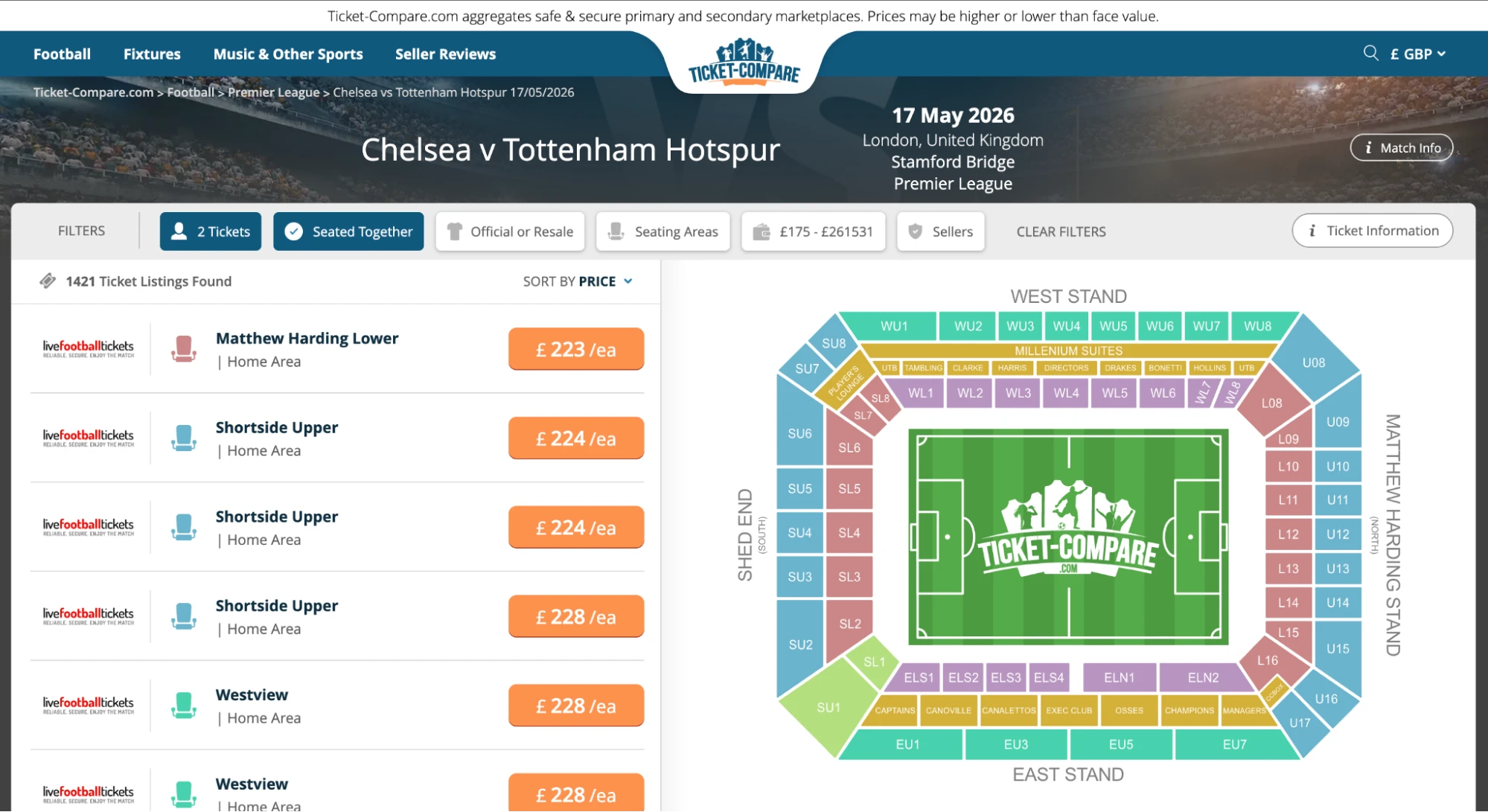
From there, users can choose a listing and complete the purchase with the provider.
Prices on the secondary market often move more directly with demand. When supply is limited, those prices tend to rise quickly, reflecting how many fans are still trying to secure a seat.
Why Are Chelsea Tickets So Expensive? | FAQ
How much does the average Chelsea ticket cost?
For 2025/26, adult general-admission tickets typically range from around $63 to over $107 depending on the match category. High-demand Premier League games usually sit in the upper bands. Many fans end up paying more in practice due to limited availability and access restrictions.
Can I buy Chelsea tickets without being a member?
It is possible to buy Chelsea tickets without a membership, but uncommon if you go through the club. Most tickets are sold through member-only priority windows, and general sale only happens if tickets remain. In practice, non-members often find availability limited, especially for Premier League matches, which pushes many to explore alternative routes.
Do Chelsea tickets ever go on general sale?
Yes, but only on the rare occasion that tickets do not sell out to members. As a rule, all Premier League fixtures sell out to members due to high demand. Lower-profile matches or early-round cup games may reach general sale, though availability is still extremely limited.
Why is it so hard to buy Chelsea tickets?
Chelsea operate with a small stadium relative to demand, and most tickets are allocated to Chelsea season ticket holders and members. Loyalty points further restrict access to popular matches, meaning many fans compete for a small pool of remaining seats.
Why are Chelsea tickets so expensive?
Chelsea tickets are expensive mainly because demand far exceeds supply at Stamford Bridge, which holds just over 40,000 fans. The club manages this through pricing tiers, memberships, and premium seating. The real cost often includes access barriers and scarcity, not just face value.
Conclusion: Why Chelsea Tickets Feel So Expensive
Chelsea tickets are expensive because the club is trying to serve global-level demand with a stadium that holds only around 40,000 people. With limited supply, the club raises value per seat through pricing, memberships, loyalty systems, and premium seating.
That structure means supporters rarely encounter just a simple face-value price. Instead, they navigate a layered system where access itself carries a cost, and where the easiest routes are often the most expensive.
For fans exploring availability beyond primary market sales, comparison platforms such as Ticket-Compare.com display a host of Chelsea ticket options in one place, helping make sense of a market where scarcity shapes almost every price.
As we speak there are 219,207 Chelsea tickets on sale on Ticket-Compare.com, with the cheapest available from $70 currently.
An upcoming Chelsea match selling fast is Liverpool vs Chelsea at $90, but you can still get in with Ticket-Compare.com.
Related Articles:
Premier League Ticket Prices by Club
Guide to Buying Official Chelsea Tickets


