

 English










Are World Cup 2026 Final Tickets Really at Record Highs? (Yes, But There’s a Catch)
Written by Aviran Zazon
FIFA’s standard prices for the 2026 World Cup final climbed to $10,990 at the top end in April 2026, with Category 2 listed at $7,380 and Category 3 at $5,785.
That put the final well above the levels seen in Qatar 2022 and every earlier men’s World Cup final on comparable official list prices.
The catch is that the headline does not tell the whole story.
FIFA’s own wording is more careful than the public argument around dynamic pricing. The April sale happened in a seat-specific last-minute phase rather than a simple fixed-band release.
Also the final-ticket market is not spread across several routes at once: Primary sale, FIFA’s resale and exchange, hospitality, and the wider secondary market.
That is important because fans do not just get it with one clean number. As we’ll explain in this article, they encounter limited releases, account controls, seat-map pricing, fees and route-specific restrictions.
Compare Prices for the Best Value
Mexico vs South Africa
FIFA World Cup・Estadio AztecaCiudad de México, Mexicofrom $3,2573,588 available ticketsSouth Korea vs Czech Republic
FIFA World Cup・Estadio AkronZapopan, Mexicofrom $5092,229 available ticketsCanada vs Bosnia And Herzegovina
FIFA World Cup・BMO FieldToronto, Canadafrom $2,0082,025 available ticketsUnited States vs Paraguay
FIFA World Cup・SoFi StadiumInglewood, United Statesfrom $1,4292,552 available tickets
What Fans Need To Know About WC 2026 Final Pricing
World Cup 2026 final tickets really have hit record official levels.
The strongest evidence is FIFA’s own listed April 2026 pricing, which put the top standard final ticket to $10,990, up from $8,680 in December and far above the $1,607 top price for the 2022 final in Qatar.
What is driving that pricing is a mix of extraordinary demand, FIFA’s willingness to reprice across sales phases, seat-by-seat pricing in the last-minute phase, and the prestige of the single biggest match in a 48-team tournament staged in North America.
Why World Cup 2026 Final Tickets Are So Expensive
Demand Was Off The Charts Early On
The first reason is the simplest one: the final is the most in-demand match in the tournament, and FIFA had the evidence to prove that demand very early.
By late November 2025 it said nearly two million tickets had already been sold, and the tournament was believed to more than 30 times oversubscribed, with more than 500 million ticket requests chasing roughly six to seven million tickets.
Pricing Was Not Fixed From The Start
The second reason is that FIFA did not lock itself into one fixed final-ticket price for the whole cycle.
FIFA says this is variable pricing rather than automatic dynamic pricing, which is an important distinction, even if many supporters experienced the outcome as surge-style pricing.
The Last-Minute Phase Changed How Tickets Were Priced
The third reason is that April 2026 was not just another ordinary release. FIFA’s last-minute ticket phase sold tickets on a first-come, first-served basis and, crucially, sold them by individual seat.
In that structure, the seat itself becomes the pricing unit.
A Category 2 seat may even be priced higher than a Category 1 seat because the category remains there mainly for orientation while the actual price reflects the characteristics of that specific seat.
That changes how supporters should read the numbers. When people compare the April 2026 final price with older World Cups, they are still right to say the listed prices are record highs. At the same time, they are not always comparing identical sales architecture.
A fixed category band from an earlier tournament is not the same thing as a seat-level, rolling-inventory phase where only certain seats are visible at a given moment.
The Tournament Was Built Around Record Revenue Expectations
There is also a more structural layer to this. FIFA’s published cycle budget projected a record $3.097 billion from hospitality and ticket sales for 2023-2026.
That does not prove one exact final-ticket number was chosen to hit one exact budget line, though it does show the 2026 World Cup was planned inside a revenue model that expected ticketing and hospitality to break previous records.
Buying A Final Ticket Comes With Extra Hurdles
A final-ticket buyer also faces route friction that pushes real-world prices higher or makes them feel higher. In practice, that includes:
- Needing a FIFA ticketing account to access official routes
- Last-minute purchases capped at four tickets per match and 40 per household
- Transfers handled within FIFA’s system rather than through informal account sharing
For a buyer trying to coordinate a group, that means not just finding stock but navigating rules around eligibility, ownership and delivery.
One more detail is worth keeping in view. FIFA did introduce a $60 Supporter Entry Tier that officially covered all 104 matches, including the final, yet that tier was tied to participating national associations and their supporter allocations. In practice, it did not operate like a broad public-market answer to the headline final prices.
Public frustration around this was easy to understand, and it spilled into supporter forums and news coverage because the numbers were so stark. The discussion below captures the mood around the April jump, though it still needs the context set out above.
FIFA hikes World Cup prices, again. Finals can now cost as much as $11,000 by u/nolesfan2011 in worldcup
The key clarification after seeing reactions like that is that the headline figure is real, but it is not the whole mechanism.
The final did reach unprecedented official list prices; still, buyers were meeting those prices inside a late, seat-specific phase, with some inventory held back for rolling release and with other official channels, such as resale and hospitality, working under different rules altogether.
The Catch Behind The Headline Prices
FIFA’s Own Description Differs From The Public Narrative
The biggest catch is that FIFA itself does not fully describe the system the way critics do.
Its own FAQ says prices can be revised as demand and availability change, then adds that this is not a model where prices are automatically modified in real time.
So when people say FIFA used dynamic pricing, they are capturing the supporter experience of rising prices, while FIFA is trying to distinguish that from an automated live-pricing system.
Different Routes Show Different Price Realities
The second catch is that not every official route tells the same pricing story. The most quoted record-high figures are primary-market standard tickets.
FIFA’s resale platform is a different story, because FIFA adds a 15% buyer fee and a 15% seller fee, while resale pricing in the United States and Canada can float above original value.
Hospitality is different again because it bundles premium seating with hospitality services rather than functioning as a like-for-like standard-ticket comparison.
Timing And Inventory Shape What You Actually See
The third catch is timing. FIFA said not all remaining tickets were released at once when the last-minute phase opened, and additional World Cup 2026 tickets would be released on a rolling basis.
That means the price a buyer sees at one moment can reflect not just tournament demand, but also which fragment of inventory FIFA has chosen to make visible right then.
For supporters, that is where the wider market comes into play. When official stock is limited, delayed or awkward to interpret, some fans widen the search rather than waiting for the next FIFA update.
Ticket-Compare.com is useful in that context because it is a ticket comparison platform rather than a seller.
It brings together listings from pre-vetted resale sites and official hospitality partners, so you can compare seat location and price in one place instead of opening tab after tab. Users then click through to buy from the provider they choose.
How The Different Ticket Routes Compare
The cleanest way to understand the final is to separate the routes rather than treating every price as if it belongs to the same market.
| Ticket Route | How Pricing Works | Who Can Use It | What To Expect | Restrictions / Friction |
|---|---|---|---|---|
| FIFA official primary sale | Prices can be revised across sales phases; in the last-minute phase seats are priced individually | Buyers with FIFA accounts, subject to availability | Record-high listed prices for the final, limited visible inventory, specific-seat selection in the last-minute phase | Rolling releases, household caps, queue pressure, not all seats visible at once |
| PMA supporter allocations | Includes supporter-specific inventory and the $60 Supporter Entry Tier | Fans meeting their national association’s criteria | Can be far cheaper on paper, including for the final | Very limited, association-controlled, not a broad open-market route |
| FIFA official resale / exchange | Resale price plus 15% purchase fee; sellers also pay 15%; pricing rules differ by host country | Buyers using FIFA’s resale marketplace | Official route to resold tickets, sometimes above face value in the US and Canada | Fees on both sides, no guarantee of resale, route split between resale and exchange models |
| FIFA hospitality | Premium seating bundled with hospitality packages | Buyers willing to pay for premium access | Different inventory logic from standard tickets; final access sits in top-end offerings | More expensive, package-based, not comparable with standard seat-only pricing |
| Wider secondary market | Prices move with demand, seat location and supply outside FIFA release windows | Any buyer using a legitimate marketplace | More visibility on what is currently available when official stock is thin or unclear | Need to compare route, provider and exact seat details carefully |
What this means in practice is that the headline price for the final is true, but incomplete. A supporter trying to buy is not really dealing with one market.
They are navigating overlapping channels that behave differently, show stock differently and attach different fees or conditions to the same match.
What The Secondary Market Changes
The secondary market is vital here because final tickets do not always appear in a neat rhythm that suits ordinary buyers.
Official FIFA releases can be phase-based, inventory can appear gradually, supporter allocations are ringfenced, and FIFA’s resale system adds another layer of fees and route-specific rules.
All of that helps explain why buyers looking specifically at the final often monitor both FIFA and the wider market rather than relying on one page refresh.
That does not mean treating every non-FIFA route as identical. It means comparing carefully.
Ticket-Compare.com is one practical way to do that because it is not a seller itself. It acts as a comparison platform, listing tickets from pre-vetted resale sites as well as official hospitality partners that may have inventory relevant to the final.
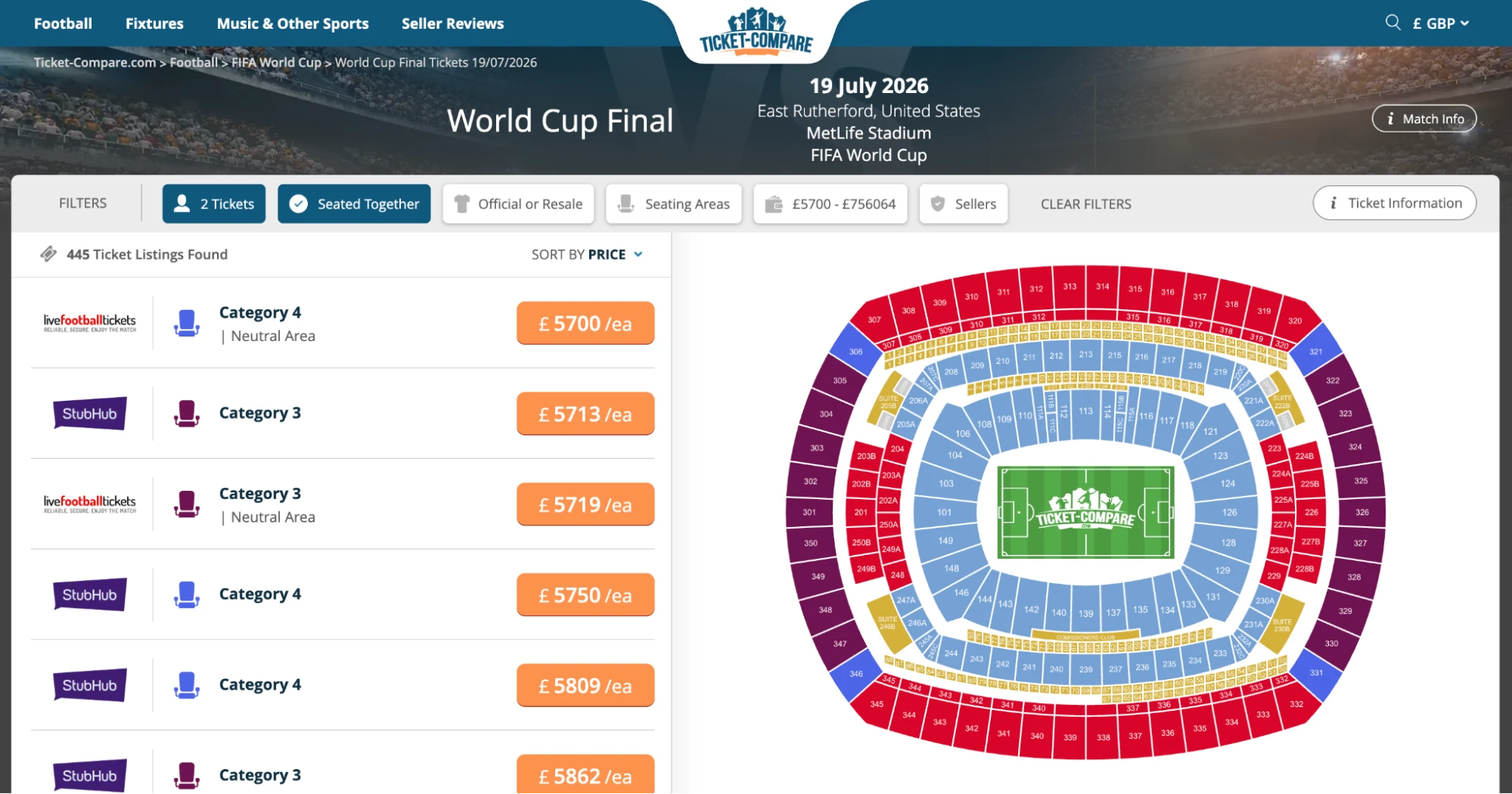
For supporters, that makes it easier to judge availability, seat position and price without hopping between multiple providers individually. And since FIFA’s systems are subject to dynamic pricing, legitimate secondary market options bring a few advantages when it comes to seat choice and how simple it is to make a purchase.
Availability still moves with demand, the exact seat, and the stage of the tournament, so the point is not that one route is always cheaper; it is that one route may be easier to compare in real time when FIFA’s own routes are fragmented.
Prices for World Cup 2026 Final tickets currently start from $379 on Ticket-Compare.com, and that price is sure to fluctuate as the tournament progresses.
World Cup 2026 Final Ticket Prices | Frequently Asked Questions
Are World Cup 2026 final tickets really at record highs?
Yes. FIFA’s listed standard prices for the April 2026 sale put the final at up to $10,990, well above the highest listed prices cited for Qatar 2022 and earlier finals.
Why are World Cup 2026 final tickets so expensive?
Because several forces are meeting at once. Unprecedented demand, FIFA’s phase-by-phase repricing model, seat-specific pricing in the last-minute phase, the prestige of the final itself, and a tournament built inside a record ticketing-and-hospitality revenue plan.
Is FIFA using dynamic pricing for the final?
Supporters and much of the media have described it that way, but FIFA’s own FAQ says it uses variable pricing and is not automatically modifying prices in real time. The practical result for buyers was still rising prices across phases.
Does FIFA have a resale platform for final tickets?
Yes, FIFA operates an official resale and exchange marketplace, charging 15% to buyers and 15% to sellers, with resale pricing above original value allowed in the United States and Canada while Mexico follows a capped exchange model.
Are hospitality tickets part of the reason the headline prices look so high?
They are part of the wider picture, though they should not be confused with standard final tickets. Hospitality is sold as a premium package with premium seating and services, so it sits in a different bucket from the primary-market final numbers that drove the record-price debate.
Do the cheapest World Cup 2026 final tickets actually stay cheap?
Not necessarily in the way most fans would hope. FIFA did create a $60 Supporter Entry Tier for every match, including the final, but those tickets were tied to national-association supporter allocations and were not a broad public-sale answer to the wider final market.
What official restrictions affect buying a final ticket?
You may need a FIFA ticketing account, official routes work inside purchase limits, and FIFA says transfers should happen between FIFA accounts through its own tools rather than by passing tickets around unofficially.
What is the safest way to compare final-ticket prices?
The sensible approach is to separate official primary sale, official resale, hospitality and the wider secondary market, then compare the exact seat, route and full price rather than one headline number.
Many supporters also use Ticket-Compare.com because it gathers multiple ticket options in one place and cuts down the need to check several resale sites one by one.
Why do some fans use Ticket-Compare.com instead of checking sites one by one?
Because final-ticket availability can be scattered across different providers and routes. A comparison platform helps supporters see multiple resale and hospitality options together, compare seat location and price more quickly, and then click through to the provider that suits them.
So, Are World Cup 2026 Final Tickets Really At Record Highs?
Yes, the official numbers support that without much room for doubt.
FIFA’s listed standard prices for the 2026 World Cup final rose to levels no previous men’s World Cup final had reached, with the top published ticket moving to $10,990 and even the lower widely cited official price points sitting far above recent tournaments.
What is important, though, is how those prices were produced.
They came through variable repricing across sales phases, a late seat-by-seat sales model, tightly managed inventory, a tiny association-controlled low-cost tier, and official resale and hospitality routes that added more layers to what fans actually saw in the market.
That is why the simple headline is true, while the buying experience underneath it is much messier.
That is also why many buyers broaden the search to Ticket-Compare.com, which lets them view final-ticket options from pre-vetted resale sites and official hospitality partners in one place before clicking through to the seller.
Right now there are 181,681 World Cup 2026 Final tickets on sale through Ticket-Compare.com.
Related Articles:
How To Transfer FIFA World Cup Tickets
World Cup Ticket Prices 2022 vs 2026: Full Cost Comparison


