

 English











How UEFA Stadium Categories Work in 2025/26
Written by Aviran Zazon | Last updated on February 22, 2026
Have you ever come across a stadium online, seen that it’s UEFA category 4 and wondered exactly what that means? Well we have and we’ll explain it in this article.
UEFA’s stadium ranking system divides football grounds across every UEFA nation into four levels. These range from Category 1, for the most basic, to Category 4, for the “elite” standard able to host the top European matches.
Now, although stadium capacities are the baseline for each category, as we’ll show a little later, UEFA’s standards take a wealth of factors into account. And to complicate things, UEFA does not publish an official list of stadiums and their categories.
Still, If you’re obsessed with stadiums like we are, you’ll find these categories fascinating. They cover everything from floodlighting and VIP/hospitality seats to media workrooms and camera positions.
So let’s explain how UEFA’s stadium categories work.
No Membership Needed
The Four UEFA Stadium Categories: What You Need to Know
First off, UEFA sets a minimum number of seats for each tier:
- Category 1: 200+ seats
- Category 2: 1,500+ seats
- Category 3: 4,500+ all-seated
- Category 4: 8,000+ all-seated
But like we said, capacity alone will never determine a stadium’s UEFA category. This is because higher category stadiums require higher-grade facilities across multiple areas. These include factors like:
- Strength of the ground's floodlights
- Size and sophistication of dressing rooms and medical areas
- Quality and extent of broadcasting infrastructure
- Provision of media sections, gantries and camera positions
- Hospitality/VIP allocation
- Crowd safety systems
- Pitch size and technical zones
If you need to sum it up, you could say that the categories rank a stadium’s all-round standard and capability, instead of just its size.
UEFA Category 4: UEFA’s ‘Elite’ Stadium Standard Explained
Category 4 stadiums are deemed fit to host the biggest football matches, so: Champions League knockout rounds, Europa League finals, international fixtures and more.
What Are the Criteria for UEFA Category 4 Stadiums?
- 8,000+ seats (almost always far above that in practice)
- High-intensity floodlighting (about 1,400 lux) suitable for HD and UHD TV
- 100+ covered VIP seats in midfield between the 16-metre (18-yard box) lines
- Large video screens, powerful PA system and designated control rooms
There are also other technical factors, which we’ll look at in a bit more depth now:
Extensive broadcast setup
An extensive broadcast setup means the stadium is geared up with all the fixed camera positions and technical platforms needed for the highest-quality TV coverage.
So that means a main camera platform on the halfway line, but also additional platforms on the 16-metre lines (on the 18-yard box) for alternative angles.
You also need behind-goal camera positions for replays and VAR use, and sufficient dedicated space for VAR equipment and operators.
Large media areas
Large media areas are all about the dedicated spaces that journalists and broadcasters will need on matchdays.
That also includes a mixed zone where players and managers give post-match interviews, like the kind where they stand in front of a sponsor backdrop, Added to that are a fully equipped press conference room and an elevated written press section.
These seats have desks and power for print and online reporters, as well as commentary positions for radio and TV broadcasters, all with clear views of the pitch.
Premier League Examples of UEFA Category 4 Stadiums
- Arsenal: Emirates Stadium Seating Plan
- Chelsea: Stamford Bridge Seating Plan
- Everton: Hill Dickinson Stadium Seating Plan
- Liverpool: Anfield Stadium Seating Plan
- Manchester City: Etihad Stadium Seating Plan
- Manchester United: Old Trafford Seating Plan
- Tottenham: Tottenham Hotspur Stadium Seating Plan
And of course we have to mention the Wembley Stadium Seating Plan, as England’s prime football venue is firmly in UEFA Category 4.
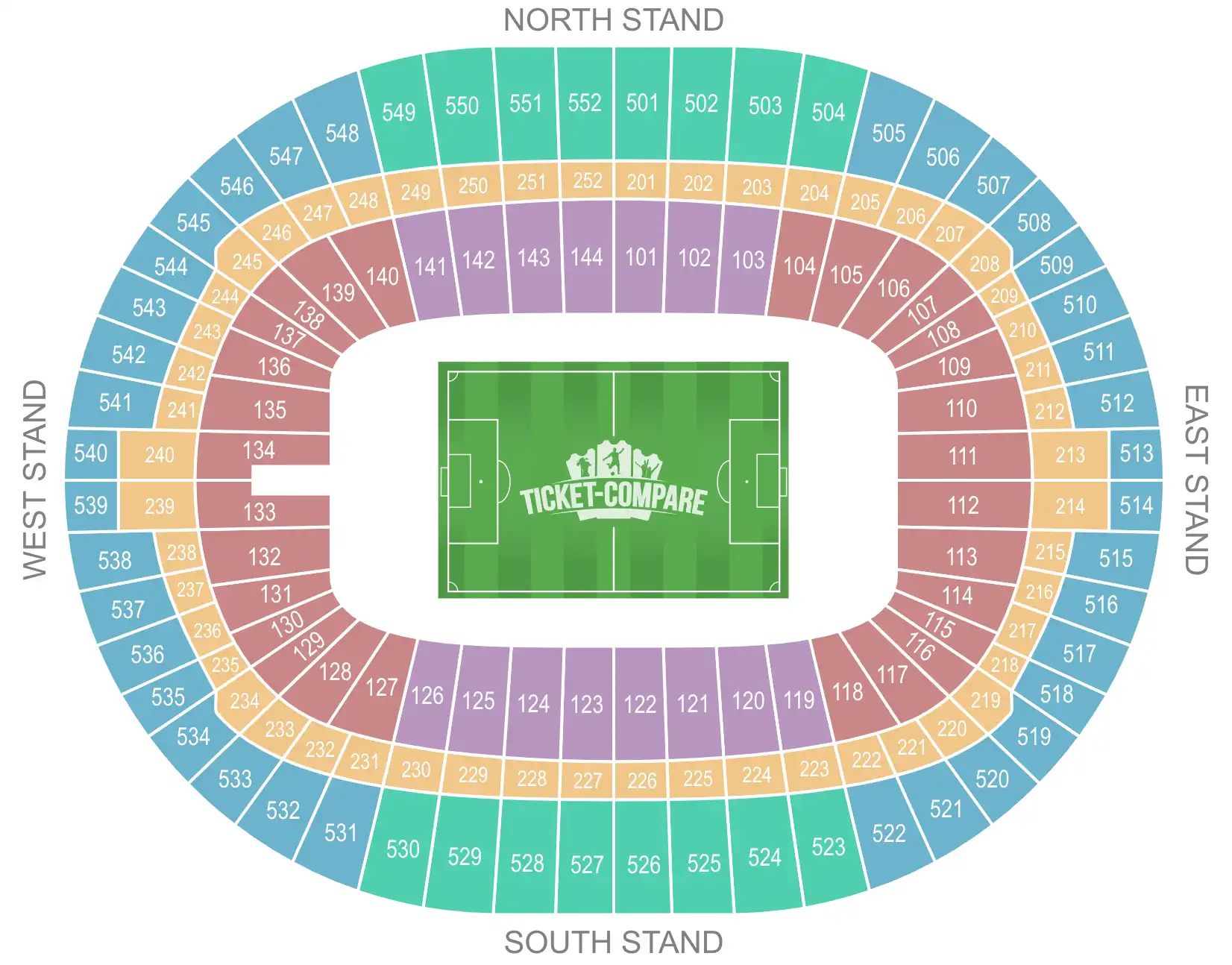
All the above venues are established Category 4 grounds due to their size, hospitality capacity, and state-of-the-art broadcasting facilities.
In fact, as a rule, any Premier League stadium that has also hosted Champions League football in the last decade, including Villa Park, St. James’ Park and Leicester City’s King Power Stadium, is automatically compliant as a UEFA Category 4 stadium.
Next we’ll take a look at Category 3 status, which applies to a couple of Premier League stadiums.
UEFA Category 3: High-Level UEFA Stadiums
Category 3 stadiums can host early-stage UEFA matches, but fall short of Cat 4’s demands, perhaps because of broadcasting and hospitality reasons. So let’s see some of the known requirements for this category:
Category 3 Key Requirements
- 4,500+ all-seated capacity
- Floodlighting around 1,200 lux
- Minimum 75 VIP seats
- Media and broadcast facilities (but fewer than Category 4)
- Fully seated stands, which means no old-school standing terraces allowed (safe standing rail seating exempted)
The Premier League “smaller” stadiums fit comfortably into Category 3 by size and structure, even if they don’t yet qualify as Category 4.
Premier League Examples of Category 3 Stadiums
By our estimation, based on the published criteria the following PL stadiums are Category 3.
- Burnley FC: Turf Moor Seating Plan
- Leeds United: Elland Road Seating Plan
- Brighton: American Express Stadium Seating Plan
One Premier League stadium, which we’ll talk about next, currently has no UEFA rating.
Due to Bournemouth’s sudden rise in status, the club is moving quickly to make sure it could potentially host European football at the Vitality Stadium
What UEFA Category is AFC Bournemouth’s Vitality Stadium?
As of 2025/26, AFC Bournemouth’s Vitality Stadium doesn’t have a UEFA category. Amid ongoing redevelopment work that will eventually boost the capacity from 11,300 to 20,000+, the stadium is about to be audited by UEFA to figure out its status:
- AFC Bournemouth: Vitality Stadium Seating Plan
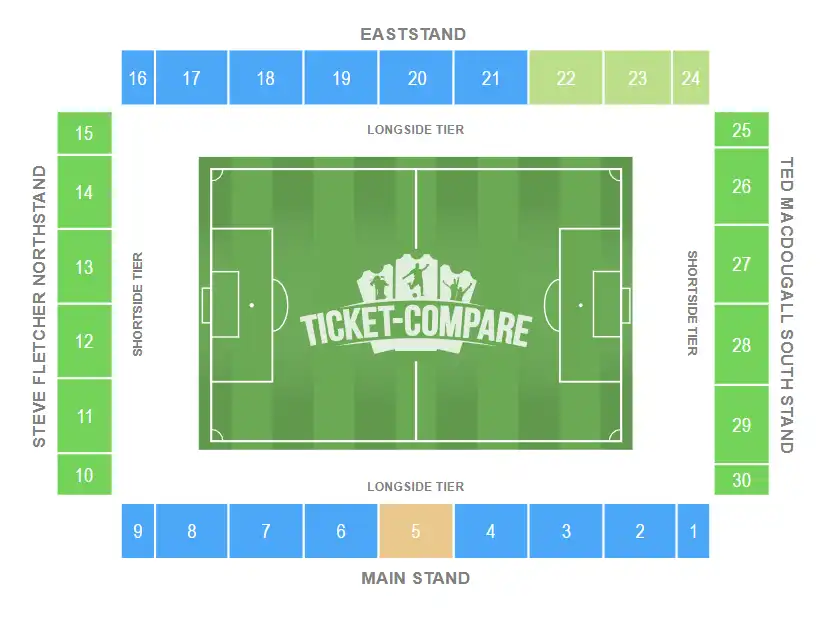
Given its small size, the Vitality Stadium has until now lacked sufficient VIP/hospitality areas and a full spread of broadcast infrastructure that would earn it Category 3 Status.
If Bournemouth qualify for the Champions League this season (not incredibly likely), the Cherries would need to urgently upgrade the stadium or move their European games elsewhere until those updates are completed.
UEFA Categories 2 and 1: Lower-Tier, Limited Stadiums
Essentially, these UEFA Categories only exist for smaller clubs or development football. So the requirements are minimal:
Category 2
- 1,500+ seats
- Suitable for some qualifying rounds and youth matches
Category 1
- 200+ seats
- Typically local or amateur-level grounds
No Premier League stadium falls into Category 1 or 2.
How UEFA Assigns Stadium Categories
So we are aware that the classification process is formal and centralised, but not publicly listed. However, this is what we do know:
National FA inspection
Each national association, such as the FA in England, is responsible for inspecting the stadium in person and assessing it against UEFA’s criteria.
After the visit, the association completes a detailed UEFA report that covers every technical and structural requirement.
UEFA review
UEFA then reviews the submitted documents. To double-check, they may also carry out their own site visit if needed
Once satisfied, UEFA goes ahead and assigns the stadium’s official category.
Internal-only record
The assigned categories are stored within UEFA’s internal TIME system, which is used for competition administration.
There is no public master list, so stadium classifications are not published externally. Secretive isn’t it?
Temporary exemptions
In certain circumstances—and this is common—UEFA may grant a temporary exemption to a stadium that is close to meeting a required category but is still undergoing improvements.
You’ll notice this kind of short-term agreement happening when a stadium is in the middle of a redevelopment..
This is why the only reliable indicator of a stadium’s category is the level of UEFA match that it’s allowed to host.
Premier League Stadium Trends (2025/26)
Most Premier League Clubs Have a Category 4 Stadium
Premier League clubs invest heavily in infrastructure, and almost every ground meets UEFA Cat 4’s demanding standards:
- Large all-seater capacities (safe standing is encouraged, but terrace blocks are not permitted)
- Full and appropriately located lineup of corporate lounges and boxes
- Expansive media sections
- LED floodlighting designed for televised matches
- Multi-level camera gantries
Current Premier League Stadium Upgrades
Notice too that Premier League Clubs are constantly updating their grounds to gain compliance or stay compliant. Let’s check up on a few teas around the league:
- Crystal Palace: In-depth work took place to immediately bring the ground up to Category 4 status in summer 2025
- Liverpool: The new Anfield Road Stand unveiled in 2024
- Manchester United: A timeline for the 100,000-seater Old Trafford replacement has been announced
- Everton: State-of-the-art 50,000-seater Hill Dickinson Stadium opened in 2025
- Manchester City: North Stand redevelopment (in progress)
- Leeds United: Category 4 status will be assured following West Stand and North Stand rebuilds, expected by 2030
- Fulham: New 8,000-seat Riverside Stand redevelopment completed in 2025
- Arsenal: Mooted Emirates Stadium upgrade to 70,000+ seats in discussion
- Nottingham Forest: Improvements due to increase the capacity 50,000+
- Newcastle United: New stadium set to be built in Leazes Park
Why UEFA Stadium Category Matters
A stadium’s UEFA Category determines exactly what European football it’s allowed to host:
- Champions League / Europa League knockout: Category 4 only
- European Qualifying rounds: Category 3 often acceptable
As a knock-on effect the stadium category also influences:
- A ground’s matchday revenue potential
- Whether a club must relocate UEFA games, which is a potential situation affecting AFC Bournemouth before their audit
West Ham United vs Wolves
Premier League・London StadiumLondon, United Kingdomfrom $584,912 available ticketsArsenal vs Bournemouth
Premier League・Emirates StadiumLondon, United Kingdomfrom $1897,762 available ticketsBurnley vs Brighton
Premier League・Turf MoorBurnley, United Kingdomfrom $6683 available ticketsBrentford vs Everton FC
Premier League・Community StadiumLondon, United Kingdomfrom $1061,252 available tickets
How UEFA Stadium Categories Work in 2025/26: Final Summary
That brings an end to our article explaining how UEFA stadium categories work. In short, UEFA’s stadium categories are a highly detailed technical benchmark, and not a simple size-based ranking, which is a common misconception.
UEFA Category 4 grounds meet the highest standards in lighting, media, VIP/hospitality capacity and safety.
No official list is published, but we can draw conclusions simply by seeing the work that has taken place around Premier League grounds.
As these standards move with the times, there’s a long-term need for major Premier League clubs to consistently invest in upgrades. To sum up:
- Category 4: Elite, ready for top European matches
- Category 3: Well-regarded, but missing some top-level infrastructure and services
- Categories 2 & 1: Small-scale grounds, and these categories are not relevant to the Premier League
As we’ve shown, most Premier League stadiums sit firmly in Categories 3 or 4, with the “Big Six” and many more all operating at a Category 4 level.
If this has whetted your appetite for football in a top-class stadium, then Ticket-Compare.com can help you snap up tickets for the biggest occasions.
It doesn't matter if the match has sold out—we can help you source resale tickets and official hospitality tickets from the club’s ticketing partners.
All purchases come with a 100% guarantee on the seller’s end, and we carefully vet every website we work with for everything from customer service to pricing. This ensures reliable tickets from reliable companies.
Today we have 229,004 Premier League tickets on sale, starting from just $43 for the cheapest seats. An upcoming match selling quickly on Ticket-Compare.com is Arsenal vs Bournemouth at $141 so make sure you’re part of the action!
Related Articles:
Premier League Away Ticket Allocations: A Guide
Premier League Season Ticket Waiting Lists
How to Buy Premier League Tickets Without Membership


