

 English












Upcoming Matches
France vs Ivory Coast
Friendly Matches・Stade de FranceParis, CanadaThe Weeknd Paris Tickets
The Weeknd・Stade de FranceParis, Francefrom £1241,432 available ticketsThe Weeknd Paris Tickets
The Weeknd・Stade de FranceParis, Francefrom £991,148 available ticketsThe Weeknd Paris Tickets
The Weeknd・Stade de FranceParis, Francefrom £1231,042 available tickets
Written by Aviran Zazon
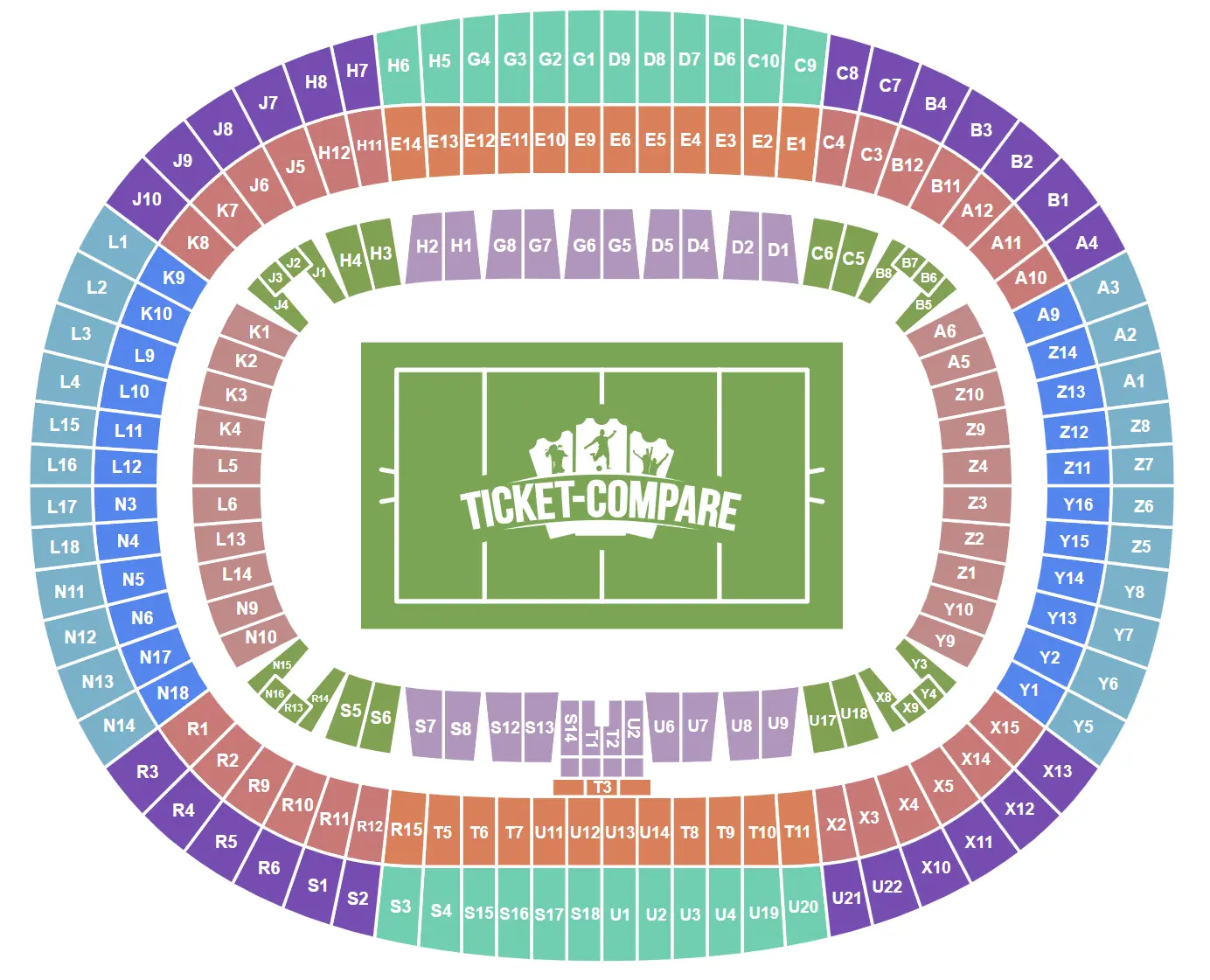
Stade de France Seating Plan at a Glance
- Capacity: 81,338 (Rugby & Football)
- Opened: 1998
- Location: Saint-Denis, Paris
- UEFA Stadium Rating: Category Four
| Stand | Seating Levels | Gate (Porte) | Block Count | Stand Character |
|---|---|---|---|---|
| Est (East Stand) | Lower, Middle, Upper | C, D, E, G, H | 34 | Longside stand with broadcast-style views; excellent for tactical rugby and football |
| Virage Sud (South Curve) | Lower, Middle, Upper | Y, Z, A | 34 | End-on drama behind the posts; big-moment viewing over tactics |
| Ouest (West Stand) | Lower, Middle, Upper | S, T, U | 37 | Main longside; premium seating and hospitality; sweeping halfway-line sightlines |
| Virage Nord (North Curve) | Lower, Middle, Upper | K, L, N | 34 | Atmosphere-focused end; popular for vocal home support (especially football) |
| Corner Sections (Quarts de Virage) | Lower, Middle, Upper | B (SE), X (SW), R (NE), J (NW) | 74 | Balanced diagonal views; blend of longside clarity and end-stand atmosphere; strong value seats for rugby and football |
The Stade de France is France’s national stadium, home of Les Bleus, and one of Europe’s most important sporting venues.
Built for the 1998 FIFA World Cup—where France famously lifted the trophy on home soil—it has since hosted the UEFA Euro 2016 final, Rugby World Cups, Champions League finals, and events during the Paris 2024 Olympic and Paralympic Games.
From a technical standpoint, the stadium was designed as a true multi-purpose arena. It features a continuous bowl, steeply raked seating for improved sightlines, and a modular lower tier that allows the stadium to adapt between football, rugby and athletics configurations.
While large by European standards, the design keeps spectators relatively close to the action compared to older Olympic-style stadiums.
Head to the Stade de France for French international football, France rugby tickets (including Six Nations and autumn tests), concert tickets for some of the biggest shows on the continent, and a host of domestic sporting finals.
This guide focuses primarily on matchday viewing for rugby and football, using the Stade de France seating plan as the framework, with notes where concerts and other events differ.
How the Stade de France Seating Plan Is Organised
The stadium is arranged as a four-sided continuous bowl:
- Est & Ouest: Longside (lateral) stands along the touchlines
- Virage Nord & Virage Sud: Curved end sections behind the goals/posts
- Les Quarts de Virage: Four corner sections, one at each angle of the pitch
Seating Tiers at Stade de France
Most of the stadium uses a three-tier structure:
- Tribune Basse (Lower tier): Closest and most immersive
- Tribune Intermédiaire (Middle tier): Often the best balance of height and clarity
- Tribune Haute (Upper tier): Panoramic views of the full pitch
Hospitality and premium seating are largely integrated between tiers on the longside stands, especially in the Ouest.
Key takeaway for first-time visitors:
- East / West (lateral stands): Best all-round view
- North / South (virages): Strongest goal-line drama and atmosphere
So, a seat in the South Curve, Upper Tier would be described as “Tribune Haute Sud”.
Next we’ll explore the Stade de France seating plan, stand by stand.
Est (East Stand) at Stade de France
Est is a popular spot within the Stade de France seating plan, particularly for first-time visitors.
Running the full length of the pitch, it delivers a classic side-on perspective that works equally well for football and rugby. Sightlines are clean and balanced, especially from the middle and upper tiers, where you can clearly follow attacking width, defensive structure and kicking strategy in rugby.
The stadium itself recommends the lower East Stand if you want to be as close to the pitch as possible without sacrificing clarity.
Many fans also note that the view here feels “television-like”, reflecting the fact that broadcast cameras are positioned on this stand at mid-tier height.
Atmospherically, the East Stand is mixed rather than intense, attracting regular supporters, families, overseas visitors and some premium seating.
Best for
- First-time visitors
- Tactical viewing for rugby and football
- Consistent, unobstructed sightlines
Less ideal for
- Fans seeking the loudest singing sections
Virage Sud (South Curve) at Stade de France
The Virage Sud curls around the south end, behind the goalposts, offering end-on views.
This stand is about big moments rather than constant clear views of the match. When action comes towards you—tries, goals, conversions—the sense of depth and scale is dramatic. Sitting slightly higher usually improves the overall view and preserves the immersive feel.
For both football and rugby, the south end suits spectators who value emotion and occasion over analysing every phase of play.
Best for
- End-on drama
- Goal-line and post action
- Memorable matchday moments
Less ideal for
- Reading the full tactical shape of the game
Ouest (West Stand) at Stade de France
Ouest is widely regarded as the stadium’s main stand. It houses a large proportion of premium seating and hospitality areas and offers excellent halfway-line views.
From a viewing perspective, it’s one of the most reliable areas in the stadium. Like the East Stand, it provides a strong side-on angle that makes the game easy to read. The middle tier is particularly prized for its balance of elevation and proximity.
Because of the concentration of hospitality and premium tickets, parts of the West Stand can feel calmer during play, even for major fixtures. The upside is comfort, smooth concourse access and high-quality facilities.
Best for
- Central, halfway-line views
- Comfort and amenities
- A composed matchday experience
Less ideal for
- Those in need of constant crowd noise
Virage Nord (North Curve) at Stade de France
The Virage Nord is strongly associated with atmosphere, particularly for football. At Ticket-compare.com, we recommend the lower tier of the north end (Tribune basse nord) as one of the loudest areas during major matches.
For rugby, this stand offers a straight-down-the-pitch view that suits set-pieces, goal attempts and defensive phases. The trade-off is reduced clarity when play moves wide to the far touchline compared to longside seating.
Crowd energy here tends to be concentrated and intense, especially during the most important events.
Best for
- Goal-post intensity for rugby
- Fans who want to experience the energy of the crowd with France football tickets
Less ideal for
- Tactical, full-width viewing
Les Quarts de Virage (Corner Sections) at Stade de France
The quarts de virage sit between the lateral stands (Tribune Est and Tribune Ouest) and the curved ends (Virage Nord and Virage Sud).
From a viewing perspective, they offer a diagonal angle across the pitch, blending some of the tactical clarity of the longside with the atmosphere of the ends.
These sections are often overlooked, but many regulars see them as a useful compromise—especially for big rugby and football fixtures where atmosphere and visibility both matter.
Lower Tier (Tribune Basse – Quarts de Virage)
Lower-tier corner seats place you close to the pitch with a strong sense of immersion. The diagonal sightline works particularly well when play is concentrated in your half, and you’re close enough to feel the physicality of tackles, rucks and goal-line defence.
The trade-off is perspective. When the ball moves quickly to the far touchline, some width and spacing can be harder to read than from a true lateral seat.
Atmosphere here is noticeably stronger than in the longside lower tiers, especially near the north corner during football internationals.
Middle Tier (Tribune Intermédiaire – Quarts de Virage)
The middle tier is where the corner sections really shine. You gain enough height to read the full pitch more clearly while keeping the diagonal angle that makes end-on moments feel dramatic.
For rugby, this tier is particularly well suited to:
- Following kicking duels and exit strategies
- Watching conversions and penalties from a natural angle
- Tracking attacking shape without feeling detached
Many fans consider the middle-tier quarts de virage one of the best-value viewing areas in the stadium, offering strong sightlines without the premium pricing of central lateral blocks.
Upper Tier (Tribune Haute – Quarts de Virage)
Upper-tier corner seats deliver a wide, panoramic view of the stadium and pitch. From here, tactical patterns are easier to follow than in lower end-on sections, and the diagonal angle still provides depth when teams attack the posts.
The atmosphere is calmer than below, and wind exposure can be slightly more noticeable, but visibility remains strong thanks to the steep rake.
These seats work well for spectators who want a clear overview without paying for halfway-line seating.
Atmosphere & Crowd Feel
Atmosphere in the quarts de virage varies by event:
- Football: Corners near the Virage Nord tend to be livelier, feeding off nearby supporter sections
- Rugby: With Six Nations tickets, crowd energy is more evenly spread, with corners offering a balanced, engaged feel rather than constant noise
You’re rarely isolated here, but it’s less intense than the core of the virages.
Best for
- A balance of atmosphere and tactical visibility
- Rugby fans who want diagonal views of posts and breakdowns
- Football matches where you want crowd energy without full end-on compromise
Less ideal for
- Fans who want the loudest supporter sections
- Spectators who prefer a pure side-on “TV angle” view
Where Are the Best Seats at the Stade de France?
Choosing the best seats using the Stade de France seating plan depends on what you value most.
Best seats for views at Stade de France
- East or West Stand, middle tier, ideally around halfway: These seats offer the clearest view of the entire pitch while keeping you engaged with the atmosphere.
Best seats for football at Stade de France
- Panoramic view: High or mid longside seating, ideal for football tickets with a clear perspective of the action
- Atmosphere: North Curve lower tier
Best seats for rugby at Stade de France
- Best balance: Corner seats in the middle tier
- Most energy: Northern corners in the middle tier, perfect for partisan support if you have TOP 14 tickets for the final
High vs low seating at Stade de France
- Very low seats feel intense but can flatten perspective
- A little height (middle tier or front of upper tier) is usually best
- Upper longside rugby tickets offer excellent tactical overview
Accessibility at Stade de France
Stade de France is designed to welcome spectators with disabilities across all areas of the stadium, with step-free routes, staffed assistance and accessible seating integrated into the main bowl rather than isolated in one zone.
While some operational details vary by event organiser, the core facilities remain consistent.
Wheelchair & accessible seating
- Wheelchair spaces are distributed around the stadium, including longside (lateral) seating and end sections, rather than being confined to a single stand.
- Seating is available at different heights (typically lower and middle levels), depending on configuration for football, rugby or concerts.
- Companion seats are provided adjacent to wheelchair bays.
- The stadium does not publish a fixed public total for wheelchair spaces; availability and exact locations are confirmed during ticket allocation for each event.
Stadium access & movement
- Step-free access routes are available from arrival points to seating areas.
- Lifts and ramps connect concourses and seating levels used by disabled spectators.
- Trained accessibility staff (PSH/PMR) are present on event days and can assist with navigation, lifts and seating on arrival.
Accessible entrances & assistance points
- Disabled spectators are not restricted to a single entrance by default.
- Dedicated accessibility reception points operate on matchdays, where staff can guide spectators to the most suitable route.
- An on-site accessibility help team is available throughout events for support inside the stadium.
Accessible toilets
- Accessible toilets are available on all public concourse levels, positioned close to wheelchair and accessible seating areas.
- As with wheelchair bays, the stadium does not clearly publish a total number, but facilities are spread throughout the venue rather than concentrated in one area.
Sensory, visual & hearing support
- Stade de France offers additional matchday support options, depending on the event: Audio description for blind and partially sighted spectators, Vibrating vests to experience crowd atmosphere through vibration and Assistive tablets for accessibility support
- These services are typically issued from a dedicated collection point inside the stadium and should be requested on arrival.
Concourse services
- Concessions and service counters include accessible or priority points, with staff assistance available.
- Circulation areas are wide, allowing easier movement around the concourse for wheelchair users and those with mobility aids.
Parking & arrival (high level)
- Accessible parking is limited and must be arranged in advance via the event organiser.
- Where parking is not available, the stadium is well served by public transport, and step-free routes are prioritised where possible.
Hospitality at Stade de France
Below is a summary of the hospitality options at Stade de France, typically for the Six Nations Championship.
A key point up front: for these Six Nations offers, seats are “Premium / best category” in the lateral grandstand (i.e., a longside / touchline stand) and are grouped together. The exact stand name (east vs west) and block are usually confirmed at delivery stage:
| Hospitality option | Type | Where you’re hosted | Food & drink | Match seats (where you sit) |
|---|---|---|---|---|
| Village Officiel | Biggest “occasion” feel; hospitality with entertainment and rugby faces | A dedicated hosted area (the “official village”) with VIP reception and extra matchday animation | Gastronomic cocktail with life-style flourishes; drinks at discretion; cloakroom + Wi-Fi; official match gift | Premium / best category, lateral grandstand (longside), sold as a central view with “best seats” |
| Salon Ferveur | Social, energetic lounge; more about buzz + mixing than formal dining | Shared lounge inside the stadium near your seats; VIP welcome | High-quality dinner cocktail; drinks at discretion; cloakroom + Wi-Fi; official match gift | Premium / best category, lateral grandstand (longside), grouped seats close to the lounge |
| Salon Ovation | A step up in “hosted comfort”; lounge + premium seats, designed for an all-round VIP day | Contemporary VIP reception space; shared lounge for your group | Gastronomic seated meal; Champagne/drinks at discretion; cloakroom + Wi-Fi; official match gift | Premium / best category, lateral grandstand (longside) |
| Salon Étoile | Similar premium positioning, pitched as refined and comfortable | Contemporary reception area with shared-lounge feel | Gastronomic seated meal; drinks + Champagne at discretion; cloakroom + Wi-Fi; official match gift | Premium / best category, lateral grandstand (longside) |
Stade de France Seating Plan FAQs
How is seating arranged at the Stade de France?
The Stade de France seating plan is arranged as a four-sided bowl, with continuous stands wrapping around the pitch rather than clearly separated “ends” in the British sense.
- The stadium is divided into lower, middle and upper tiers around most of the bowl
- Longside seating (lateral stands) is generally preferred for tactical viewing
- Curved end sections (north and south curves) are associated with atmosphere
The design prioritises sightlines, meaning even higher seats retain a clear view of the playing surface.
Which seats are best for rugby at the Stade de France?
For rugby, most regular attendees agree that lateral (sideline) seating with some height offers the best overall experience.
Best options for rugby:
- Lower or middle tier along the long sides for closeness and tactical clarity
- Corner (quarts de virage) seats in the middle tier, which give a strong diagonal view of the posts and breakdowns
So if you’re hunting for Autumn Internationals tickets, end-on seats can be thrilling for tries and goal-line defence, but they make it harder to follow wide play at the far touchline.
Where is the best atmosphere for football matches at the Stade de France?
For football internationals, atmosphere tends to concentrate in the lower sections of the ends, particularly the north curve (Virage Nord), which is traditionally associated with more vocal support.
These sections:
- Feel louder due to crowd density and proximity
- Are popular with organised supporter groups
- Deliver a more immersive experience, especially during big matches
If atmosphere matters more than tactics, these areas are often preferred.
Are all seats covered at the Stade de France?
Yes. All spectator seating is covered by the stadium’s roof, which protects fans from rain.
However, conditions can still vary:
- Upper tiers are more exposed to wind
- Lower tiers feel more enclosed and insulated
- Weather can be more noticeable in corner sections
For winter rugby or evening matches, middle tiers are often the most comfortable.
Where are the big screens located at the Stade de France?
Large video screens are positioned at the ends of the stadium, behind the goals, meaning most spectators have a clear line of sight to at least one screen.
These are used for:
- Live replays
- Match information and timing
- Crowd engagement during breaks
They’re especially useful if you’re seated end-on and play is happening at the far side.
What are the best seats for concerts at the Stade de France?
If you want to be closest to the stage, look for Carré Or or Pelouse Or / Fosse Or on the seating plan. These are the premium pitch-level zones nearest the stage and deliver maximum immersion, but they are usually standing and sightlines can depend on crowd height and stage design.
For the best all-round concert experience, many regulars favour lower-tier side stands (Tribune basse latérale) positioned just to the side of the stage rather than directly behind it. These seats offer a clear view of the artist, screens and lighting while avoiding the visual compromises that can come with end-on or pitch-level standing areas.
If you’re prioritising value and clarity, middle-tier side seating (Tribune intermédiaire) is often the sweet spot. It provides enough height to see the full production clearly, usually at a lower price than premium lower-tier blocks.
In short:
- Closest & most intense: Carré Or / Pelouse Or
- Best balance of view, sound and comfort: Lower side stands near the stage
- Best value seated option: Middle-tier side stands
Side-on locations are generally safer than end-on seats for concerts at the Stade de France, especially for large end-stage productions.
| Section | Blocks | Block Count |
|---|---|---|
| Corner Lower Tier | B5, B6, B7, B8, C5, C6, H3, H4, J1, J2, J3, J4, N15, N16, R13, R14, S5, S6, U17, U18, X8, X9, Y3, Y4 B5, B6, B7 | 24 |
| Corner Middle Tier | A10, A11, A12, B11, B12, C3, C4, H11, H12, J5, J6, K7, K8, R1, R10, R11, R12, R2, R9, X14, X15, X2, X3, X4, X5 A10, A11, A12 | 25 |
| Corner Upper Tier | A4, B1, B2, B3, B4, C7, C8, H7, H8, J10, J7, J8, J9, R3, R4, R5, R6, S1, S2, U21, U22, X10, X11, X12, X13 A4, B1, B2 | 25 |
| Longside Lower Tier | D1, D2, D4, D5, G5, G6, G7, G8, H1, H2, S12, S13, S14, S14, S7, S8, T1, T1, T2, T2, U5, U5, U6, U7, U8, U9 D1, D2, D4 | 26 |
| Longside Middle Tier | E1, E10, E11, E12, E13, E14, E2, E3, E4, E5, E6, E9, R15, T10, T11, T3, T3, T3, T5, T6, T7, T8, T9, U11, U12, U13, U14 E1, E10, E11 | 27 |
| Longside Upper Tier | C10, C9, D6, D7, D8, D9, G1, G2, G3, G4, H5, H6, S15, S16, S17, S18, S3, S4, U1, U19, U2, U20, U3, U4 C10, C9, D6 | 24 |
| Shortside Lower Tier | A5, A6, K1, K2, K3, K4, L13, L14, L5, L6, N10, N8, Y10, Y9, Z1, Z10, Z2, Z3, Z4, Z9 A5, A6, K1 | 20 |
| Shortside Middle Tier | A9, K10, K9, L10, L11, L12, L9, N17, N18, N3, N4, N5, N6, Y1, Y13, Y14, Y15, Y16, Y2, Z11, Z12, Z13, Z14 A9, K10, K9 | 23 |
| Shortside Upper Tier | A1, A2, A3, L1, L13_0, L14_1, L15, L16, L17, L18, L2, N11, N12, N13, N14, Y5, Y6, Y7, Y8, Z5, Z6, Z7, Z8 A1, A2, A3 | 23 |

Co-founder of Ticket-Compare.com, Aviran Zazon is a web developer, marketer and lifelong sports fan, inspired by the magic of Ronaldinho’s Barcelona.


